Union Budget 2026 criticised for ignoring medical inflation and costs
Source:The Hindu ↗
Why It Matters
Out-of-pocket expenditure is a critical metric for healthcare affordability in India and a frequent subject in UPSC mains. Understanding the interplay between customs duties, patent monopolies, and drug pricing is essential for addressing public health inequities and achieving Universal Health Coverage.
Summary
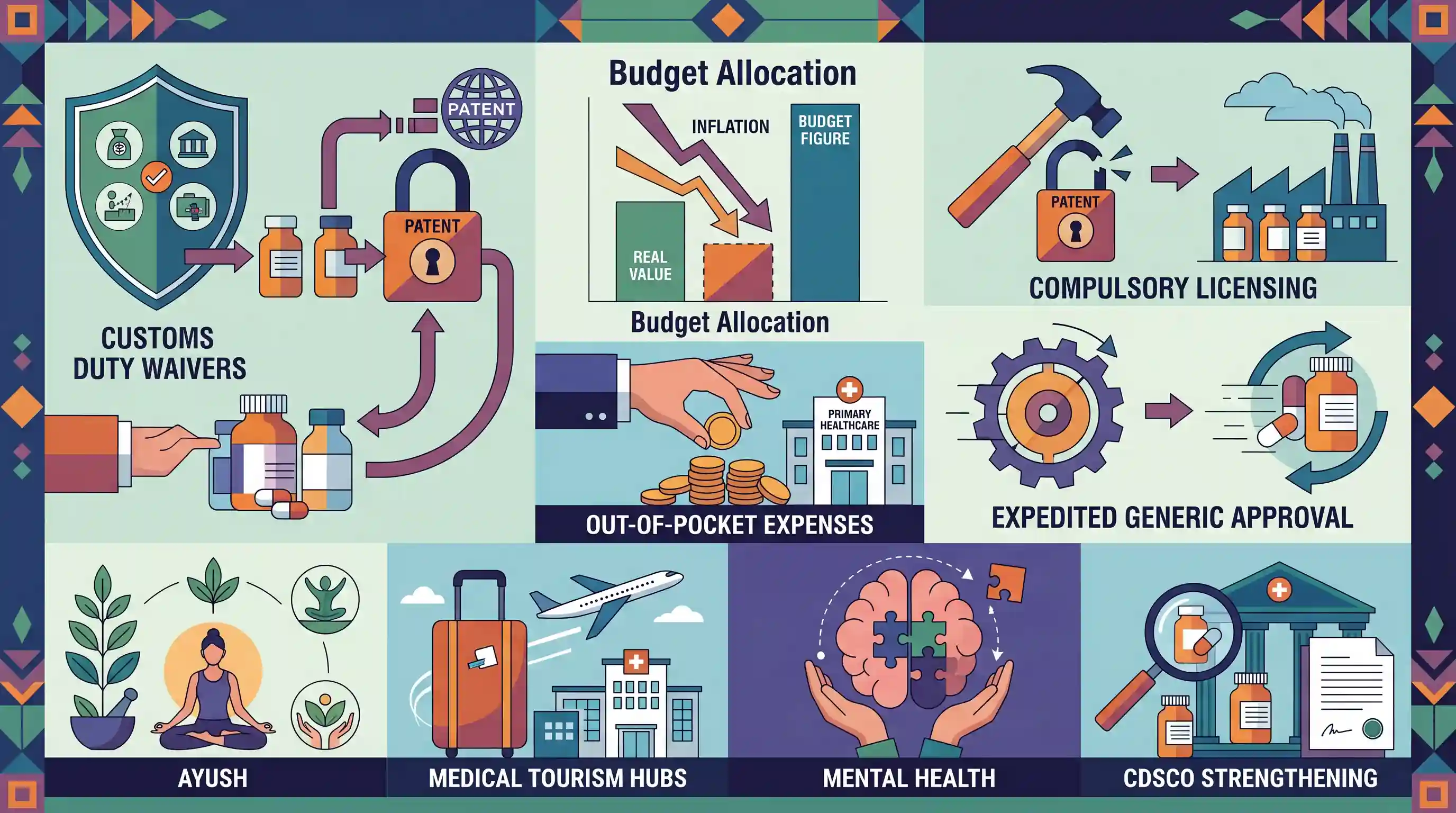
Experts have criticized the healthcare allocations in the Union Budget 2026-27 for failing to adequately address out-of-pocket medical expenses and primary healthcare needs, arguing that real health spending has effectively declined when adjusted for inflation. While basic customs duty (BCD) was waived for 17 cancer and seven rare disease medicines, health groups note that such exemptions rarely result in lower prices for patients due to intellectual property monopolies. Critics urge the government to employ tools like compulsory licensing and expedited generic approvals under the Patents Act instead of merely offering tax waivers that primarily benefit multinational pharmaceutical companies. Conversely, industry stakeholders praised the budget's targeted focus on AYUSH expansion, medical tourism hubs, mental health programs, and strengthening the Central Drugs Standard Control Organisation (CDSCO).
Key Points
- Experts argue that the Union Budget 2026-27 lacks direction for healthcare, doing little to address medical inflation or reduce out-of-pocket (OOP) expenses for the common man.
- While basic customs duty (BCD) was eliminated for 17 cancer drugs and 7 rare disease medicines, experts note that multinational pharmaceutical companies rarely pass these benefits onto patients, leaving maximum retail prices unaffordable.
- Intellectual property monopolies, specifically patents, are identified as the root cause of exorbitant drug prices; experts recommend deploying government use and compulsory licenses under the Patents Act instead of relying solely on tax exemptions.
- Adjusted for inflation, public health spending has effectively declined, with a criticized over-reliance on medical tourism, pharmaceuticals, and specialized care at the expense of primary healthcare infrastructure.
- The Budget received praise in some quarters for its focus on AYUSH capacity building, allied health professional training, mental health programs, and strengthening the Central Drugs Standard Control Organisation (CDSCO).
Important Terms
Union Budget 2026-27

Annual financial statement of India for FY 2026-27, allocating ₹1,06,530 crore to healthcare, focusing on biopharma innovation (Biopharma Shakti), customs duty waivers for cancer drugs, and AYUSH infrastructure expansion.
UPSC context
GS Paper III (Economy/Budgeting); tests knowledge of sectoral allocations, fiscal priorities, and new health initiatives like Biopharma Shakti.
Patents Act, 1970
The primary legislation (amended 2005) governing intellectual property in India. It balances innovator rights with public health via provisions like Section 3(d) (anti-evergreening) and Section 84 (compulsory licensing).
UPSC context
GS Paper III (Science & Tech/IPR); critical for understanding India's 'pharmacy of the world' status and TRIPS compliance.
Compulsory Licensing
A legal mechanism under Sections 84-92A of the Patents Act allowing the government to authorize third-party manufacturing of a patented drug without the owner's consent to ensure affordability.
UPSC context
GS Paper II/III (Health/IPR); frequently tested as a tool for Universal Health Coverage and balancing private profit vs. public good.
Central Drugs Standard Control Organisation (CDSCO)
India's national regulatory body for drugs, cosmetics, and medical devices under the Drugs and Cosmetics Act, 1940. It approves new drugs and sets clinical trial standards.
UPSC context
GS Paper II (Governance/Statutory Bodies); essential for questions on drug safety, vaccine regulation, and institutional frameworks.
All India Institute of Ayurveda (AIIA)
The apex autonomous institute under the Ministry of AYUSH, modeled after AIIMS, dedicated to tertiary care, research, and standardizing Ayurvedic education and practices.
UPSC context
GS Paper II (Social Justice/Health); relevant for topics on traditional medicine, health infrastructure, and the pluralistic healthcare model.
Central Government Health Scheme (CGHS)
A comprehensive healthcare scheme launched in 1954 for central government employees, pensioners, and their dependents, providing outpatient (wellness centers) and inpatient (empanelled hospitals) facilities.
UPSC context
GS Paper II (Social Justice/Governance); tested under health insurance models and government welfare schemes for social security.
Prelims Trap
"The CDSCO is responsible for regulating the pricing of essential and life-saving medicines in India."
CDSCO (Health Ministry) handles drug approvals, trials, and quality. Pricing and affordability are regulated by the National Pharmaceutical Pricing Authority (NPPA) under the Ministry of Chemicals and Fertilizers.
Static Concepts Connected
When can a Compulsory License be issued for a patented drug in India?
- Time threshold: It can only be issued after the expiration of three years from the date of the grant of a patent.
- Public requirement: If the reasonable requirements of the public regarding the patented invention have not been satisfied.
- Affordability constraint: If the patented invention (like a rare disease drug) is not available to the public at a reasonably affordable price.
- Local manufacturing: If the patented invention is not worked or manufactured within the territory of India.
What constitutes Out-of-Pocket Expenditure (OOPE) in healthcare?
- Direct payments: Direct outlays made by households at the point of receiving healthcare services, including hospital fees and pharmacy bills.
- Excludes prepayments: It strictly excludes any prepayment mechanisms like health insurance premiums or taxes paid to the government.
- Impoverishment driver: High OOPE is a primary driver of medical impoverishment in India, historically accounting for over 45% of total health expenditure.
Cross-Topic Patterns
Compulsory Licensing & TRIPS flexibilities
The demand to use compulsory licensing rather than just customs duty waivers aligns directly with the WTO's 2001 Doha Declaration, which affirms member states' rights to use TRIPS flexibilities for public health.
Tax waivers vs. NPPA Price Controls
Waiving Basic Customs Duty (BCD) on imported drugs rarely lowers MRPs if the drug enjoys a patent monopoly, exposing the limits of tax policy versus active price-capping under the DPCO.

Expect a 2026 prelims question contrasting CDSCO's quality-control mandate with NPPA's pricing powers and compulsory licensing conditions.
Linked PYQs · 5
Linked PYQs · 5
- 2024MainsGS2
In a crucial domain like the public healthcare system the Indian State should play a vital role to contain the adverse impact of marketisation of the system. Suggest some measures through which the State can enhance the reach of public healthcare at the grassroots level.
- 2021MainsGS2
“Besides being a moral imperative of a Welfare State, primary health structure is a necessary precondition for sustainable development.” Analyze.
- 2015MainsGS2
Public health system has limitations in providing universal health coverage. Do you think that the private sector could help in bridging the gap? What other viable alternatives would you suggest?
- 2024MainsGS3
What is the present world scenario of intellectual property rights with respect to life materials? Although, India is second in the world to file patents, still only a few have been commercialized. Explain the reasons behind this less commercialization.
- 2014MainsGS3
In a globalized world, Intellectual Property Rights assume significance and are a source of litigation. Broadly distinguish between the terms-Copyrights, Patents and Trade Secrets.
