Defence Budget Allocation and Military Indigenisation Push
Source:The Hindu ↗
Why It Matters
The allocation and composition of the defence budget are directly relevant to GS3 topics such as Government Budgeting, Internal Security, and Indigenisation of Technology. The reservation of 75% of capital acquisition for domestic industries highlights India's strategic shift towards self-reliance ('Make in India' in defence), while increased capital expenditure reflects long-term capacity building for border management and national security.
Summary
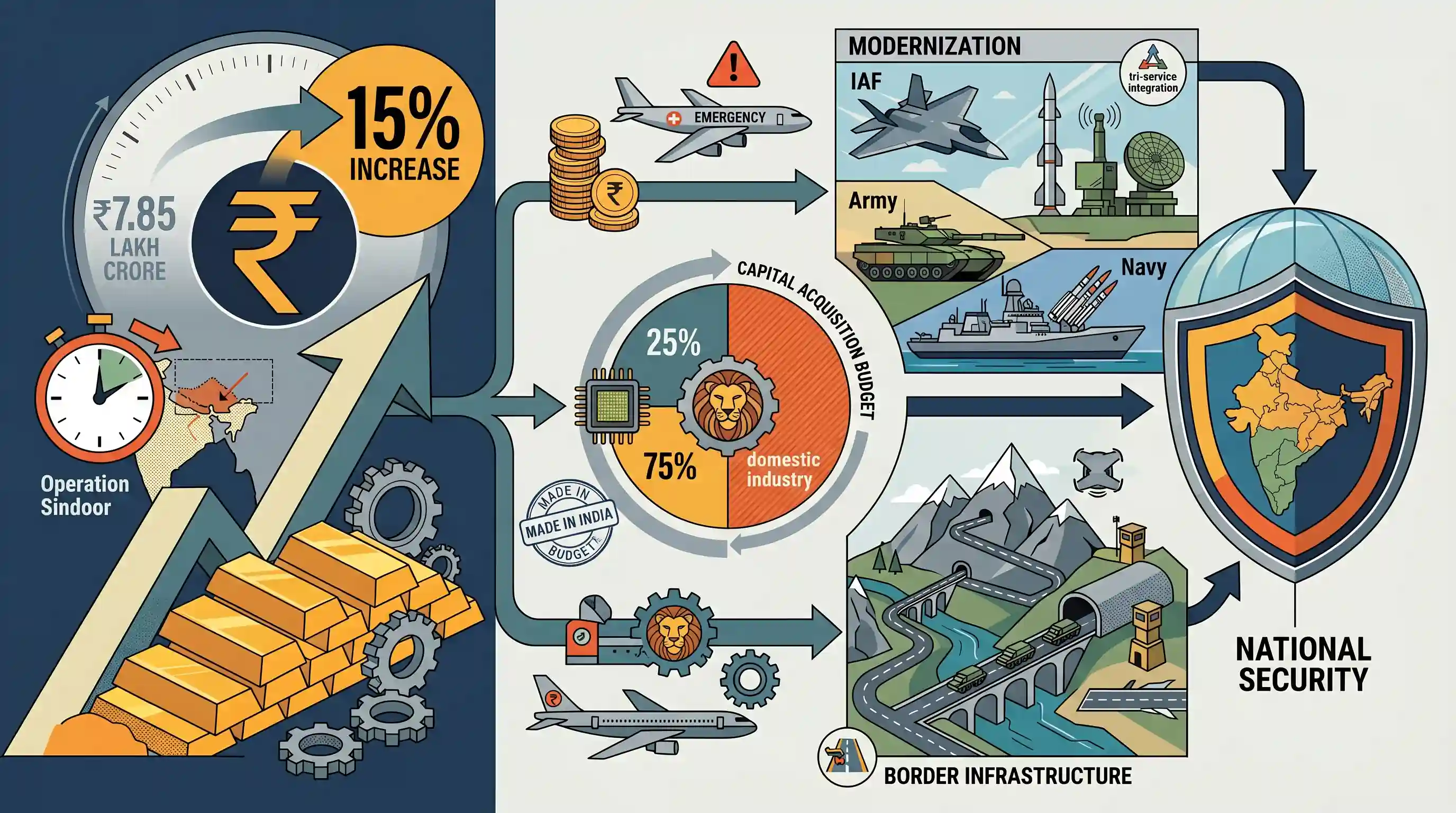
The Union Budget 2026-27 has allocated a record ₹7.85 lakh crore to the defence sector, reflecting a 15% increase from the previous year. Driven by emergency procurement needs following 'Operation Sindoor', the budget heavily emphasizes military modernization and self-reliance (Aatmanirbhar Bharat). Capital expenditure has been increased to ₹2.19 lakh crore, with 75% of the capital acquisition budget exclusively reserved for domestic defence industries. The outlay also provides notable enhancements for border infrastructure, R&D, and veterans' welfare, making defence the highest-funded sector at 14.67% of total government expenditure.
Key Points
- The defence budget for 2026-27 is set at a record ₹7.85 lakh crore, marking a 15% increase and accounting for 2% of the estimated GDP.
- Capital expenditure has seen a sharp 22% rise to ₹2.19 lakh crore, emphasizing the modernization of military capabilities.
- In a major push for self-reliance, 75% of the capital acquisition budget (₹1.39 lakh crore) is earmarked for procurement from domestic industries.
- The enhanced allocation addresses emergency procurement needs arising post-Operation Sindoor.
- Funds have also been increased for border infrastructure, veterans' healthcare, research and development, and pensions.
Important Terms
Operation Sindoor

A May 2025 military operation involving missile and precision strikes against terrorist infrastructure in Pakistan, launched after the Pahalgam terror attack to establish a doctrine of conventional military response to sub-conventional threats.
UPSC context
GS Paper 3: Internal Security. Tests understanding of India's evolving deterrence doctrine and military responses to cross-border terrorism.
Aatmanirbhar Bharat
A national campaign for self-reliance; in defense, it involves reserving 75% of capital acquisition funds for domestic industry to reduce import dependence and boost local manufacturing/MSMEs.
UPSC context
GS Paper 3: Economy and Security. Relevant for 'Indigenization of Technology' and 'Developing a Domestic Defense Industrial Base'.
Capital Expenditure (Capex)
Funds earmarked for modernization and procurement of new weapons, platforms, and technology. For FY 2026-27, this reached ₹2.19 lakh crore to enhance multi-domain operational capabilities.
UPSC context
GS Paper 3: Public Finance and Internal Security. Tests knowledge of budget composition and the balance between sustenance and modernization.
Border Infrastructure
Strategic development of roads, bridges, and tunnels in frontier regions, often executed by the Border Roads Organisation (BRO), to ensure rapid troop movement and logistics during conflicts.
UPSC context
GS Paper 3: Internal Security. Vital for 'Security Challenges and their Management in Border Areas'.
Viksit Bharat
The vision of transforming India into a developed nation by 2047, requiring the defense sector to achieve technological resilience, high production targets, and integration into global value chains.
UPSC context
GS Paper 2 & 3: Governance and Economy. Broad vision for socio-economic development including strategic autonomy.
Prelims Trap
The 2026-27 defence budget finally achieves the Standing Committee's recommended benchmark of 3% of GDP.
While it is a record allocation at roughly 2% of GDP, it still falls short of the 3% benchmark long recommended by the Standing Committee on Defence for optimal modernization.
Static Concepts Connected
How is the Indian Defence Budget broadly categorized?
- Capital Expenditure: Funds meant for purchasing new weapons, aircraft, warships, and land. It directly drives military modernization and asset creation.
- Revenue Expenditure: Covers day-to-day running costs, including salaries, maintenance, stores, and ammunition. Historically, this has dominated the budget.
- Defence Pensions: Kept as a separate component within the broader defence allocation to cover retirement benefits for armed forces personnel.
What are the core initiatives driving defence indigenisation in India?
- Positive Indigenisation Lists: Rolling embargoes on importing specific weapons and platforms beyond established timelines to force domestic procurement.
- Enhanced FDI Limits: Foreign Direct Investment limit was raised to 74% under the automatic route to attract global OEMs to manufacture locally.
- iDEX Initiative: Innovations for Defence Excellence fosters innovation and technology development by engaging R&D institutes, academia, and startups.
Cross-Topic Patterns
Domestic quota intersections with MSME growth
Earmarking 75% of capital acquisition for domestic industries directly intersects with GS3 Economy, incentivizing the domestic defence-tech MSME ecosystem and reducing current account deficits.
Capex shift fueling Border Infrastructure
Increased capital outlay impacts the Border Roads Organisation (BRO) and the Vibrant Villages Programme, accelerating the construction of dual-use strategic infrastructure along the LAC.

Expect a GS3 Mains question analyzing the 'Capital vs Revenue' expenditure skew in defence and the viability of the 75% domestic quota.
Linked PYQs · 4
Linked PYQs · 4
- 2024MainsGS3
India has a long and troubled border with China and Pakistan fraught with contentious issues. Examine the conflicting issues and security challenges along the border. Also give out the development being undertaken in these areas under the Border Area Development Programme (BADP) and Border Infrastructure and Management (BIM) Scheme.
- 2022PrelimsGS1
With reference to the expenditure made by an organisation or a company, which of the following statements is/are correct? 1. Acquiring new technology is capital expenditure. 2. Debt financing is considered capital expenditure, while equity financing is considered revenue expenditure. Select the correct answer using the code given below:
- 2016PrelimsGS1
Which of the following is/are included in the capital budget of the Government of India? 1. Expenditure on acquisition of assets like roads, buildings, machinery, etc. 2. Loans received from foreign governments 3. Loans and advances granted to the States and Union Territories Select the correct answer using the code given below.
- 2014MainsGS3
Foreign Direct Investment (FDI) in the defence sector is now set to be liberalized. What influence this is expected to have on Indian defence and economy in the short and long run?
