Union Budget 2026 sets defence outlay at 7.85 lakh crore rupees
Source:The Hindu ↗
Why It Matters
The significant jump in defence capital expenditure and the reservation of 75% for domestic procurement highlights India's strategic shift toward self-reliance in defence (GS-3 Security and Economy). It is highly relevant for Mains questions on the indigenization of technology, modernizing the armed forces, and managing border security challenges (especially in the context of operations like Operation Sindoor).
Summary
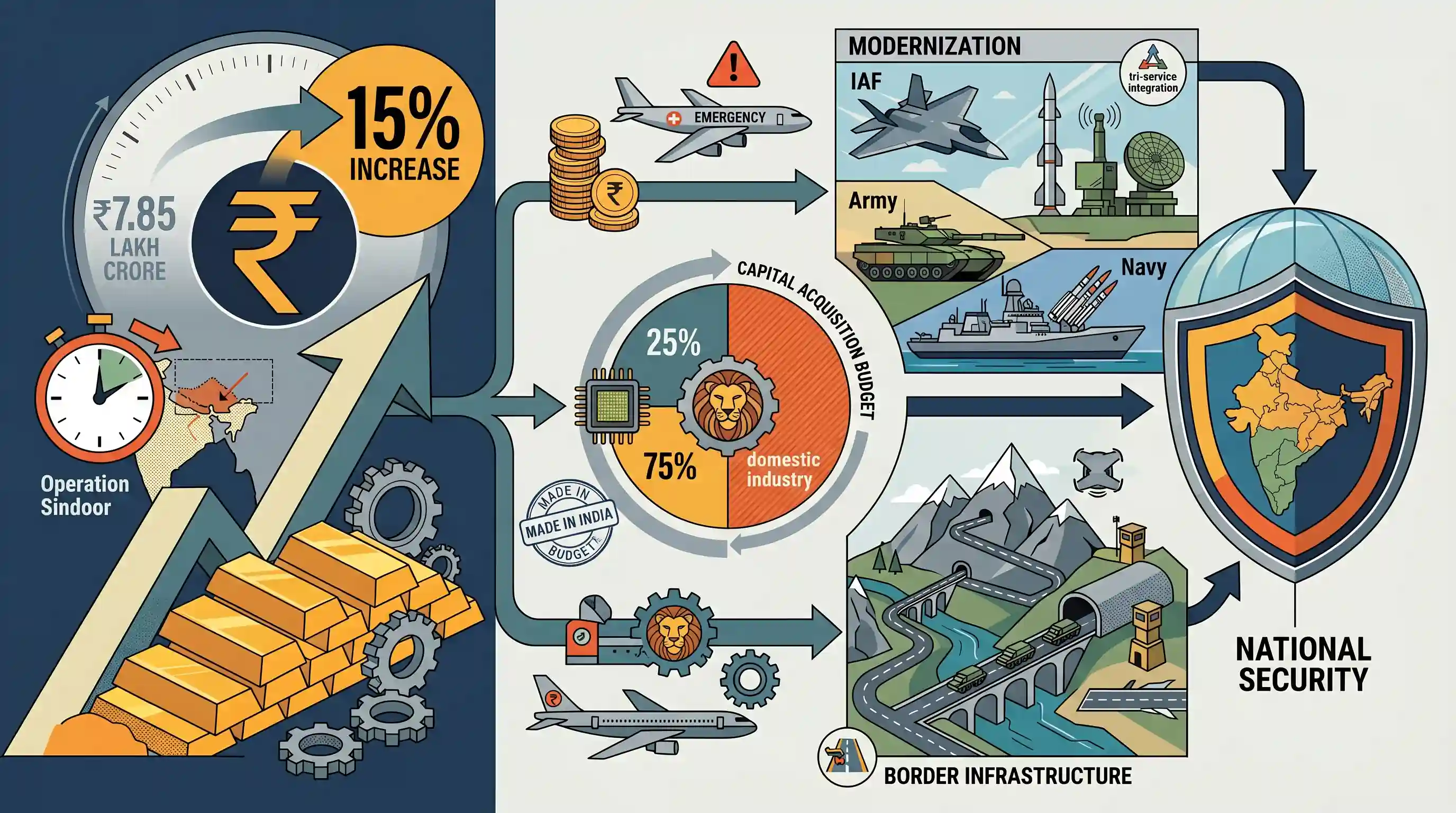
The Union Budget 2026 has allocated a record ₹7.85 lakh crore to the defence sector, marking a 15% increase driven by the need for emergency procurements post-'Operation Sindoor' and a strong push for indigenous manufacturing. With capital expenditure raised to ₹2.19 lakh crore, 75% of the capital acquisition budget is specifically reserved for domestic industries, underscoring the government's commitment to Aatmanirbhar Bharat and the modernization of the armed forces.
Key Points
- The Union Budget 2026 allocates a record ₹7.85 lakh crore to defence services, representing 2% of the estimated GDP and a 15.19% increase over the previous year.
- The funding boost addresses emergency procurements made post-'Operation Sindoor' and accelerates the modernization of armed forces.
- Capital expenditure is raised to ₹2.19 lakh crore, with ₹1.85 lakh crore specifically set aside for capital acquisition.
- In a major push for indigenization (Aatmanirbhar Bharat), 75% of the capital acquisition budget (₹1.39 lakh crore) is earmarked for procurement from domestic industries.
- Additional budget allocations are focused on border infrastructure, R&D, and veterans' healthcare.
Important Terms
Union Budget 2026-27

The annual financial statement for fiscal year 2026-27, which allocated a record ₹7.85 lakh crore to defence, prioritizing modernization and self-reliance in a high-threat environment.
UPSC context
Relevant for GS Paper-3 (Economy and Security); tests understanding of fiscal priorities, sectoral allocations, and national security funding.
Operation Sindoor
A May 2025 tri-service military operation targeting cross-border terrorist infrastructure; its lessons on combat readiness significantly influenced the 15% surge in the 2026-27 defence budget.
UPSC context
GS Paper-3 (Internal Security); tests knowledge of India's counter-terrorism doctrine, tri-service coordination, and strategic response to security threats.
Aatmanirbhar Bharat (Defence)
A strategic policy aimed at achieving self-reliance in defence through indigenous manufacturing, reserved domestic procurement (75% of CapEx), and reduced dependency on foreign military imports.
UPSC context
GS Paper-3 (Security and Science & Tech); crucial for topics on indigenization of technology and domestic industrial growth.
Capital Expenditure (CapEx)
Budgetary allocation for acquiring long-term assets like advanced fighter jets, submarines, and weapon systems; in 2026-27, this reached ₹2.19 lakh crore to enhance combat capabilities.
UPSC context
GS Paper-3 (Economy/Budgeting); differentiates between operational sustenance (revenue) and long-term asset creation (capital) in national security.
Modernization of Armed Forces
The systematic upgrade of military technology and platforms to maintain a technological edge; the 2026 budget emphasizes AI, UAVs, and next-generation stealth platforms.
UPSC context
GS Paper-3 (Security); focuses on the transition from a manpower-intensive to a technology-driven military to counter two-front threats.
Border Roads Organisation (BRO)
The nodal agency for constructing and maintaining strategic road networks in India’s border regions, allocated ₹7,394 crore in 2026-27 to enhance rapid troop mobilization.
UPSC context
GS Paper-3 (Border Management); essential for discussions on strategic infrastructure and logistical preparedness at the frontiers.
Prelims Trap
"75% of India's total defence budget is exclusively reserved for procurement from domestic industries."
The 75% domestic reservation applies strictly to the capital acquisition budget (procuring new equipment), not the overall defence budget which includes massive revenue expenditures.
Static Concepts Connected
What constitutes capital versus revenue expenditure in the defence budget?
- Capital Expenditure: Funds the creation of new strategic assets like fighter jets, naval ships, and advanced technology procurements (capability creation).
- Revenue Expenditure: Covers day-to-day operations, including salaries, ammunition, fuel, and routine maintenance (force maintenance).
- Defence Pensions: A massive non-salary component that has historically constrained the overall proportion of funds available for capital modernization.
What is the mandate and administrative control of the Border Roads Organisation (BRO)?
- Administrative Control: Functions entirely under the Ministry of Defence, having been shifted from the Ministry of Road Transport and Highways in 2015.
- Strategic Mandate: Develops and maintains road networks in India's border areas and friendly neighboring countries, ensuring rapid military mobilization and strategic access.
Cross-Topic Patterns
Domestic Procurement & Defence Corridors
The 75% domestic capital quota directly vitalizes the UP and Tamil Nadu Defence Industrial Corridors, merging fiscal policy with regional manufacturing and MSME integration.
Op Sindoor & Asymmetric Warfare
Post-Sindoor emergency procurements highlight a definitive military shift from conventional troop-heavy strategies to technology-driven deterrence, emphasizing drones and precise missile capabilities.

Expect a multi-statement Prelims question mixing defence capital/revenue expenditure definitions with the 75% domestic procurement quota.
Linked PYQs · 3
Linked PYQs · 3
- 2014MainsGS3
Foreign Direct Investment (FDI) in the defence sector is now set to be liberalized. What influence this is expected to have on Indian defence and economy in the short and long run?
- 2020MainsGS3
For effective border area management, discuss the steps required to be taken to deny local support to militants and also suggest ways to manage favourable perception among locals.
- 2020MainsGS3
Analyze internal security threats and transborder crimes along Myanmar, Bangladesh and Pakistan borders including Line of Control (LoC). Also discuss the role played by various security forces in this regard.
