Union Budget defence allocation and capital spending on aerospace
Source:Indian Express ↗
Why It Matters
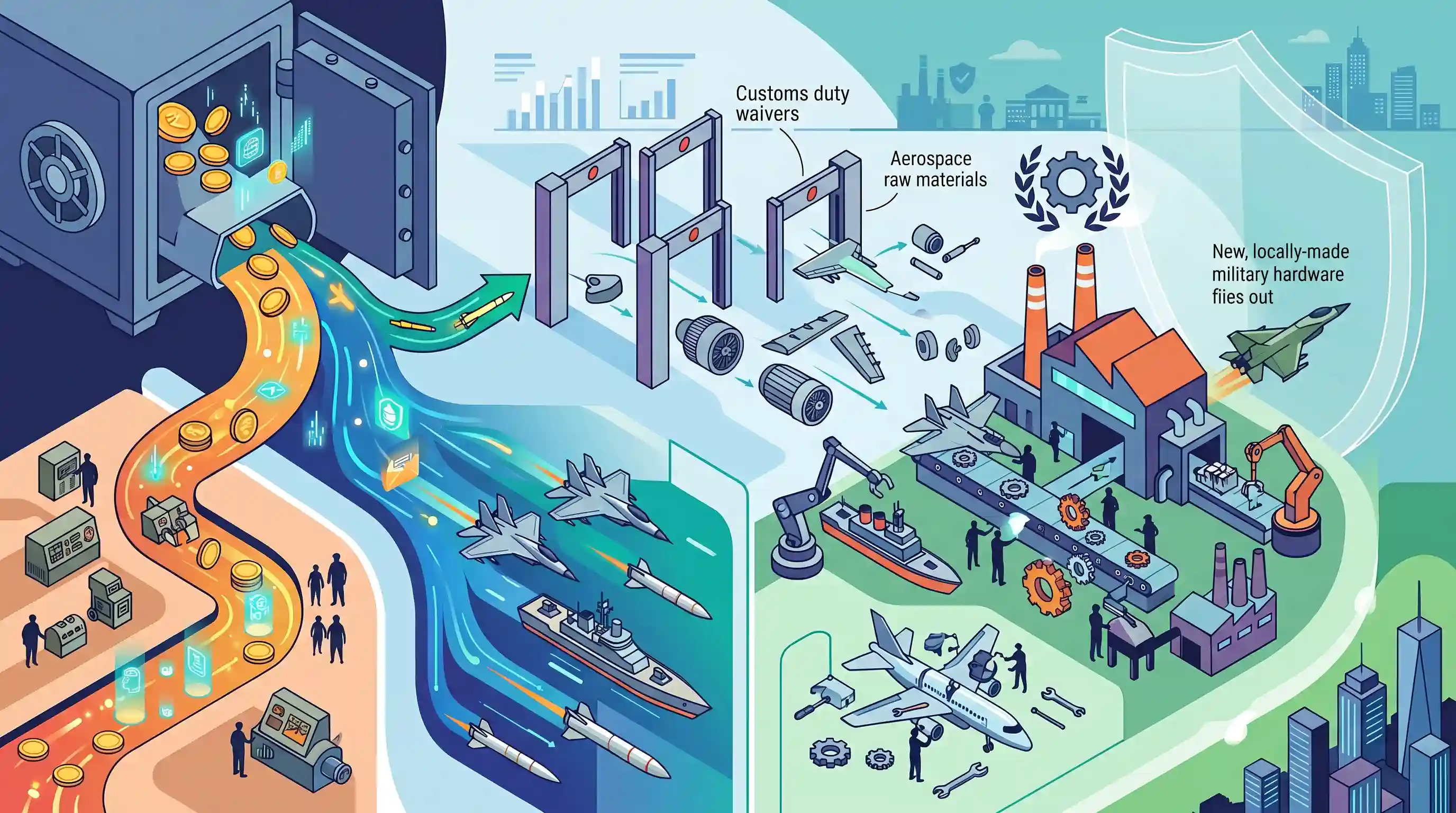
The allocation reflects the government's approach to balancing daily operational readiness and personnel costs with the long-term capital modernization of the armed forces. Duty waivers emphasize the continuing policy push toward Atmanirbhar Bharat in defence and MRO manufacturing, making it highly relevant for questions on industrial policy, budgeting, and self-reliance in the security sector.
Summary
The Union Budget 2026-27 highlights a strong commitment to national security and defence modernization, allocating a record Rs 7.84 lakh crore to the Ministry of Defence. While revenue expenditure, including pensions, continues to form the bulk of this allocation, substantial capital expenditure is earmarked for acquiring aircraft, aero engines, and naval fleets. Furthermore, policy interventions such as customs duty waivers on aerospace components and raw materials for MRO (Maintenance, Repair, and Overhaul) indicate a push toward indigenization and boosting domestic manufacturing capabilities in the defence sector.
Key Points
- The Union Budget 2026-27 allocated Rs 7.84 lakh crore to the defence sector, a substantial jump from the previous fiscal year's Rs 6.81 lakh crore.
- A capital expenditure of Rs 2,19,306 crore was designated for modernizing the armed forces, heavily focusing on aircraft, aero engines, and naval fleets.
- The revenue expenditure continues to comprise the bulk of the allocation at Rs 5.53 lakh crore, which includes over Rs 1.71 lakh crore just for pensions.
- To boost domestic manufacturing and self-reliance, basic customs duty was waived on components for civilian and training aircraft, and on raw materials used by defence-sector units for MRO (maintenance, repair, and overhaul).
Important Terms
Capital Expenditure (CapEx) in Defence

Government spending on creating or upgrading long-term assets like fighter jets and submarines. In 2026-27, defence capital outlay reached ₹2.19 lakh crore to prioritize modernization and aerospace capabilities.
UPSC context
GS3: Economy and Security. Tests understanding of resource allocation for military modernization vs. maintenance.
Revenue Expenditure (Defence)
Recurring government spending for daily operations, including salaries, transportation, and pensions. In the 2026-27 defence budget, it accounts for the majority of the ₹7.84 lakh crore total allocation.
UPSC context
GS3: Economy. Relevant for analyzing the 'committed expenditure' burden (like pensions) on the fiscal deficit.
Indigenization of Technology
The capability to design, develop, and manufacture defence equipment within the country to achieve self-reliance. It aims to reduce import dependency (historically 60-70%) and build a domestic industrial base.
UPSC context
GS3: Science & Tech and Security. Core theme for 'Aatmanirbhar Bharat' and strategic autonomy.
Maintenance, Repair, and Overhaul (MRO)
Specialized services for the upkeep and repair of aircraft and engines. The 2026 Budget waived basic customs duty on MRO raw materials to lower input costs and boost domestic servicing capacity.
UPSC context
GS3: Industrial Policy. Important for aerospace sector growth, job creation, and operational readiness.
Annual Financial Statement (AFS)
The constitutional name for the Union Budget under Article 112. It is a mandatory statement of estimated receipts and expenditure presented annually by the government to Parliament.
UPSC context
GS2: Polity. Foundational constitutional concept regarding the legislature's control over the executive's power to spend.
Strategic Autonomy
A nation's ability to pursue its own national interests and foreign policy without being constrained by other states. Reducing military import dependence is a primary tool for achieving this status.
UPSC context
GS2/GS3: International Relations/Security. Tests the link between domestic manufacturing and geopolitical independence.
Prelims Trap
"The majority of India's defence budget is allocated to capital expenditure for the modernization of the armed forces."
Despite headlines emphasizing massive modernization drives, revenue expenditure (salaries, pensions, and maintenance) consistently consumes over two-thirds of the Indian defence budget.
Static Concepts Connected
How are Defence Budget expenditures classified in India?
- Revenue Expenditure: Covers recurring operational costs, including salaries, maintenance, and notably, defence pensions, which alone consume over 20% of the total budget.
- Capital Expenditure: Focuses on asset creation and modernization, such as purchasing new aircraft, aero-engines, naval fleets, and strategic infrastructure.
What are the primary policy tools for Defence Indigenization?
- Positive Indigenization Lists: Bans the import of listed weapons, platforms, and sub-systems, mandating their procurement from domestic manufacturers to boost self-reliance.
- Fiscal Incentives: Waiving basic customs duties on specialized raw materials (like MRO components) lowers input costs for domestic MSMEs and manufacturers.
- FDI Limits: Increased up to 74% under the automatic route to attract foreign original equipment manufacturers (OEMs) and facilitate technology transfer.
Cross-Topic Patterns
Defence MRO as an aviation multiplier
Customs duty waivers for defence MRO components synergize with civil aviation policies aimed at making India a global MRO hub, linking military logistics with broader infrastructure growth.
Naval capital spend + Indo-Pacific strategy
The capital budget's specific allocation for naval fleets and aero-engines reflects a doctrinal shift from continental border defense to maritime security and power projection in the Indo-Pacific.

Expect a Prelims question in 2026 contrasting Defence Revenue vs Capital expenditure trends alongside MRO customs duty exemptions.
Linked PYQs · 5
Linked PYQs · 5
- 2021MainsGS3
Distinguish between Capital Budget and Revenue Budget. Explain the components of both these Budgets.
- 2014MainsGS3
Foreign Direct Investment (FDI) in the defence sector is now set to be liberalized. What influence this is expected to have on Indian defence and economy in the short and long run?
- 2025PrelimsGS1
Suppose the revenue expenditure is ₹ 80,000 crores and the revenue receipts of the Government are ₹60,000 crores. The Government budget also shows borrowings of ₹ 10,000 crores and interest payments of ₹ 6,000 crores. Which of the following statements are correct? I. Revenue deficit is ₹ 20,000 crores. II. Fiscal deficit is ₹ 10,000 crores. III. Primary deficit is ₹ 4,000 crores. Select the correct answer using the code given below.
- 2022PrelimsGS1
With reference to the expenditure made by an organisation or a company, which of the following statements is/are correct? 1. Acquiring new technology is capital expenditure. 2. Debt financing is considered capital expenditure, while equity financing is considered revenue expenditure. Select the correct answer using the code given below:
- 2016PrelimsGS1
Which of the following is/are included in the capital budget of the Government of India? 1. Expenditure on acquisition of assets like roads, buildings, machinery, etc. 2. Loans received from foreign governments 3. Loans and advances granted to the States and Union Territories Select the correct answer using the code given below.
