Union Budget 2026 announces NIMHANS in North India for mental health
Source:The Hindu ↗
Why It Matters
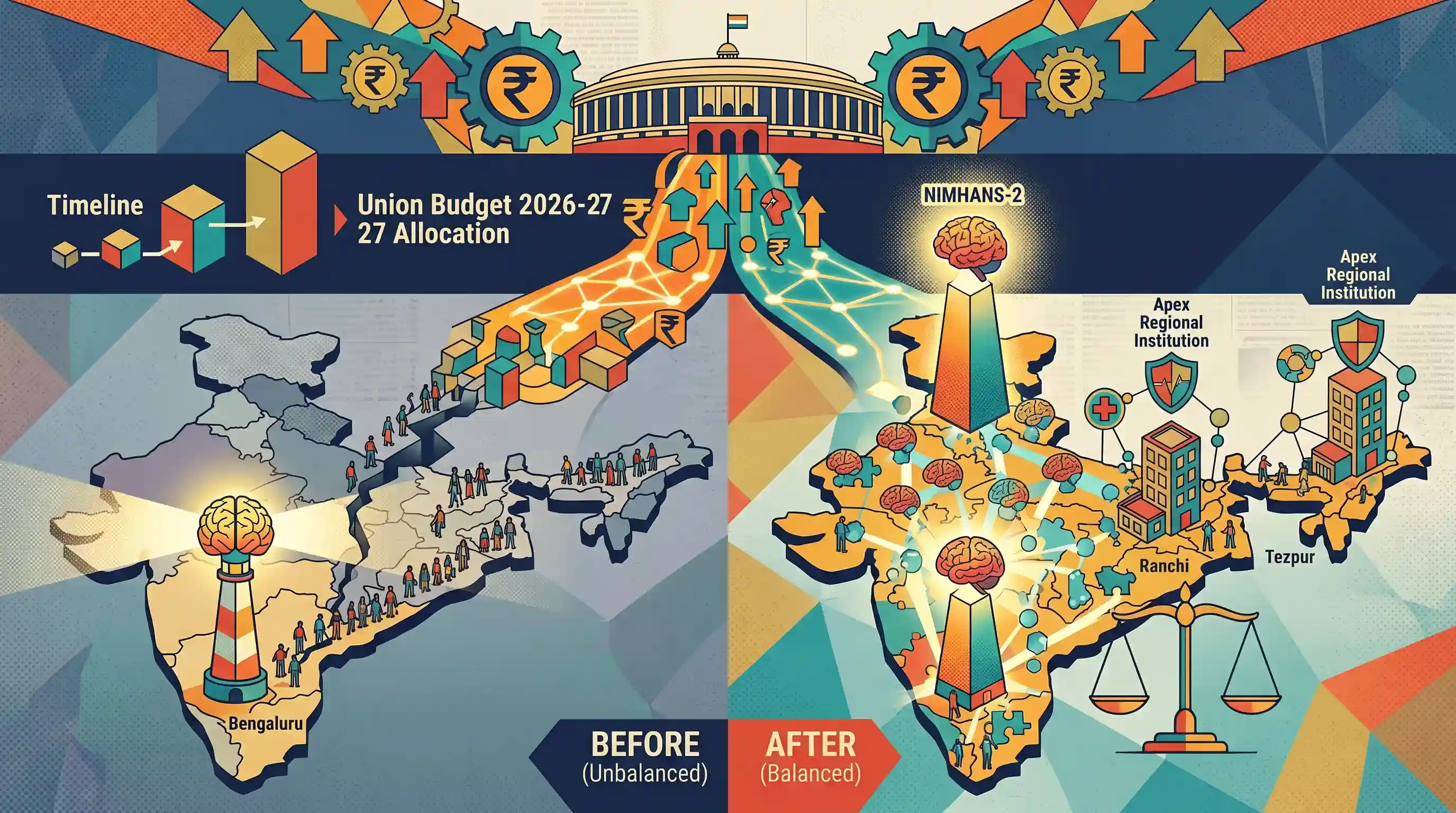
Mental health has historically been neglected in India\'s public health infrastructure. The announcement of new and upgraded apex institutes under the Union Budget demonstrates a critical policy shift towards mainstreaming mental health and addressing regional disparities in specialized healthcare access.
Summary
The Union Budget 2026-27 highlighted a significant push for mental health infrastructure by announcing the setup of a second National Institute of Mental Health and Neuro-Sciences (NIMHANS-2) in North India. Additionally, the government will upgrade the Central Institute of Psychiatry in Ranchi and the Lokpriya Gopinath Bordoloi Regional Institute of Mental Health in Tezpur to regional apex institutions, aiming to bridge the regional gap in specialized mental healthcare and trauma services.
Key Points
- Finance Minister Nirmala Sitharaman announced the establishment of NIMHANS-2 in North India during the Union Budget 2026-27 presentation.
- The initiative aims to address the absence of national mental health care institutes in the northern region, though the exact location is yet to be revealed.
- The national mental health institutes in Ranchi (Central Institute of Psychiatry) and Tezpur (Lokpriya Gopinath Bordoloi Regional Institute of Mental Health) will be upgraded to regional apex institutions.
- These measures reaffirm the Union government\'s commitment to improving mental health and trauma care infrastructure across the country.
Important Terms
Union Budget 2026-27

The Annual Financial Statement (Article 112) of the Indian government; the 2026-27 edition significantly expanded mental health infrastructure to address regional healthcare gaps and trauma services.
UPSC context
GS Paper III: Government Budgeting. Tests understanding of fiscal priorities and thematic shifts in public expenditure (e.g., health infrastructure).
NIMHANS
An Institute of National Importance in Bengaluru; it is India’s premier multidisciplinary center for psychiatric care, neuroscience research, and specialized mental health training.
UPSC context
GS Paper II: Health/Governance. Relevant for institutional frameworks and the role of specialized centers in national health missions.
Central Institute of Psychiatry (CIP)
A premier centrally-administered mental health institute in Ranchi, Jharkhand (est. 1918); it provides advanced psychiatric treatment and professional training for the eastern Indian region.
UPSC context
GS Paper II: Social Justice/Health. Important for understanding regional healthcare disparities and the decentralization of specialized medical services.
Lokpriya Gopinath Bordoloi Regional Institute of Mental Health (LGBRIMH)
An autonomous tertiary mental health institute in Tezpur, Assam, under the MoHFW; it is a vital center for psychiatric care and research in Northeast India.
UPSC context
GS Paper II: Issues related to the Northeast. Tests knowledge of regional-specific healthcare infrastructure and central autonomous bodies.
Regional Apex Institution
A designation for premier medical facilities providing advanced specialized care, research, and training for specific geographical zones, aimed at decentralizing high-level expertise from metropolitan hubs.
UPSC context
GS Paper II: Health Infrastructure. Pertains to government strategies for equitable access to specialized tertiary healthcare across India.
Prelims Trap
NIMHANS was established as a statutory body under the Mental Healthcare Act, 2017.
NIMHANS is an Institute of National Importance under its own NIMHANS Act, 2012. The 2017 Act secures patient rights but didn't establish NIMHANS.
Static Concepts Connected
What are the landmark provisions of the Mental Healthcare Act, 2017?
- Advance Directive: Empowers individuals of sound mind to specify in writing how they wish to be treated (or not treated) for mental illness in the future.
- Decriminalization of Suicide: Presumes severe stress in cases of suicide attempts, effectively decriminalizing it by restricting the application of Section 309 of the Indian Penal Code.
- Right to Access: Guarantees every person the right to access mental healthcare and treatment from services run or funded by the government.
How is the Tele-MANAS initiative structured for mental health delivery?
- Tier-1 Basic Care: Consists of state Tele-MANAS cells equipped with trained counselors and mental health specialists for immediate, basic helpline response.
- Tier-2 Specialized Care: Involves specialized care where NIMHANS serves as the apex nodal center, leveraging e-Sanjeevani integration for advanced audio-visual clinical consultations.
- Tech Support: The International Institute of Information Technology-Bangalore (IIITB) acts as the nodal agency providing the underlying technology framework.
Cross-Topic Patterns
Mental Health & Demographic Dividend
Economic Surveys repeatedly link youth productivity to psychological well-being, framing tertiary mental healthcare expansion not just as welfare, but as critical infrastructure to harness India's demographic dividend.
Decentralization of Apex Healthcare
Follows the AIIMS expansion model. Bridging the regional divide in specialized tertiary care reduces distress migration and catastrophic out-of-pocket expenditure (OOPE) for vulnerable patients.

Expect a 2026 multi-statement question combining Mental Healthcare Act 2017 rights, Tele-MANAS framework, and NIMHANS's statutory status.
Linked PYQs · 3
Linked PYQs · 3
- 2020MainsGS2
In order to enhance the prospects of social development, sound and adequate health care policies are needed particularly in the fields of geriatric and maternal health care. Discuss.
- 2021MainsGS2
“Besides being a moral imperative of a Welfare State, primary health structure is a necessary precondition for sustainable development.” Analyze.
- 2024MainsGS2
In a crucial domain like the public healthcare system the Indian State should play a vital role to contain the adverse impact of marketisation of the system. Suggest some measures through which the State can enhance the reach of public healthcare at the grassroots level.
