Union Budget Agricultural Allocations and Digital Farming Initiatives
Source:The Hindu ↗
Why It Matters
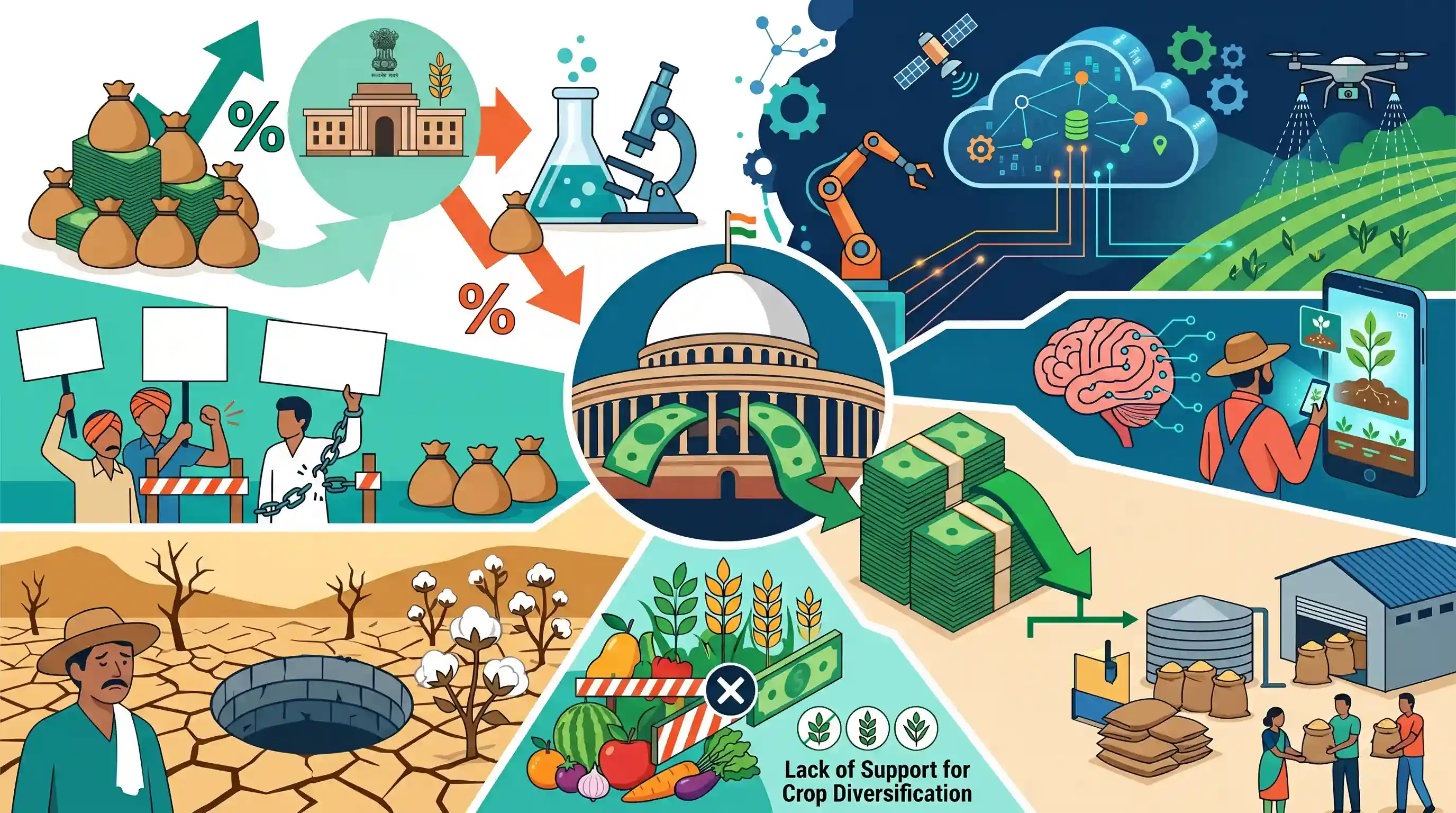
The agricultural allocations in the Union Budget are a core theme for GS3. The article highlights the tension between the government's push for digital agriculture (Bharat-VISTAAR) and farmers' demands for foundational economic security (legal MSP, debt relief). It also underscores the environmental and geographic consequences of agricultural policy, such as the urgent need for crop diversification in water-stressed regions like Punjab.
Summary
The Union Budget 2026-27 announced a marginal 2.6% increase in the Agriculture Ministry's allocation, maintaining the PM-KISAN outlay at ₹63,500 crore while reducing funds for agricultural research by 4.8%. The introduction of Bharat-VISTAAR, a ₹150 crore AI-driven initiative integrating AgriStack and ICAR, aims to boost farm productivity through digital advisory. Despite these digital pushes and a 10% hike in the food subsidy budget (reaching ₹2.27 lakh crore), prominent farm unions expressed dissatisfaction. They criticized the Centre for sidestepping core demands, primarily a legally guaranteed Minimum Support Price (MSP) and comprehensive farm debt relief. Regional experts, particularly from Punjab, highlighted the glaring lack of financial support for crop diversification, which is critical to reversing the state's severe groundwater depletion and the alarming decline in cotton cultivation.
Key Points
- The Agriculture Ministry received a marginal 2.6% budget increase to ₹1.30 lakh crore for 2026-27, with the PM-KISAN allocation remaining stagnant at ₹63,500 crore.
- A new ₹150 crore AI-driven initiative, Bharat-VISTAAR, was launched to integrate AgriStack portals with ICAR extension packages for better agricultural advisory and productivity.
- Food subsidy allocations witnessed a 10% surge, rising to ₹2.27 lakh crore, reflecting sustained government expenditure on the Public Distribution System.
- The budget for Agricultural Research and Education was cut by 4.8%, drawing criticism from farm groups for contradicting the need for climate-resilient farming.
- Farm unions and state commissions criticized the budget for ignoring critical demands such as a statutory guarantee for MSP, farm debt relief, and funding for crop diversification to address groundwater depletion in states like Punjab.
Important Terms
PM Kisan Samman Nidhi (PM-KISAN)

A Central Sector Scheme providing ₹6,000 annual income support to landholding farmer families via three direct installments. The 2026-27 Budget maintained its outlay at ₹63,500 crore.
UPSC context
GS-III: Welfare schemes; issues related to direct/indirect farm subsidies and direct benefit transfer (DBT).
Bharat-VISTAAR
A multilingual, AI-driven digital platform launched in Budget 2026-27 to provide personalized, real-time farm advisories by integrating AgriStack data with ICAR’s scientific packages.
UPSC context
GS-III: E-technology in the aid of farmers; Role of AI in agricultural productivity.
AgriStack
A Digital Public Infrastructure (DPI) project creating unique 'Farmer IDs' linked to land records, intended to streamline credit, insurance, and subsidy delivery through data-driven precision.
UPSC context
GS-III: IT in agriculture; Digital public infrastructure; land reforms and digitisation.
Indian Council of Agricultural Research (ICAR)
The apex autonomous body for coordinating agricultural research and education in India. Its 2026-27 allocation was reduced by approximately 4.8% to ₹9,967 crore.
UPSC context
GS-III: Science and Technology developments; Agricultural research and productivity challenges.
Price Stabilisation Fund (PSF)
A mechanism used to mitigate extreme price volatility in essential agri-horticultural commodities like pulses and onions through market interventions; currently part of the PM-AASHA umbrella scheme.
UPSC context
GS-III: Buffer stocks; Food security; Issues related to agricultural marketing and price volatility.
Minimum Support Price (MSP)
The minimum price at which the government guarantees crop purchase from farmers. Union demands for a legal guarantee of MSP remain a central point of farmer-government friction.
UPSC context
GS-III: Major crop patterns; issues related to direct/indirect farm subsidies and price incentives.
Crop Diversification
A policy shift from monoculture (like wheat-paddy in Punjab) to high-value or water-efficient crops to restore soil health and groundwater. Budget 2026-27 emphasized plantation and coastal crops.
UPSC context
GS-III: Cropping patterns; Environmental conservation; Sustainable agriculture and food security.
Prelims Trap
Minimum Support Price (MSP) is a statutory guarantee enforced under the Essential Commodities Act.
MSP is an administrative policy based on CACP recommendations, not a legal right. Only the Fair and Remunerative Price (FRP) for sugarcane has statutory backing.
Static Concepts Connected
How is the Minimum Support Price (MSP) determined and implemented?
- Advisory body: CACP recommends MSP for 22 mandated crops utilizing A2+FL or C2 production cost formulas.
- Final authority: The Cabinet Committee on Economic Affairs (CCEA), chaired by the Prime Minister, takes the final decision on MSP declarations.
- Legal status: It remains an administrative guarantee, devoid of any specific statutory framework or parliamentary act backing.
What are the core components of the AgriStack initiative?
- Farmer Registry: A federated, Aadhaar-seeded database uniquely identifying farmers and dynamically linked to digitized state land records.
- Crop Sown Registry: Records field-level crop details utilizing satellite remote sensing alongside digital ground-truthing.
- Unified API: Provides unified APIs allowing private and public sectors to build AI-advisory tools like the newly announced Bharat-VISTAAR.
Cross-Topic Patterns
Revenue burden vs Capital R&D investment
Rising food subsidies and PM-KISAN outlays show a heavy skew towards revenue expenditure, actively crowding out capital investment in climate-resilient agricultural R&D (cut by 4.8%).
Groundwater depletion & Cropping patterns
The lack of budget support for crop diversification links Punjab's severe groundwater crisis directly to the current MSP regime, which structurally favors water-guzzling crops like paddy over cotton.

Expect a 2026 prelims question linking Bharat-VISTAAR's AI features (AgriStack) with the revenue-vs-capital expenditure skew in agriculture.
Linked PYQs · 5
Linked PYQs · 5
- 2023MainsGS3
What are the direct and indirect subsidies provided to farm sector in India? Discuss the issues raised by the World Trade Organization (WTO) in relation to agricultural subsidies.
- 2018MainsGS3
What do you mean by Minimum Support Price (MSP)? How will MSP rescue the farmers from the low income trap?
- 2023MainsGS3
How does e-Technology help farmers in production and marketing of agricultural produce? Explain it.
- 2021MainsGS3
What are the present challenges before crop diversification? How do emerging technologies provide an opportunity for crop diversification?
- 2020PrelimsGS1
In India, which of the following can be considered as public investment in agriculture? 1. Fixing Minimum Support Price for agricultural produce of all crops 2. Computerization of Primary Agricultural Credit Societies 3. Social Capital development 4. Free electricity supply to farmers 5. Waiver of agricultural loans by the banking system 6. Setting up of cold storage facilities by the governments Select the correct answer using the code given below:
