Union Budget 2026 raises agri allocation but faces farmer criticism
Source:The Hindu ↗
Why It Matters
Budgetary allocations dictate the direction of agricultural policy in India. This article is highly relevant for GS3 as it directly addresses core syllabus topics including MSP, direct/indirect farm subsidies, the role of e-technology (AgriStack, AI), and crop diversification, providing up-to-date policy points for Mains answers.
Summary
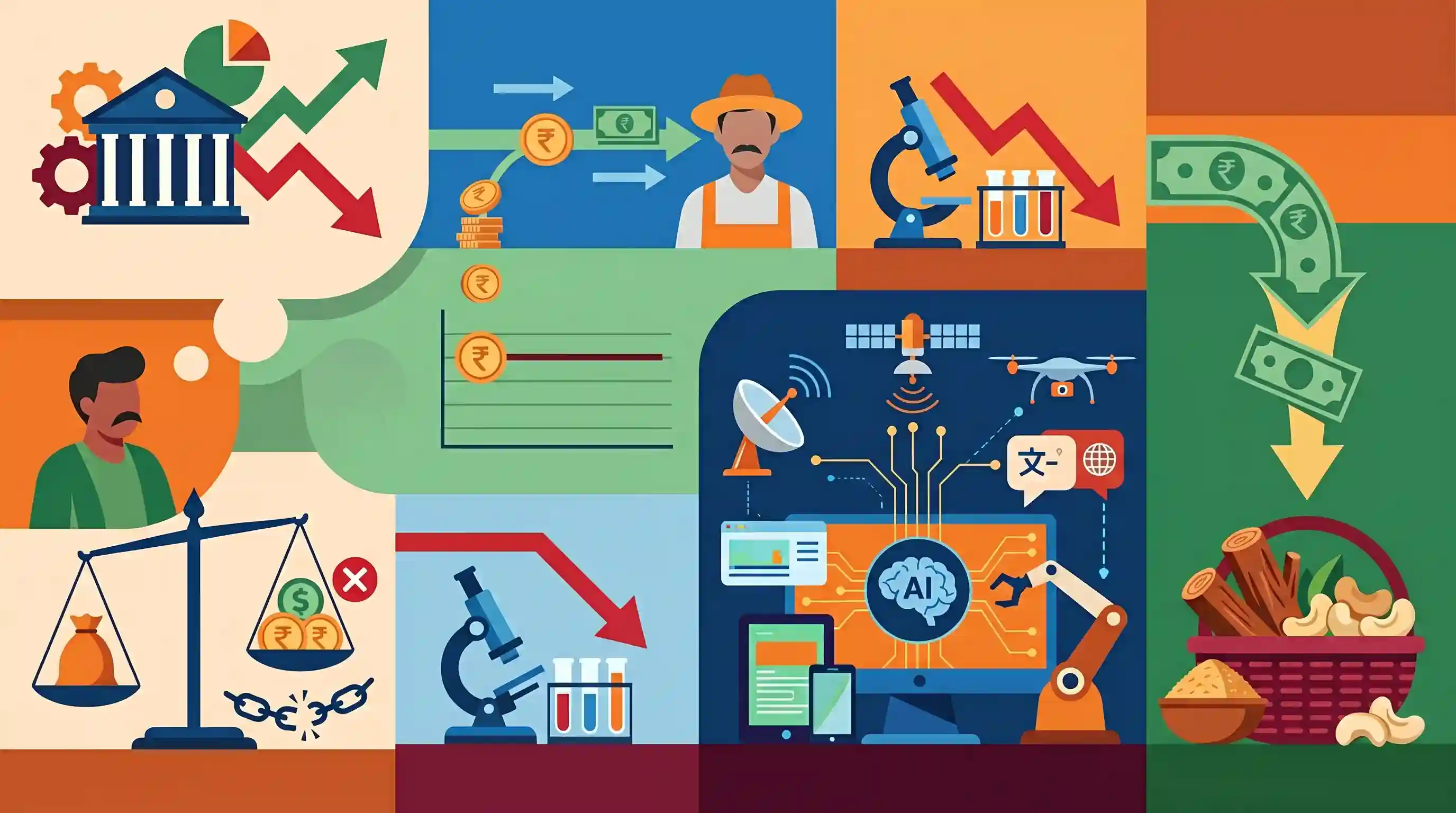
The Union Budget 2026 allocated ₹1.30 lakh crore to the Agriculture Ministry, representing a modest 2.6% increase that left several major farmer organizations dissatisfied. Key omissions cited by groups like the Bharatiya Kisan Sangh (BKS) and All India Kisan Sabha included the lack of statutory Minimum Support Price (MSP) and debt relief. The PM-KISAN scheme maintained its ₹63,500 crore funding, but agricultural research experienced a 4.8% funding cut. Despite criticisms, the budget highlighted technological and diversification initiatives, notably launching 'Bharat-VISTAAR'—a multilingual AI tool linked to AgriStack—and allocating ₹350 crore to promote high-value crops like sandalwood and cashew.
Key Points
- The Agriculture Ministry's budget allocation for 2026-27 saw a marginal 2.6% increase to ₹1.30 lakh crore, sparking dissatisfaction among farmer unions.
- Farmer groups criticized the budget for ignoring key demands like a statutory guarantee for Minimum Support Price (MSP), farm debt relief, and protection from global trade tariffs.
- While PM-KISAN allocation was retained at ₹63,500 crore, the budget for agricultural research and education saw a decline of 4.8%.
- The government introduced 'Bharat-VISTAAR', a new multilingual AI tool that integrates the AgriStack portals to improve farmer access to resources.
- A ₹350 crore allocation aims to promote high-value agriculture (e.g., coconut, cashew, sandalwood) and encourage crop diversification.
Important Terms
Minimum Support Price (MSP)

A price guarantee set by the Union Government to purchase crops from farmers, protecting them from market volatility. It is recommended by the CACP for 22 mandated crops and sugarcane.
UPSC context
GS Paper III (Agriculture); tests understanding of price policy, farmer welfare, and food security.
PM-KISAN (Kisan Samman Nidhi)
A Central Sector scheme providing ₹6,000 annual income support to all landholding farmer families via three direct installments. It aims to supplement financial needs for agricultural inputs and household expenses.
UPSC context
GS Paper II (Government Schemes) and III; tests knowledge of income support and DBT mechanisms.
Bharat-VISTAAR
A multilingual AI-based advisory platform launched in Budget 2026. It integrates AgriStack data with ICAR research to provide real-time, customized guidance on weather, soil health, and pests in local languages.
UPSC context
GS Paper III (E-technology in agriculture); tests AI applications for precision farming and last-mile connectivity.
AgriStack
A Digital Public Infrastructure (DPI) creating a centralized database of Aadhaar-linked farmer IDs and land records. It facilitates streamlined subsidy distribution, credit access, and data-driven agricultural policy planning.
UPSC context
GS Paper III (E-technology/Agriculture); tests digital transformation and governance in the primary sector.
Indian Council of Agricultural Research (ICAR)
The autonomous apex body under the Ministry of Agriculture responsible for coordinating agricultural research and education. It was instrumental in the Green Revolution and ensures national food and nutritional security.
UPSC context
GS Paper III (Agricultural Research); tests institutional frameworks for food security and productivity enhancement.
All India Kisan Sabha (AIKS)
A prominent peasant organization founded in 1936 by Swami Sahajanand Saraswati. It advocates for land reforms and farmers' rights, historically linking agrarian struggles with the national independence movement.
UPSC context
GS Paper I (Modern History) and II; tests history of peasant movements and pressure groups.
Prelims Trap
The Union Budget 2026 increased allocations for agricultural research to support new AI platforms like Bharat-VISTAAR.
Despite the introduction of new technological tools like the AI-based Bharat-VISTAAR, the actual budget allocation for agricultural research and education was cut by 4.8%.
Static Concepts Connected
How does the WTO's Agreement on Agriculture (AoA) impact India's MSP regime?
- Amber Box: Under AoA, MSP is classified as an Amber Box (trade-distorting) subsidy subject to reduction commitments.
- De Minimis Rule: Subsidy limits are capped at 10% of the total value of agricultural production for developing nations like India.
- Peace Clause: India currently relies on the 2013 Bali 'Peace Clause' to protect its public stockholding programs from legal challenges at the WTO.
What are the core components of the AgriStack initiative?
- Digital Public Infrastructure: A collection of technology-based interventions in agriculture creating a unified digital foundation for the sector.
- Farmer ID: Assigns a unique digital identification to farmers, linked to Aadhaar and land records, to optimize subsidy delivery and advisory.
Cross-Topic Patterns
AgriStack + Digital Public Infrastructure
The launch of 'Bharat-VISTAAR' extends the Digital Public Infrastructure (DPI) model to farming, bridging GS3 e-technology topics with broader governance frameworks like India Stack and ONDC.
Crop Diversification + Ecological Conservation
The ₹350 crore push for cashew and sandalwood aligns with efforts to break the ecologically damaging wheat-paddy cycle, linking budget allocations directly to groundwater conservation and climate-resilient agriculture.

AgriStack combined with Bharat-VISTAAR makes DPI in agriculture a highly probable multi-statement Prelims question in 2026.
Linked PYQs · 5
Linked PYQs · 5
- 2018MainsGS3
What do you mean by Minimum Support Price (MSP)? How will MSP rescue the farmers from the low income trap?
- 2023MainsGS3
What are the direct and indirect subsidies provided to farm sector in India? Discuss the issues raised by the World Trade Organization (WTO) in relation to agricultural subsidies.
- 2017MainsGS3
How do subsidies affect the cropping pattern, crop diversity and economy of farmers? What is the significance of crop insurance, minimum support price and food processing for small and marginal farmers?
- 2023MainsGS3
How does e-Technology help farmers in production and marketing of agricultural produce? Explain it.
- 2025MainsGS3
Explain the factors influencing the decision of the farmers on the selection of high value crops in India.
