Union Budget 2026 targets capital expenditure for economic resilience
Source:The Hindu ↗
Why It Matters
The Union Budget is a cornerstone of India's macroeconomic management. Understanding its allocations, strategic infrastructure projects (like dedicated freight corridors and rare earth corridors), and taxation philosophy is vital for answering questions on fiscal policy, economic growth, and resource mobilization in GS Paper 3.
Summary
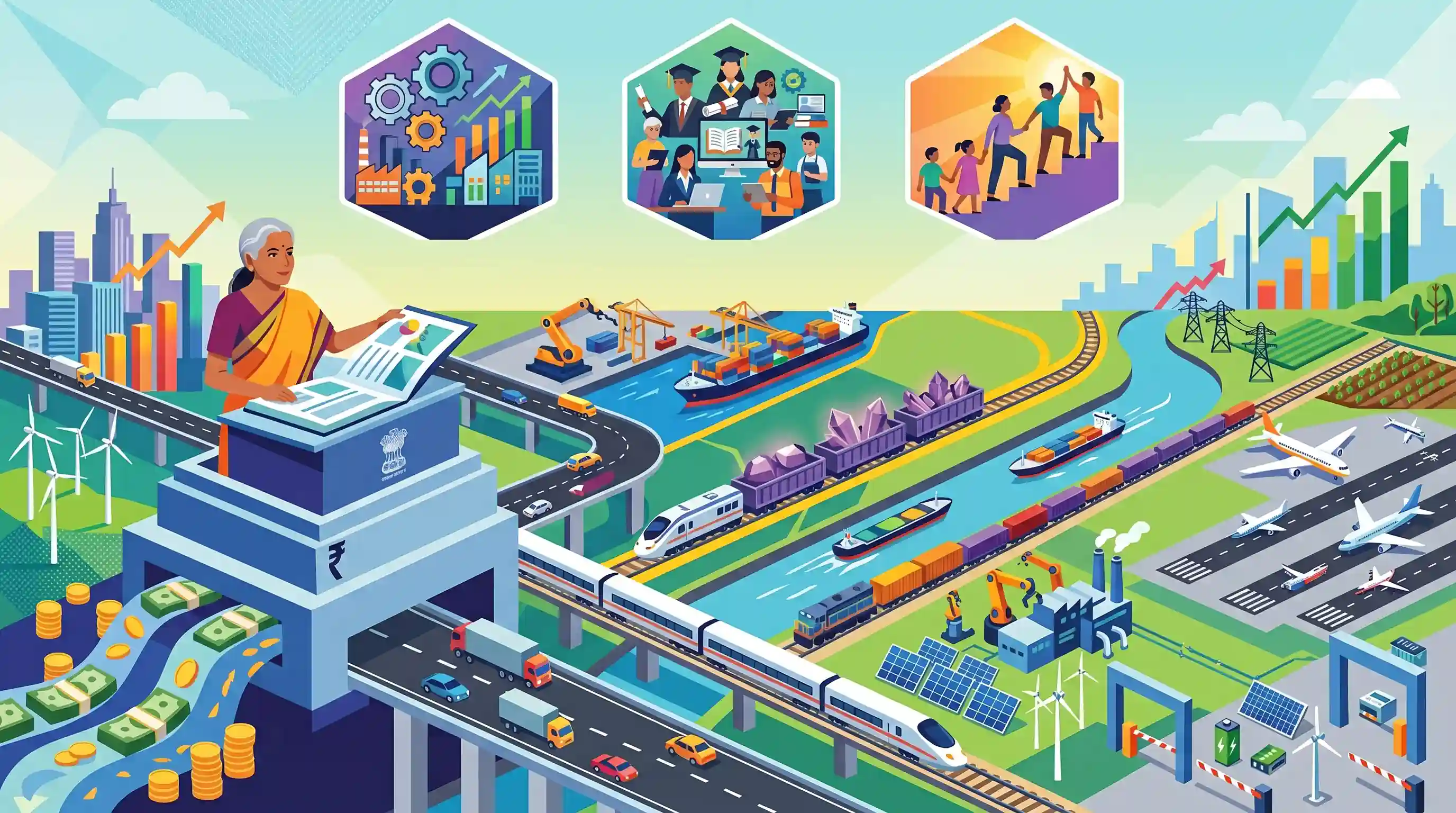
Finance Minister Nirmala Sitharaman presented the Union Budget 2026, centering on a significant capital expenditure target of ₹12.2 lakh crore to foster long-term economic resilience. Anchored by three core duties (kartavyas), the budget emphasizes enhanced productivity, human capacity building, and inclusive growth. Notable infrastructural and strategic highlights include the creation of rare earth corridors, new national waterways, industrial freight corridors, and targeted customs duty reductions to support critical manufacturing sectors and the ongoing energy transition.
Key Points
- The Union Budget 2026 sets a robust capital expenditure target of ₹12.2 lakh crore to counter global economic volatility.
- The budget outlines three 'kartavyas': accelerating economic growth, fulfilling aspirations through capacity building, and ensuring inclusive development (Sabka Sath, Sabka Vikas).
- Key infrastructure initiatives include developing rare earth corridors across Odisha, Kerala, Andhra Pradesh, and Tamil Nadu.
- Connectivity is enhanced via new National Waterways in Odisha, an integrated East Coast Industrial Corridor linking Durgapur, and a dedicated freight corridor from Dankuni to Surat.
- While direct taxes saw no major changes, customs duties were selectively reduced on marine, leather, textile products, and energy transition materials to boost manufacturing and exports.
Important Terms
Capital Expenditure (CapEx)

Government spending on creating long-term physical or financial assets like infrastructure, machinery, and buildings. It has a high multiplier effect on economic growth and employment.
UPSC context
GS III: Government Budgeting. Tests understanding of fiscal policy, growth drivers, and the difference between revenue and capital accounts.
Rare Earth Corridors
Integrated industrial value chains proposed in four coastal states (Odisha, Kerala, Andhra Pradesh, Tamil Nadu) to secure domestic supplies of critical minerals and reduce import reliance.
UPSC context
GS III: Infrastructure and Energy. Relevant for resource security, Indigenization of technology, and supply chain resilience against China’s dominance.
MSMEs
Enterprises classified by investment and turnover limits. Budget 2026 emphasizes their 'formalization' and 'scale-up' through the ₹10,000 crore SME Growth Fund to create 'Champion MSMEs'.
UPSC context
GS III: Indian Economy. Key for employment, exports, and inclusive growth topics. High weightage in Prelims and Mains.
Coconut Promotion Scheme
A strategic agricultural initiative focused on boosting productivity and replacing old, non-productive trees with high-yielding varieties to support India’s position as a top global producer.
UPSC context
GS III: Agriculture. Relevant for high-value crops, farmer income doubling, and coastal economy development.
Kartavyas (Budgetary Duties)
Three guiding principles for Budget 2026: sustaining economic growth through productivity, building human capacity, and ensuring inclusive participation (Sabka Saath Sabka Vikas).
UPSC context
GS II/III: Governance and Economy. Tests knowledge of the government’s strategic vision and philosophical framing of development policies.
National Waterways and Freight Corridors
Inland water transport routes (like the 20 new ones proposed) and high-speed rail/road paths designed to lower logistics costs and improve industrial connectivity.
UPSC context
GS III: Infrastructure. Crucial for understanding logistics efficiency, multi-modal connectivity, and environmental benefits of water-based transport.
Prelims Trap
"The 2026 Budget establishes rare earth mineral corridors exclusively in the Himalayan and North-Eastern regions."
UPSC frequently sets geographical traps. The proposed rare earth corridors leverage monazite beach sand deposits found in coastal states (Odisha, Kerala, AP, TN), not the Himalayan or North-Eastern regions.
Static Concepts Connected
What constitutes Capital Expenditure (Capex) in the Union Budget?
- Asset Creation: Expenditure leading to the creation of physical or financial assets, such as roads, hospitals, land, or equity investments.
- Liability Reduction: The repayment of principal on loans by the central government is classified as capital expenditure.
- Multiplier Effect: High capex spurs private investment, boosts job creation, and expands the long-term productive capacity of the economy.
Why are Odisha, Kerala, AP, and TN significant for Rare Earth Elements (REEs)?
- Monazite Sands: Placer deposits on the beaches of these coastal states are rich in Monazite, a principal source of light rare earth elements.
- Radioactive Nature: Monazite contains Thorium, a radioactive element, placing it under the strict purview of the Atomic Energy Act.
- Strategic Value: REEs are non-negotiable raw materials for EV batteries, wind turbines, and defense electronics, vital for the ongoing energy transition.
Cross-Topic Patterns
Rare Earths and Quad's Mineral Security
The domestic push for rare earth corridors in coastal states directly aligns with the Quad's Critical and Emerging Technology goals to diversify mineral supply chains away from China.
PM Gati Shakti & Dedicated Freight Corridors
The new Dankuni-Surat dedicated freight corridor integrates East-West logistics, tying into the PM Gati Shakti framework and the National Logistics Policy's aim to reduce logistics costs to single digits.

Multi-statement Prelims question expected linking monazite beach sands (Kerala/Odisha), REE corridors, and atomic minerals regulations.
Linked PYQs · 4
Linked PYQs · 4
- 2021MainsGS3
“Investment in infrastructure is essential for more rapid and inclusive economic growth.” Discuss in the light of India's experience.
- 2021MainsGS3
Distinguish between Capital Budget and Revenue Budget. Explain the components of both these Budgets.
- 2025PrelimsGS1
Consider the following statements : Statement I: Some rare earth elements are used in the manufacture of flat television screens and computer monitors. Statement II : Some rare earth elements have phosphorescent properties. Which one of the following is correct in respect of the above statements?
- 2019MainsGS3
Enumerate the indirect taxes which have been subsumed in the Goods and Services Tax (GST) in India. Also, comment on the revenue implications of the GST introduced in India since July 2017.
