Union Budget 2026-27 outlines rural growth and allied agriculture
Source:The Hindu ↗
Why It Matters
This article covers the core announcements of the Union Budget 2026-27, detailing new schemes (like Mahatma Gandhi Gram Swaraj Yojana) and capital outlays in infrastructure and allied agriculture. It is highly relevant for GS3 questions on government budgeting, agricultural diversification, and infrastructure development.
Summary
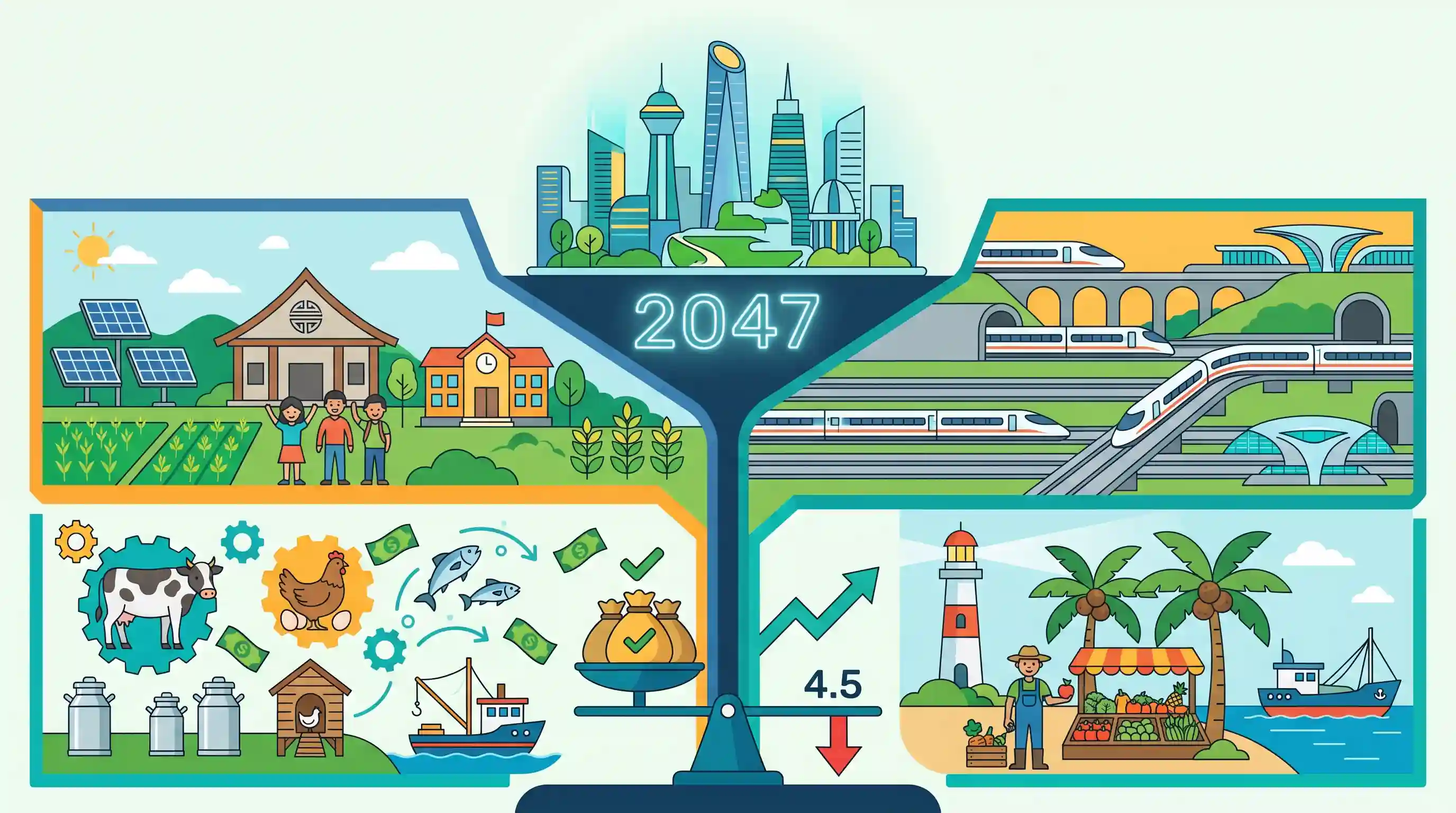
Union Home Minister Amit Shah highlighted the core themes of the Union Budget 2026-27, emphasizing a balance between fiscal prudence (deficit below 4.5%) and transformative growth under the 'Viksit Bharat 2047' framework. Key interventions include the Mahatma Gandhi Gram Swaraj Yojana to empower the rural economy, alongside major boosts to allied agricultural sectors like dairy, poultry, and fisheries. The budget also targets robust infrastructure development through seven new high-speed rail corridors and introduces targeted schemes for coastal and regional agriculture, such as the Coconut Promotion Scheme.
Key Points
- The Union Budget 2026-27 focuses on realizing the 'Viksit Bharat 2047' vision while maintaining macroeconomic stability, capping the fiscal deficit below 4.5%.
- The newly announced Mahatma Gandhi Gram Swaraj Yojana aims to strengthen the rural economy by directly supporting farmers, weavers, and the handloom sector.
- Allied agricultural sectors received significant focus, including credit-linked subsidies for dairy and poultry, and the development of 500 reservoirs for fisheries.
- Livestock health and farmer incomes are targeted through an increase in the number of veterinarians and veterinary centers.
- Infrastructure and connectivity are emphasized with the proposed establishment of seven high-speed rail corridors connecting major cities.
- Specific regional agricultural interventions include the Coconut Promotion Scheme in coastal areas, promotion of cashew exports, and sandalwood conservation.
Important Terms
Mahatma Gandhi Gram Swaraj Yojana

A flagship rural initiative (Budget 2026-27) shifting focus from wage labor to "entrepreneurial self-reliance." It revitalizes Khadi, Handlooms, and Handicraft sectors through global market linkages and process modernization.
UPSC context
GS Paper III: Rural Development and Agricultural Marketing. Relevant for questions on grassroots empowerment and traditional industry modernization.
Coconut Promotion Scheme
A central sector scheme (Budget 2026-27) aiming to enhance India's global competitiveness in coconut production by replanting old trees with high-yielding, climate-resilient varieties and promoting value addition.
UPSC context
GS Paper III: Economics of Animal-Rearing and Major Crops. Tests knowledge of sector-specific agricultural interventions.
Viksit Bharat 2047
The government's roadmap to transform India into a developed nation by its 100th independence anniversary. It rests on four pillars: Yuva (Youth), Garib (Poor), Mahila (Women), and Annadata (Farmers).
UPSC context
GS Paper II & III: Governance and Economic Development. Essential for understanding long-term national planning and inclusive growth targets.
Fiscal Deficit (FY27 Target)
In Budget 2026-27, the target was set at 4.3% of GDP, continuing the glide path toward debt consolidation while maintaining record high capital expenditure for infrastructure.
UPSC context
GS Paper III: Government Budgeting. Tests understanding of fiscal prudence and macroeconomic stability markers.
High-Speed Rail Corridors
A ₹16 lakh crore proposal in Budget 2026-27 to develop seven corridors (e.g., Mumbai-Pune, Delhi-Varanasi) to reduce travel time and enhance regional economic integration.
UPSC context
GS Paper III: Infrastructure (Railways). Focuses on connectivity projects and their role as "growth connectors."
Prelims Trap
Mahatma Gandhi Gram Swaraj Yojana focuses on Panchayati Raj political devolution.
Despite the 'Gram Swaraj' name, this specific scheme is an economic intervention providing direct support to farmers, weavers, and the handloom sector, rather than a governance or political empowerment initiative.
Static Concepts Connected
What is the Fiscal Consolidation Glide Path?
- Original FRBM Target: The FRBM Act initially mandated a fiscal deficit target of 3% of GDP, which was repeatedly paused or amended due to macroeconomic shocks like the COVID-19 pandemic.
- Post-COVID Glide Path: The government set a revised, gradual reduction plan (glide path) in 2021-22 to bring the fiscal deficit below 4.5% of GDP by the target year.
- Financing the Deficit: The government bridges this fiscal gap primarily through internal market borrowings (G-Secs) and utilizing the National Small Savings Fund (NSSF).
Why is the allied agricultural sector crucial for rural income?
- Growth Engine: Allied sectors like dairy, poultry, and fisheries consistently register higher Gross Value Added (GVA) growth rates compared to the traditional crop sector.
- Income Stability: Unlike seasonal crops, livestock and dairy provide daily or weekly cash flows, acting as a crucial shock absorber against climate-induced crop failures.
- Egalitarian Nature: Livestock wealth is more equitably distributed than land in India, making allied sector growth inherently pro-poor and supportive of small/marginal farmers.
Cross-Topic Patterns
High-Speed Rail + PM Gati Shakti
The 7 new high-speed rail corridors integrate into the PM Gati Shakti National Master Plan, prioritizing multimodal connectivity and regional economic nodes over mere passenger transit.
Coastal Agri & ODOP Exports
The Coconut Promotion Scheme and cashew export drives link coastal agricultural resilience with the One District One Product (ODOP) initiative to boost localized forex earnings.
Non-Farm Rural Economy Integration
By targeting weavers and handlooms under a rural scheme, the budget bridges the agriculture-MSME divide, a crucial step for absorbing surplus agricultural labor into the non-farm economy.

Fiscal consolidation glide path (4.5% target) paired with new rural non-farm schemes (MG Gram Swaraj) is a high-probability 2026 MCQ.
Linked PYQs · 5
Linked PYQs · 5
- 2025MainsGS3
Explain how the Fiscal Health Index (FHI) can be used as a tool for assessing the fiscal performance of states in India. In what way would it encourage the states to adopt prudent and sustainable fiscal policies?
- 2019MainsGS3
The public expenditure management is a challenge to the Government of India in the context of budget making during the post-liberalization period. Clarify it.
- 2015MainsGS3
Livestock rearing has a big potential for providing non-farm employment and income in rural areas. Discuss suggesting suitable measures to promote this sector in India.
- 2021MainsGS3
“Investment in infrastructure is essential for more rapid and inclusive economic growth.” Discuss in the light of India's experience.
- 2025PrelimsGS1
Consider the following statements : Statement I: In India, income from allied agricultural activities like poultry farming and wool rearing in rural areas is exempted from any tax. Statement II: In India, rural agricultural land is not considered a capital asset under the provisions of the Income-tax Act, 1961. Which one of the following is correct in respect of the above statements?
