Decentralization of Welfare Responsibilities in Union Budget
Source:The Hindu ↗
Why It Matters
The article is crucial for UPSC aspirants as it touches upon the core issues of fiscal federalism, Centre-State relations, and government budgeting. Understanding the shift in welfare burden is vital for analyzing policies related to Centrally Sponsored Schemes and state fiscal health.
Summary
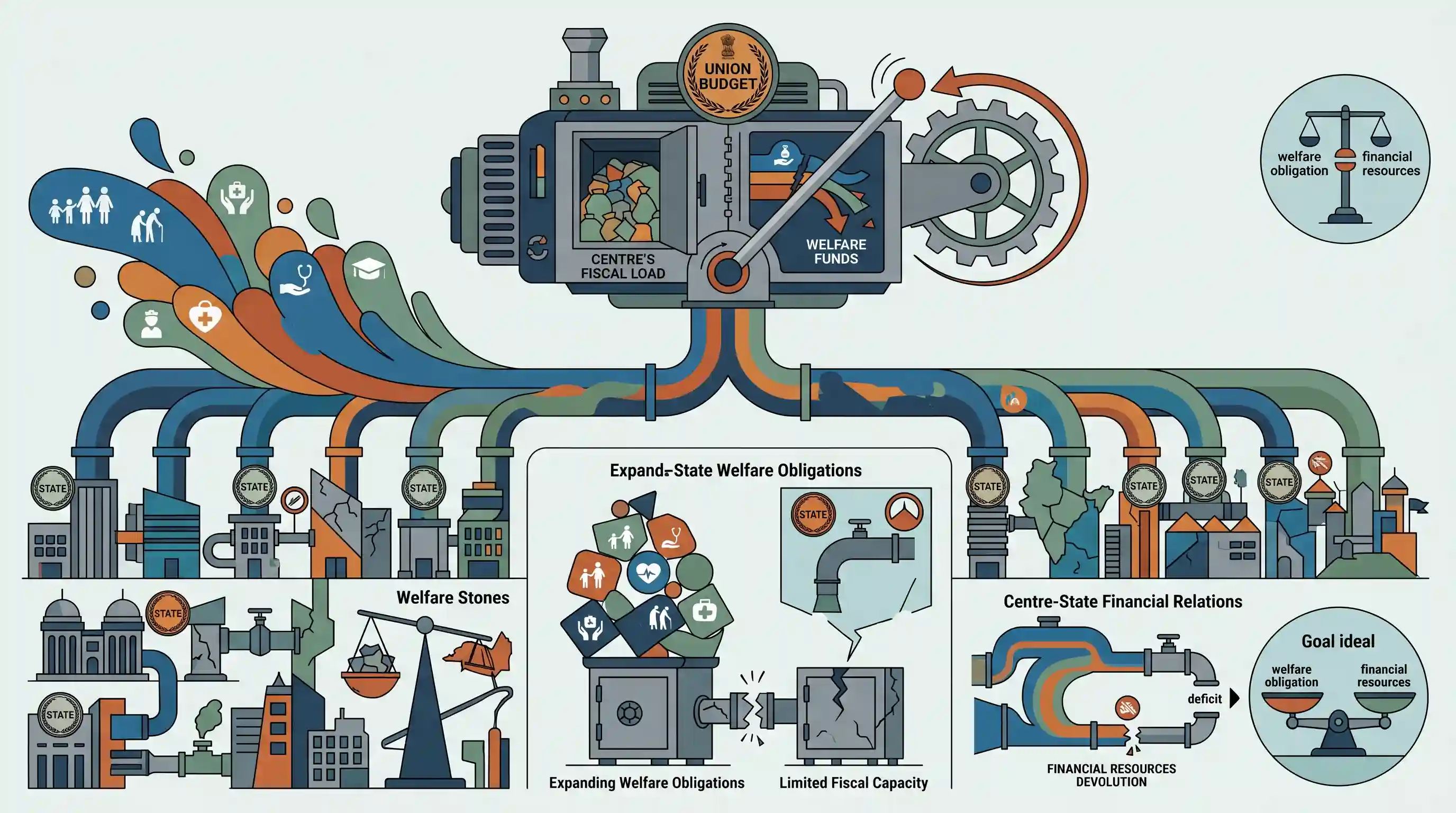
The Union Budget 2026-27 indicates a strategic pivot in India's welfare economics by increasingly transferring the responsibility and financial burden of welfare programs to State governments. This decentralization aims to align welfare delivery with state-specific needs but introduces significant challenges regarding the fiscal capacity of States. The shift underscores the evolving nature of Centre-State financial relations and fiscal federalism, necessitating adequate resource devolution to prevent States from facing severe fiscal stress while fulfilling their expanding welfare obligations.
Key Points
- The Union Budget 2026-27 signals a structural shift by decentralizing welfare responsibilities and pushing the financial burden of welfare programs towards State governments.
- This approach necessitates robust tax devolution and adequate fiscal space for States, as they are now expected to shoulder a larger share of welfare implementation.
- The move has significant implications for fiscal federalism, highlighting the evolving dynamics of Centre-State financial relations.
- While it promotes localized, state-specific policy-making, it raises concerns over potential strains on state finances and the risk of increasing state debt to meet welfare obligations.
Important Terms
Centrally Sponsored Schemes (CSS)

Schemes funded jointly by the Centre and States (e.g., 60:40 ratio) but implemented by State governments to address national socio-economic priorities.
UPSC context
GS II & III: Tests knowledge of fiscal transfers, scheme implementation, and challenges in Centre-State administrative cooperation.
Finance Commission
A constitutional body (Article 280) that recommends the distribution of net tax proceeds between the Union and States and determines the principles for grants-in-aid.
UPSC context
GS II & III: Essential for understanding the mechanism of resource allocation and the 'balancing wheel' of Indian federalism.
Fiscal Federalism
The division of taxing powers, expenditure responsibilities, and financial transfers between central and sub-national governments to ensure efficient and equitable public service delivery.
UPSC context
GS II & III: A recurring theme regarding state autonomy, cooperative federalism, and the vertical/horizontal fiscal imbalance.
Tax Devolution
The transfer of financial resources from the Union's divisible pool of taxes to State governments, based on recommendations by the Finance Commission.
UPSC context
GS III: Vital for analyzing state fiscal capacity and the impact of central tax policy on state budgets.
Grants-in-aid
Financial assistance from the Centre to States; includes Statutory Grants (Article 275) recommended by the Finance Commission and Discretionary Grants (Article 282) for public purposes.
UPSC context
GS II: Crucial for understanding how the Union supports revenue-deficit states and influences state-level welfare spending.
Annual Financial Statement (Budget)
Mandated by Article 112, it is a statement of the estimated receipts and expenditure of the Government of India for a specific financial year.
UPSC context
GS III: The core topic of government budgeting, fiscal policy, and parliamentary control over finances.
Prelims Trap
States receive exactly 41% of the Centre's gross tax revenues under the Finance Commission mandate.
The 41% applies only to the 'divisible pool'. The Centre's reliance on non-shareable cesses and surcharges reduces the effective transfer to States to around 34%.
Static Concepts Connected
What constitutes the divisible pool of taxes?
- Constitutional basis: Article 270 allows certain Union taxes and duties to be shared between the Centre and the States.
- Exclusions: Article 271 explicitly excludes cesses and surcharges levied for specific purposes from this divisible pool.
- Finance Commission: The Finance Commission recommends the vertical (Centre to State) and horizontal (among States) distribution formulas.
How do Centrally Sponsored Schemes differ from Central Sector Schemes?
- Funding ratio: CSS are jointly funded by the Centre and States (e.g., 60:40), whereas Central Sector schemes are 100% Union funded.
- Implementation: CSS are implemented by State governments, while Central Sector schemes are directly executed by Union agencies.
- Constitutional domain: CSS typically address subjects in the State List to ensure national minimum standards across states.
Cross-Topic Patterns
Welfare spending vs. Capital Expenditure
Rising state welfare mandates limit capital expenditure, linking Centre-State financial relations directly to long-term national macroeconomic debt sustainability and infrastructure growth.
NITI Aayog indices and soft fiscal control
Evaluation frameworks like NITI Aayog's Fiscal Health Index act as soft-power mechanisms, steering states away from unchecked revenue-expenditure models toward quality capital investments.

Expect a 2026 multi-statement question linking 16th FC devolution limits, the exclusion of cesses from the divisible pool, and state debt.
Linked PYQs · 3
Linked PYQs · 3
- 2025MainsGS2
Examine the evolving pattern of Centre-State financial relations in the context of planned development in India. How far have the recent reforms impacted the fiscal federalism in India?
- 2024MainsGS2
What changes has the Union Government recently introduced in the domain of Centre-State relations ? Suggest measures to be adopted to build the trust between the Centre and the States and for strengthening federalism.
- 2025MainsGS3
Explain how the Fiscal Health Index (FHI) can be used as a tool for assessing the fiscal performance of states in India. In what way would it encourage the states to adopt prudent and sustainable fiscal policies?
