Budget Provisions Aim to Strengthen India Deep Tech Pipeline
Source:Indian Express ↗
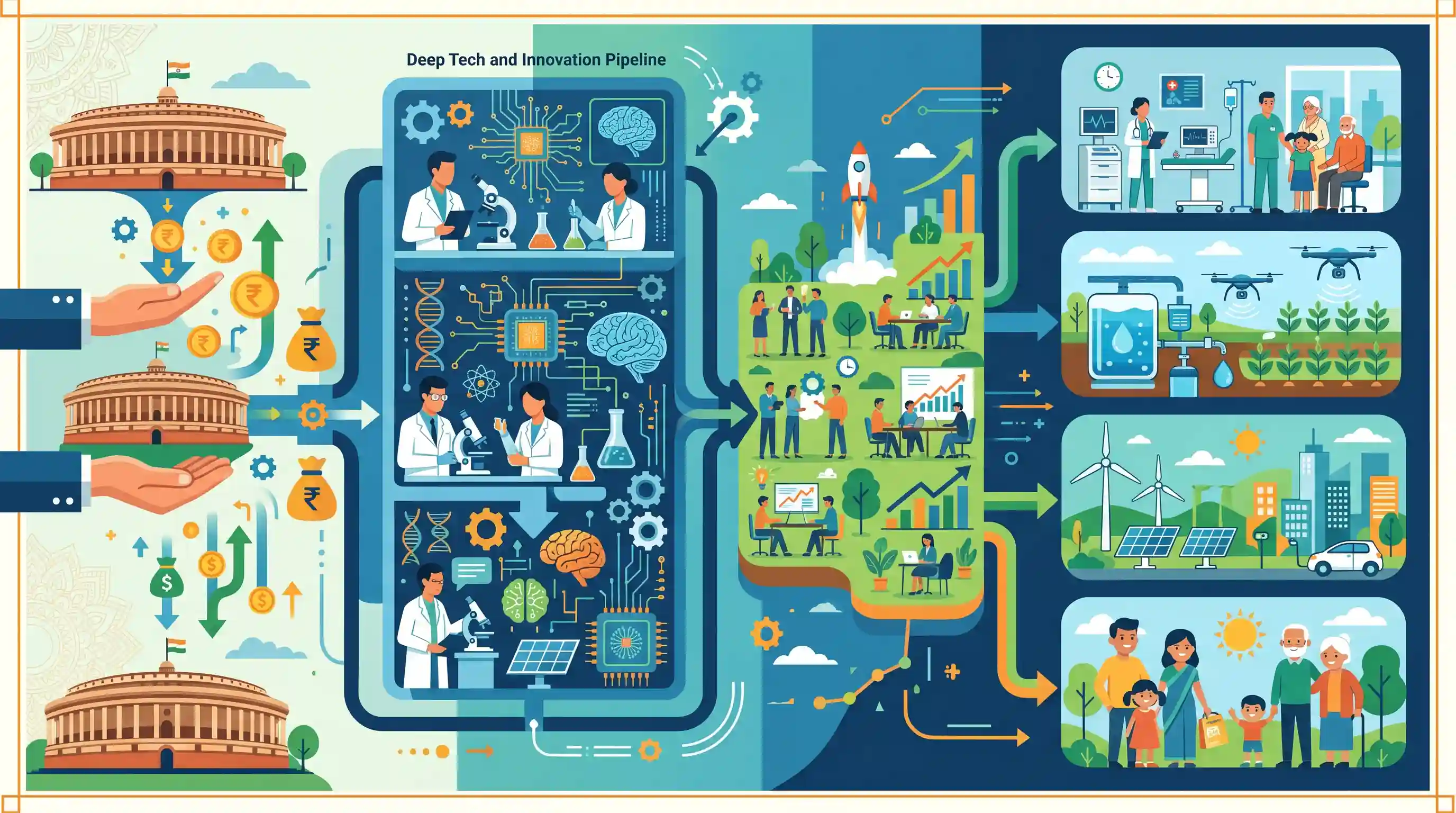
Why It Matters
The Union Budget's allocations towards deep tech and scientific research are critical for India's economic transition into a knowledge-based economy. This topic is directly relevant to GS3 (Science and Technology, Indian Economy, and Mobilization of Resources), particularly focusing on how R&D funding translates into socio-economic development (public value).
Summary
The Union Budget 2026-27 introduces provisions aimed at strengthening India's deep-tech pipeline, emphasizing the need to align scientific research and technological innovation with public value. By directing capital expenditure and R&D funding towards deep technology, the government seeks to foster a robust startup ecosystem that not only drives economic growth but also addresses pressing socio-economic challenges, ensuring that scientific advancements translate into tangible benefits for the public.
Key Points
- The Union Budget 2026-27 focuses on strengthening India's deep-technology pipeline to foster indigenous innovation.
- There is an emphasis on keeping scientific research anchored to public value and socio-economic development.
- Increased capital expenditure and targeted funding in R&D are crucial for transitioning scientific concepts into commercially viable deep-tech startups.
- The alignment of science and technology funding with broader public goals ensures that technological progress benefits society at large.
Important Terms
Union Budget 2026-27

The financial plan for FY 2026-27 focusing on 'Intelligence-First' growth, with ₹12.22 lakh crore capital expenditure targeting deep-tech, semiconductors (ISM 2.0), and AI sovereignty.
UPSC context
GS Paper III: Indian Economy and Budgeting; tests knowledge of fiscal priorities, capital expenditure, and sectoral allocations.
National Deep Tech Startup Policy (NDTSP)
A framework to foster innovation in high-impact frontier technologies like AI and space-tech by providing 'patient capital', IP protection, and a 20-year startup recognition period.
UPSC context
GS Paper III: Science and Technology and Indigenization of Technology; tests understanding of the startup ecosystem and innovation policy.
Deep Tech
Technologies based on significant scientific or engineering breakthroughs, characterized by high R&D intensity, long gestation periods, and the potential to solve complex socio-economic challenges.
UPSC context
GS Paper III: Science and Technology; tests ability to distinguish between service-based and innovation-led technological advancements.
Anusandhan National Research Foundation (ANRF)
A statutory body established to provide strategic direction for research and innovation, overseeing a ₹50,000 crore fund to bridge the gap between industry and academia.
UPSC context
GS Paper III: Science and Technology; tests knowledge of institutional frameworks for R&D and funding mechanisms.
India Semiconductor Mission (ISM) 2.0
An expanded phase of the semiconductor mission focusing on the entire value chain, including equipment, materials, and 'full-stack' Indian-owned intellectual property in chip design.
UPSC context
GS Paper III: S&T and Economy; tests understanding of strategic industrial policies and global supply chain resilience.
Biopharma SHAKTI
A ₹10,000 crore initiative introduced in Budget 2026-27 to establish India as a global hub for biologics and biosimilars manufacturing and clinical-trial capacity.
UPSC context
GS Paper III: Science and Technology; tests awareness of government missions in the pharmaceutical and biotechnology sectors.
Prelims Trap
"India's Gross Expenditure on R&D (GERD) is primarily driven by private sector investments."
In India, the government funds the majority of R&D. The private sector's contribution is only ~37%, unlike advanced economies like the US or China where it exceeds 70%.
Static Concepts Connected
What distinguishes Capital Expenditure from Revenue Expenditure in R&D?
- Asset Creation: CapEx involves spending that builds productive assets, such as deep-tech labs, testing facilities, and infrastructure with long-term economic benefits.
- Operational Costs: RevEx covers day-to-day administrative running costs, routine maintenance, and regular salaries, which do not directly result in new physical assets.
What are the key features of the Anusandhan National Research Foundation (ANRF)?
- Statutory Apex Body: Established under the ANRF Act 2023 to provide strategic direction for scientific research, officially replacing the Science and Engineering Research Board (SERB).
- Private Sector Integration: Designed to overcome India's low private R&D participation by crowding in private capital, aiming for ~70% of its funding to come from non-government sources.
Cross-Topic Patterns
Deep Tech + IPR Regime
Deep-tech requires immense upfront capital and long gestation, making a robust Intellectual Property Rights (IPR) and fast-tracked patent ecosystem critical for startup survival and valuation.
Science for Public Value + DPI
Anchoring innovation to socio-economic needs mirrors India's Digital Public Infrastructure (UPI, ONDC) strategy, aiming to turn high-end technological breakthroughs into scalable, accessible public goods.

A multi-statement Prelims question comparing India's GERD composition, ANRF funding targets, and the exact criteria of 'Deep Tech' is highly likely.
Linked PYQs · 4
Linked PYQs · 4
- 2015MainsGS3
What are the areas of prohibitive labour that can be sustainably managed by robots ? Discuss the initiatives that can propel research in premier research institutes for substantive and gainful innovation.
- 2016MainsGS3
Discuss India's achievements in the field of Space Science and Technology. How the application of this technology has helped India in its socio-economic development?
- 2025MainsGS3
How does nanotechnology offer significant advancements in the field of agriculture? How can this technology help to uplift the socio-economic status of farmers?
- 2022PrelimsGS1
With reference to the expenditure made by an organisation or a company, which of the following statements is/are correct? 1. Acquiring new technology is capital expenditure. 2. Debt financing is considered capital expenditure, while equity financing is considered revenue expenditure. Select the correct answer using the code given below:
