Union Budget Infrastructure Capital Expenditure Allocation
Source:Indian Express ↗
Why It Matters
This article ties directly into India's fiscal strategy of prioritizing capital expenditure on infrastructure (specifically railways and highways) to drive economic multiplier effects, lower logistics costs, and foster inclusive growth, making it vital for GS Paper 3.
Summary
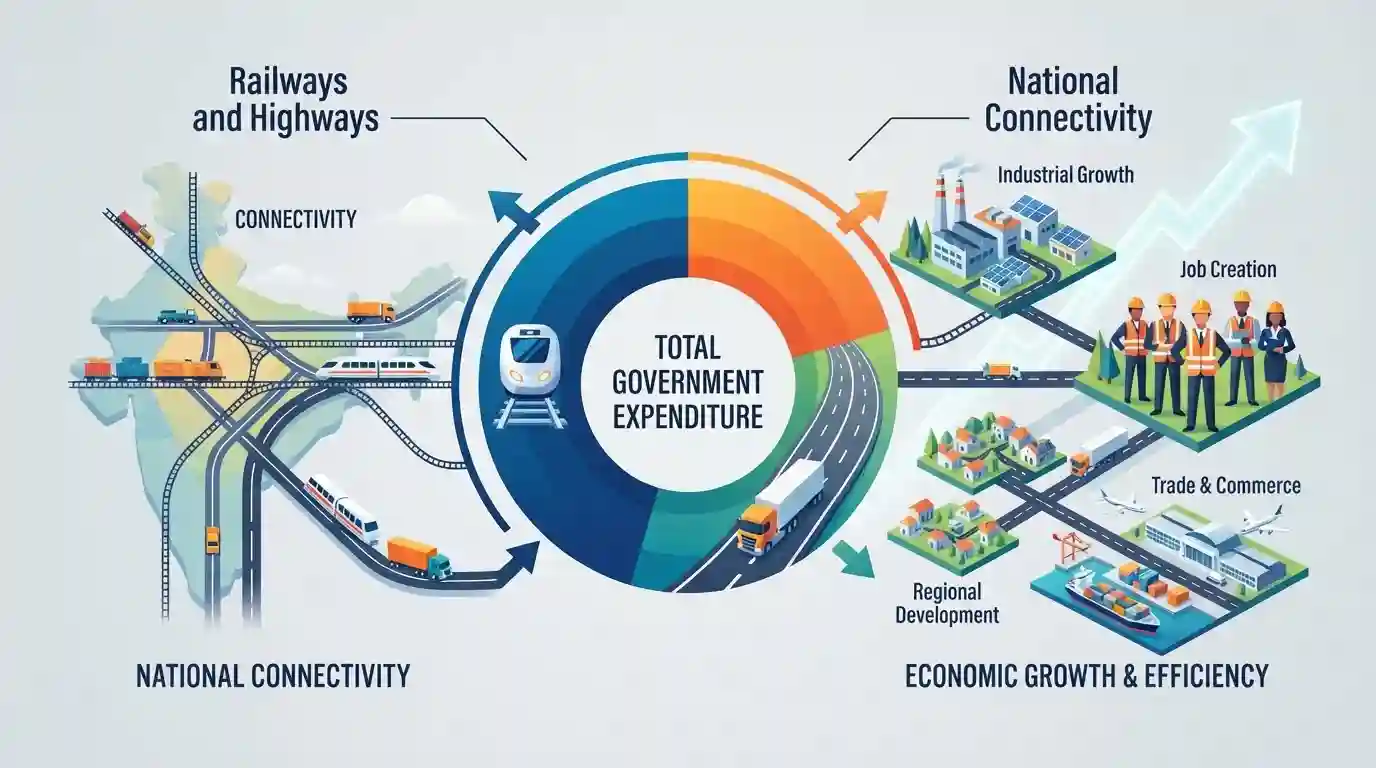
The Union Budget 2026-27 continues the government's emphasis on infrastructure-led growth, with railways and highways dominating capital expenditure allocation by capturing nearly 47 percent of the total capex outlay to boost national connectivity and economic efficiency.
Key Points
- Union Budget 2026-27 maintains a strong focus on mega connectivity, with railways and highways accounting for nearly 47 percent of the total capital expenditure (capex).
- Capital expenditure remains a key driver for long-term economic growth, supply chain efficiency, and employment generation in India.
- Continued state-backed push on transport infrastructure aims to crowd in private investment and bridge critical logistics gaps.
Important Terms
Union Budget 2026-27

The annual financial statement of the Government of India detailing estimated receipts and expenditures for the upcoming fiscal year, featuring a major push towards infrastructure-led capital expenditure.
UPSC context
GS Paper III (Indian Economy & Infrastructure). Tests understanding of fiscal policy, resource allocation, and growth-oriented public spending.
Railways
The state-owned rail transport system that forms a crucial backbone of national logistics, receiving substantial capital allocations for capacity augmentation, high-speed rail, and freight corridors.
UPSC context
GS Paper III (Infrastructure: Energy, Ports, Roads, Airports, Railways). Tests knowledge of multimodal transport connectivity and logistics efficiency.
Highways
National roadways and expressways funded through public capital expenditure to revitalize construction activities, reduce logistics costs, and improve inter-state economic connectivity.
UPSC context
GS Paper III (Infrastructure). Evaluates the role of road networks in driving economic growth and regional integration.
Static Concepts Connected
What is the difference between Capital Expenditure (Capex) and Revenue Expenditure in the Union Budget?
- Nature of Outlay: Asset Creation: Capex creates durable physical or financial assets or reduces liabilities, whereas revenue expenditure is for day-to-day running and maintenance.
- Multiplier Effect: Economic Impact: Capex has a significantly higher fiscal multiplier effect on GDP growth and job creation compared to revenue spending.
Cross-Topic Patterns
Capex Multipliers + National Logistics Policy
State-led infrastructure creation directly lowers logistics costs, tying into national competitiveness frameworks like the National Logistics Policy and PM GatiShakti.

Capital expenditure multiplier effect vs revenue expenditure, along with logistics cost reduction metrics, are high-probability prelims concepts.
Linked PYQs · 3
Linked PYQs · 3
- 2021MainsGS3
“Investment in infrastructure is essential for more rapid and inclusive economic growth.” Discuss in the light of India's experience.
- 2021MainsGS3
Distinguish between Capital Budget and Revenue Budget. Explain the components of both these Budgets.
- 2022MainsGS3
Why is Public Private Partnership (PPP) required in infrastructural projects ? Examine the role of PPP model in the redevelopment of Railway Stations in India.
