Finance Commission Devolution Formula and Fiscal Federalism
Source:Indian Express ↗
Why It Matters
Tax devolution is a core component of Indian federalism. The introduction of economic performance metrics fundamentally alters the balance between equity and efficiency in Centre-State financial relations, a highly probable topic for both Prelims and Mains GS2/GS3.
Summary
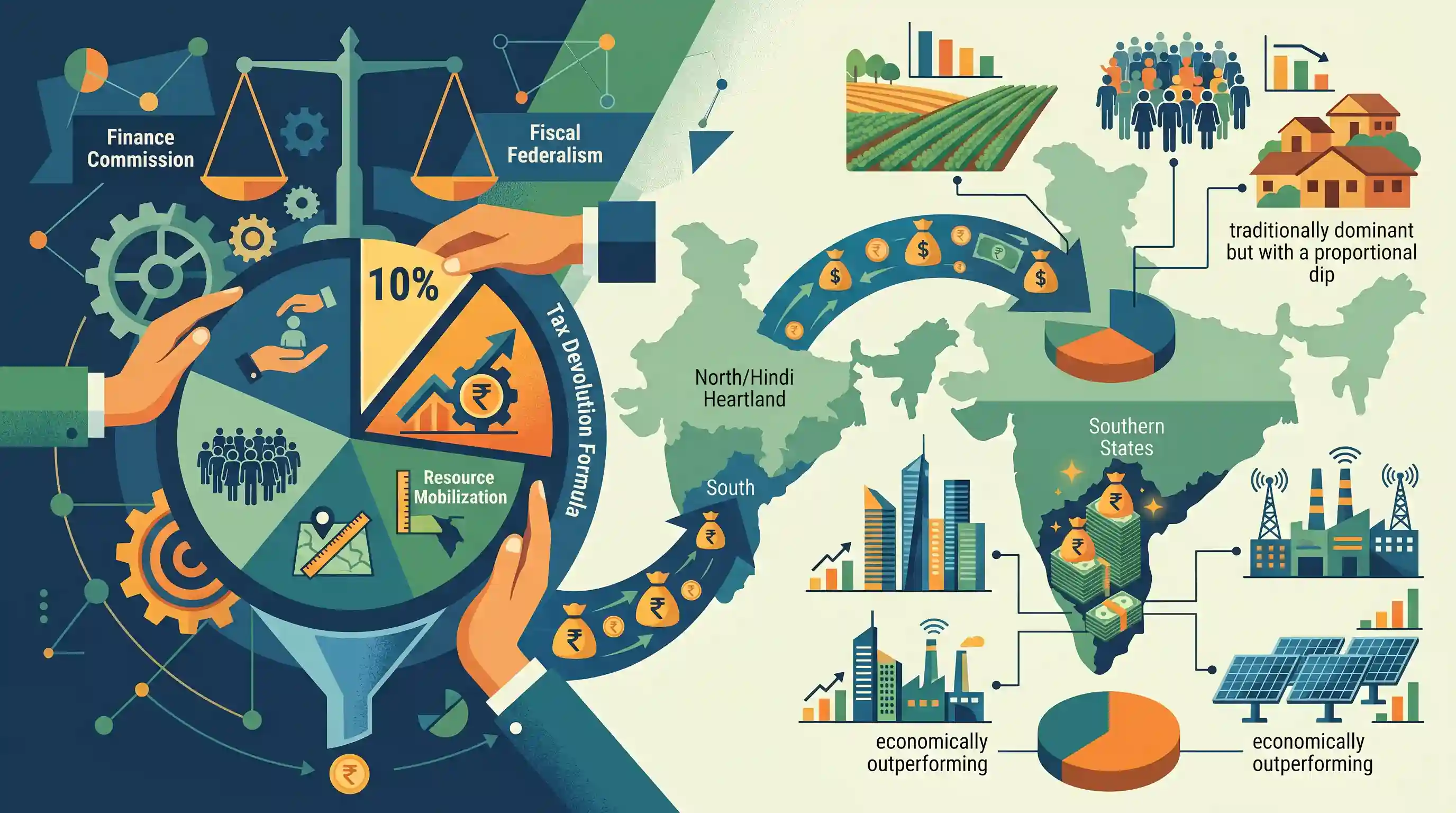
The Union Budget 2026-27 introduces a significant shift in Centre-State financial relations by incorporating a new 10% 'GDP criteria' in the tax devolution formula. This structural change results in a higher share of central taxes being allocated to economically outperforming Southern states, while traditionally dominant Hindi heartland states experience a proportional dip in their share. The move reflects evolving dynamics in fiscal federalism and addresses the long-standing North-South debate over demographic and economic performance versus equity in resource distribution.
Key Points
- The Union Budget 2026-27 implements a revised tax devolution formula shifting resources towards Southern states.
- A newly introduced 10% 'GDP criteria' in the devolution formula financially rewards states with stronger economic performance.
- Consequently, the share of central taxes allocated to Hindi heartland states has seen a proportional dip.
- The adjustment addresses long-standing grievances of Southern states regarding the 'North-South divide' in fiscal federalism and penalization for better demographic management.
Important Terms
Fiscal Federalism

The financial relationship and distribution of taxing powers and expenditure responsibilities between the Union and the States in a federal structure.
UPSC context
GS Paper 2 & 3: Tests Centre-State relations and balancing regional equity with national economic goals.
16th Finance Commission
A constitutional body (Article 280) that recommends the distribution of net tax proceeds between the Union and States and among individual States.
UPSC context
GS Paper 2: Constitutional Bodies; crucial for its new 2026-31 award period recommendations.
Tax Devolution
The transfer of tax revenues from the Centre to States; it involves 'vertical' (total pool) and 'horizontal' (among states) distribution mechanisms.
UPSC context
GS Paper 3: Indian Economy; tests the primary mechanism of resource mobilization for State governments.
Divisible Pool
The portion of gross central tax revenue shared with States; it excludes cesses, surcharges, and collection costs under Article 270.
UPSC context
GS Paper 3: Budgeting; focuses on revenue leakage via non-shareable cesses and vertical fiscal imbalances.
GDP Criteria (Horizontal Devolution)
A new 10% weightage in the horizontal devolution formula rewarding states based on their economic output and contribution to national growth.
UPSC context
GS Paper 3: Performance-linked incentives; tests the debate between economic efficiency and equity in resource distribution.
Vertical Devolution
The percentage of the divisible pool of taxes that the Central government shares with all States collectively (retained at 41% for 2026-31).
UPSC context
GS Paper 2/3: Tests understanding of the aggregate financial share allotted to States from the Union.
Prelims Trap
The Union Budget unilaterally determines the formula for horizontal tax devolution among states.
Tax devolution criteria are recommended by the Finance Commission under Article 280. The Union Budget merely implements the accepted recommendations; it does not unilaterally invent them.
Static Concepts Connected
What is the difference between Vertical and Horizontal tax devolution?
- Vertical Devolution: Determines the total share of the Centre's net tax revenue that goes to all states combined (e.g., 41% recommended by the 15th FC).
- Horizontal Devolution: The formula that dictates how the combined states' share is distributed among individual states based on equity, need, and efficiency criteria.
What were the core criteria used by the 15th Finance Commission?
- Equity parameters: Heavy reliance on 'Income Distance' (45%) to ensure equity and help poorer states bridge the wealth gap.
- Population shift: Shifted entirely to the 2011 Census (15% weight) but introduced 'Demographic Performance' (12.5%) to reward states controlling population.
- Efficiency & Ecology: Included 'Tax and Fiscal Efforts' (2.5%) and 'Forest and Ecology' (10%) to promote efficiency and environmental conservation.
Cross-Topic Patterns
Post-2026 Delimitation vs. Fiscal Share
Southern states' fear of losing political representation in the impending post-2026 Lok Sabha delimitation is closely intertwined with this fiscal debate. The 'GDP criteria' addresses the fiscal grievance, but political anxieties remain.
Cesses, Surcharges and the Divisible Pool
As the Centre increasingly relies on cesses and surcharges (which are excluded from the divisible pool), states are hyper-focused on maximizing their horizontal share of the remaining divisible taxes.

Expect a multi-statement question combining the new Finance Commission 'GDP criteria' with the impending 2026 Lok Sabha delimitation debate.
Linked PYQs · 5
Linked PYQs · 5
- 2025MainsGS2
Examine the evolving pattern of Centre-State financial relations in the context of planned development in India. How far have the recent reforms impacted the fiscal federalism in India?
- 2018MainsGS2
How is the Finance Commission of India constituted? What do you know about the terms of reference of the recently constituted Finance Commission? Discuss.
- 2024MainsGS2
What changes has the Union Government recently introduced in the domain of Centre-State relations ? Suggest measures to be adopted to build the trust between the Centre and the States and for strengthening federalism.
- 2023PrelimsGS1
Consider the following: 1. Demographic performance 2. Forest and ecology 3. Governance reforms 4. Stable government 5. Tax and fiscal efforts For the horizontal tax devolution, the Fifteenth Finance Commission used how many of the above as criteria other than population area and income distance?
- 2015PrelimsGS1
With reference to the Fourteenth Finance Commission, which of the following statements is/are correct? 1. It has increased the share of States in the central divisible pool from 32 percent to 42 percent. 2. It has made recommendations concerning sector-specific grants. Select the correct answer using the code given below.
