Budget 2026 Introduces CCUS Scheme for Industrial Decarbonisation
Source:The Hindu ↗
Why It Matters
The 2026-27 Budget's formal allocation to CCUS signifies India's shift from policy discussion to active state-backed R&D funding for industrial decarbonisation. Understanding CCUS mechanisms is crucial for the GS3 Environment and Science syllabus, while its strategic link to avoiding carbon tariffs connects to Economy and International Relations.
Summary
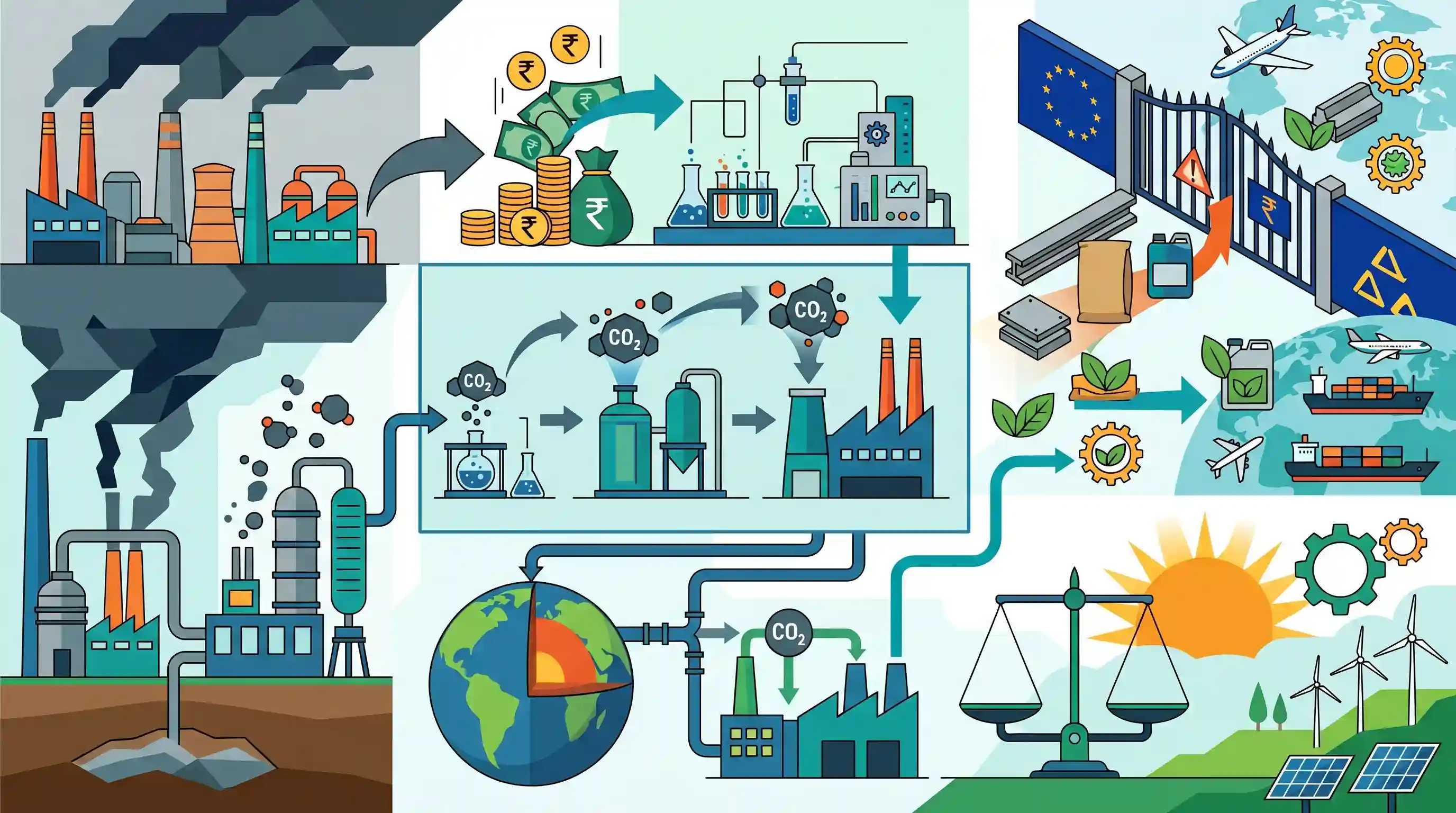
The Union Budget 2026-27 has introduced a ₹20,000 crore scheme to support Carbon Capture Utilisation and Storage (CCUS), a critical technology for decarbonising hard-to-abate sectors like iron, steel, cement, and chemicals. This R&D-led initiative will unfold in three phases—from lab research to commercial demonstration—aiming to help India reach net-zero by 2070. The push for CCUS also serves as a strategic response to impending trade barriers such as the European Union’s Carbon Border Adjustment Mechanism (CBAM), ensuring the global competitiveness of Indian manufacturing.
Key Points
- The Union Budget 2026-27 allocated ₹20,000 crore for a three-phase Carbon Capture Utilisation and Storage (CCUS) programme, with an initial ₹500 crore released to the Ministry of Power.
- CCUS technology captures carbon dioxide emissions from large point sources (e.g., thermal power plants, steel mills) and either utilizes it to manufacture secondary products or securely stores it in geological formations.
- The programme is deemed essential for decarbonising 'hard-to-abate' industrial sectors, aligning with India's commitment to achieve net-zero emissions by 2070.
- The scheme emphasizes an R&D-led approach to foster indigenous technologies, proposing the establishment of centres of excellence and the development of shared transport and storage infrastructure.
- Expediting domestic emission cuts through CCUS will help Indian exporters mitigate the impact of external trade barriers, such as the EU's Carbon Border Adjustment Mechanism (CBAM).
Important Terms
Carbon Capture Utilisation and Storage (CCUS)

Technologies that capture CO2 from industrial processes to be reused in products (like chemicals) or permanently stored underground, preventing atmospheric release.
UPSC context
GS Paper III (Environment/S&T): Critical for 'hard-to-abate' industrial decarbonisation and achieving India's Net-Zero 2070 target.
Carbon Border Adjustment Mechanism (CBAM)
A European Union tariff on carbon-intensive imports (e.g., steel, cement) designed to prevent 'carbon leakage' by ensuring imported goods pay a carbon price equivalent to EU producers.
UPSC context
GS Paper II (IR) & III (Economy): Tests understanding of non-tariff trade barriers and global climate diplomacy.
Hard-to-Abate Sectors
Industrial sectors where emissions are difficult to eliminate using only renewable electricity because they require high-temperature heat or chemical processes (e.g., steel, cement, chemicals).
UPSC context
GS Paper III (Economy/Environment): Vital for discussing industrial policy, sustainable manufacturing, and climate mitigation strategies.
Office of the Principal Scientific Advisor (PSA)
The apex scientific advisor to the Government of India. The office coordinates inter-ministerial R&D roadmaps and strategic technological missions like national CCUS development.
UPSC context
GS Paper II (Governance): Relevant for institutional frameworks supporting Science, Technology, and Innovation (STI) policy.
Department of Science and Technology (DST)
A nodal department under the Ministry of Science and Technology that promotes R&D, infrastructure, and technology demonstration in emerging fields like CCUS.
UPSC context
GS Paper III (S&T): Core body for government-funded research, development, and technology commercialisation initiatives.
Council on Energy, Environment and Water (CEEW)
A prominent Indian non-profit policy research institution that provides data and analysis on energy, environment, and climate transition to inform government policy.
UPSC context
GS Paper II/III: Illustrates the role of civil society and think tanks in shaping environmental and economic governance.
Prelims Trap
CCUS technologies capture carbon dioxide directly from the ambient atmosphere to decarbonise sectors.
This describes Direct Air Capture (DAC). CCUS technologies capture CO2 from concentrated point sources (exhaust flues of factories/plants), not from the ambient atmosphere.
Static Concepts Connected
What is the EU Carbon Border Adjustment Mechanism (CBAM)?
- Carbon border tax: A carbon tariff imposed by the EU on carbon-intensive products (steel, cement, fertilizers, aluminum) imported into the bloc.
- Core objective: To prevent 'carbon leakage'—where EU industries relocate to countries with less strict climate policies to avoid emission costs.
- Impact on India: Forces Indian exporters to decarbonise domestic supply chains using tech like CCUS or face steep entry taxes in European markets.
Why are sectors like cement and steel classified as "hard-to-abate"?
- Process emissions: Emissions stem from unavoidable chemical reactions (e.g., heating limestone for cement), meaning simply switching to renewable electricity cannot eliminate them.
- High heat requirement: These industries require intense, continuous thermal heat that is currently difficult or too expensive to generate using just electricity.
- Key examples: Iron, steel, cement, petrochemicals, and heavy-duty transport (shipping, aviation). CCUS is currently the primary viable pathway to decarbonise them.
Cross-Topic Patterns
CCUS + National Green Hydrogen Mission
Both target hard-to-abate sectors. While Green Hydrogen replaces fossil fuels in steelmaking (e.g., green DRI), CCUS specifically tackles unavoidable chemical process emissions, like calcination in cement production.
Domestic Carbon Markets (CCTS) + CCUS
The success of India's Carbon Credit Trading Scheme (CCTS) relies on technologies like CCUS. Industries adopting CCUS will generate tradable carbon certificates to monetize their emission reductions.

Expect a multi-statement question on CCUS vs Direct Air Capture mechanisms, linked to EU's CBAM impact on Indian steel/cement in 2026.
Linked PYQs · 3
Linked PYQs · 3
- 2025MainsGS3
What is Carbon Capture, Utilization and Storage (CCUS)? What is the potential role of CCUS in tackling climate change?
- 2025PrelimsGS1
With reference to 'Direct Air Capture', an emerging technology, which of the following statements is/are correct? I. It can be used as a way of carbon sequestration. II. It can be a valuable approach for plastic production and in food processing. III. In aviation, it can be a source of carbon for combining with hydrogen to create synthetic low-carbon fuel. Select the correct answer using the code given below.
- 2024PrelimsGS1
Consider the following statements: Statement-I : The European Parliament approved The Net-Zero Industry Act recently. Statement-II: The European Union intends to achieve carbon neutrality by 2040 and therefore aims to develop all of its own clean technology by that time. Which one of the following is correct in respect of the above statements?
