Parliament Tables Statutory Union Budget 2026 Documents
Source:The Hindu ↗
Why It Matters
The Union Budget and Economic Survey form the cornerstone of India's annual macroeconomic planning and fiscal policy. Understanding the components of the Annual Financial Statement (Receipts, Expenditure, Demand for Grants) and constitutional requirements (like Article 112 and 113) is fundamental for UPSC aspirants for both Prelims (conceptual clarity) and Mains (policy analysis and public expenditure management).
Summary
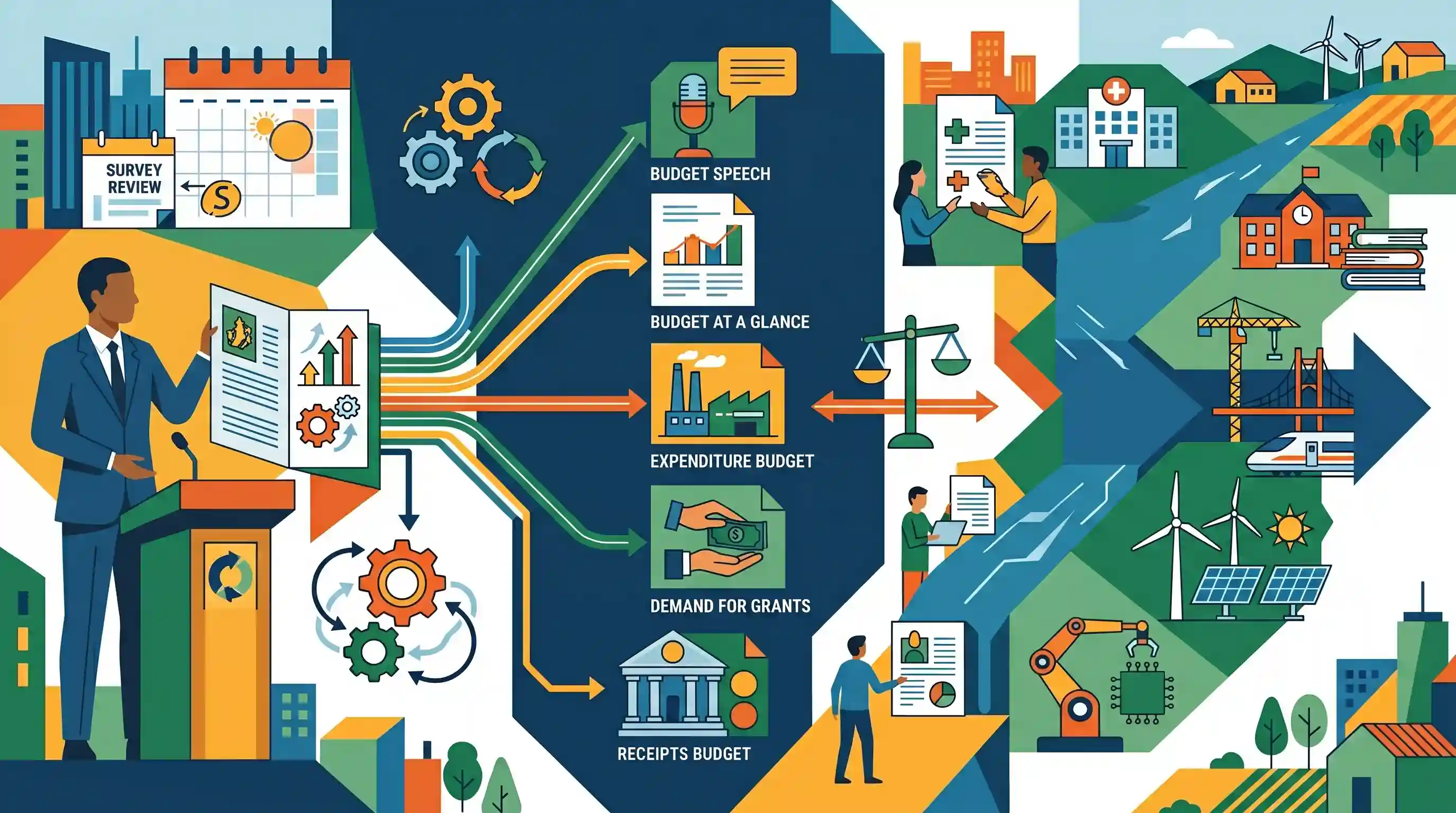
Union Finance Minister Nirmala Sitharaman presented her ninth consecutive Union Budget for 2026-27 on Sunday, February 1, 2026, marking the first time the budget has been presented on a Sunday in Indian history. The Economic Survey for 2025-26 was tabled beforehand on January 29, 2026. The release provides public access to all vital statutory budget documents including the Budget Speech, Budget at a Glance, Expenditure Budget, Demand for Grants, and Receipts Budget, which are crucial for assessing the government's fiscal trajectory and developmental priorities.
Key Points
- The Union Budget 2026-27 was presented by Finance Minister Nirmala Sitharaman on February 1, 2026.
- This marked her ninth consecutive budget and the first time in Indian history that a Union Budget was presented on a Sunday.
- The article serves as a central repository for key budget documents, including the Budget Speech, Budget at a Glance, Demand for Grants, and Receipts/Expenditure budgets.
- The Economic Survey 2025-26 was tabled earlier on January 29, 2026, establishing the macroeconomic backdrop for the budget.
Important Terms
Union Budget (Annual Financial Statement)

Known constitutionally as the Annual Financial Statement (Article 112), it outlines the government's estimated receipts and expenditures for the upcoming fiscal year (April 1 to March 31).
UPSC context
GS Paper III: Government Budgeting. Essential for understanding fiscal policy, resource mobilization, and constitutional requirements (Articles 112-117).
Economic Survey
The Ministry of Finance's flagship annual document, prepared by the Chief Economic Advisor, reviewing the economy's performance over the previous year and providing a macroeconomic outlook.
UPSC context
GS Paper III: Indian Economy. Provides authoritative data for mains answers on GDP growth, inflation, and sectoral performance.
Demand for Grants
Formal requests for funds made by various ministries to the Lok Sabha (Article 113). They represent the estimated expenditure required to be voted on by Parliament.
UPSC context
GS Paper II: Parliament. Tests knowledge of parliamentary control over finances and the difference between voted and charged expenditure.
Fiscal Deficit
The difference between the government's total expenditure and its total non-debt receipts (revenue plus non-debt capital receipts), indicating the total borrowing required for the year.
UPSC context
GS Paper III: Indian Economy. A key indicator of fiscal health and the government's adherence to the FRBM Act.
Finance Bill
A Money Bill (Article 110) introduced alongside the budget to give legal effect to the government's taxation proposals and other financial changes for the next year.
UPSC context
GS Paper II: Polity. Crucial for understanding the legislative process of enacting tax laws and the definition of Money Bills.
Expenditure Budget
A budget document that details the total spending of various ministries, distinguishing between revenue expenditure (salaries, subsidies) and capital expenditure (asset creation).
UPSC context
GS Paper III: Public Finance. Analyzes government priorities between consumption-led spending (revenue) and investment-led growth (capital).
Prelims Trap
"The Macro-Economic Framework Statement is presented alongside the Budget as mandated by Article 112 of the Constitution."
This statement is mandated by the statutory FRBM Act of 2003, not the Constitution. Article 112 only mandates the presentation of the Annual Financial Statement.
Static Concepts Connected
Which budget documents are mandated by the Constitution versus the FRBM Act?
- Constitutional Mandate: Article 112 requires the Annual Financial Statement, Article 113 requires Demands for Grants, and Article 110/114 govern Finance and Appropriation Bills.
- Statutory Mandate: The Fiscal Responsibility and Budget Management (FRBM) Act, 2003 requires the Macro-Economic Framework, Medium-Term Fiscal Policy, and Fiscal Policy Strategy Statements.
How does the Indian Constitution structurally classify government expenditure?
- Revenue vs Capital: Article 112(2) explicitly mandates that the Annual Financial Statement must distinguish expenditure on revenue account from other (capital) expenditures.
- Economic Implications: Revenue expenditure encompasses recurring, non-asset-creating expenses (like interest payments and salaries), while capital expenditure focuses on asset creation or liability reduction.
Cross-Topic Patterns
DRSCs and the Demands for Grants
Following the budget presentation, Parliament enters a recess where 24 Departmentally Related Standing Committees scrutinize the Demands for Grants of individual ministries before final voting.
Economic Survey and CEA's Role
The Economic Survey acts as the macroeconomic foundation for the Budget. It is drafted by the DEA's Economics Division under the guidance of the Chief Economic Adviser.

Expect a multi-statement prelims question asking you to map specific Budget documents to either their Constitutional or FRBM Act origins.
Linked PYQs · 4
Linked PYQs · 4
- 2024PrelimsGS1
With reference to Union Budget, consider the following statements : 1. The Union Finance Minister on behalf of the Prime Minister lays the Annual Financial Statement before both the Houses of Parliament. 2. At the Union level, no demand for a grant can be made except on the recommendation of the President of India. Which of the statements given above is/are correct?
- 2025PrelimsGS1
Suppose the revenue expenditure is ₹ 80,000 crores and the revenue receipts of the Government are ₹60,000 crores. The Government budget also shows borrowings of ₹ 10,000 crores and interest payments of ₹ 6,000 crores. Which of the following statements are correct? I. Revenue deficit is ₹ 20,000 crores. II. Fiscal deficit is ₹ 10,000 crores. III. Primary deficit is ₹ 4,000 crores. Select the correct answer using the code given below.
- 2025PrelimsGS1
A country's fiscal deficit stands at ₹50,000 crores. It is receiving ₹10,000 crores through non-debt creating capital receipts. The country's interest liabilities are ₹1,500 crores. What is the gross primary deficit?
- 2019MainsGS3
The public expenditure management is a challenge to the Government of India in the context of budget making during the post-liberalization period. Clarify it.
