Union Budget Allocates Rs 20000 Crore for CCUS Technology
Source:Indian Express ↗
Why It Matters
CCUS was explicitly asked in the 2025 UPSC Mains (GS3). Understanding the mechanics, economic challenges, and policy push behind carbon sequestration is crucial for answering questions on climate change mitigation, India's net-zero targets, and the transition of hard-to-abate industries.
Summary
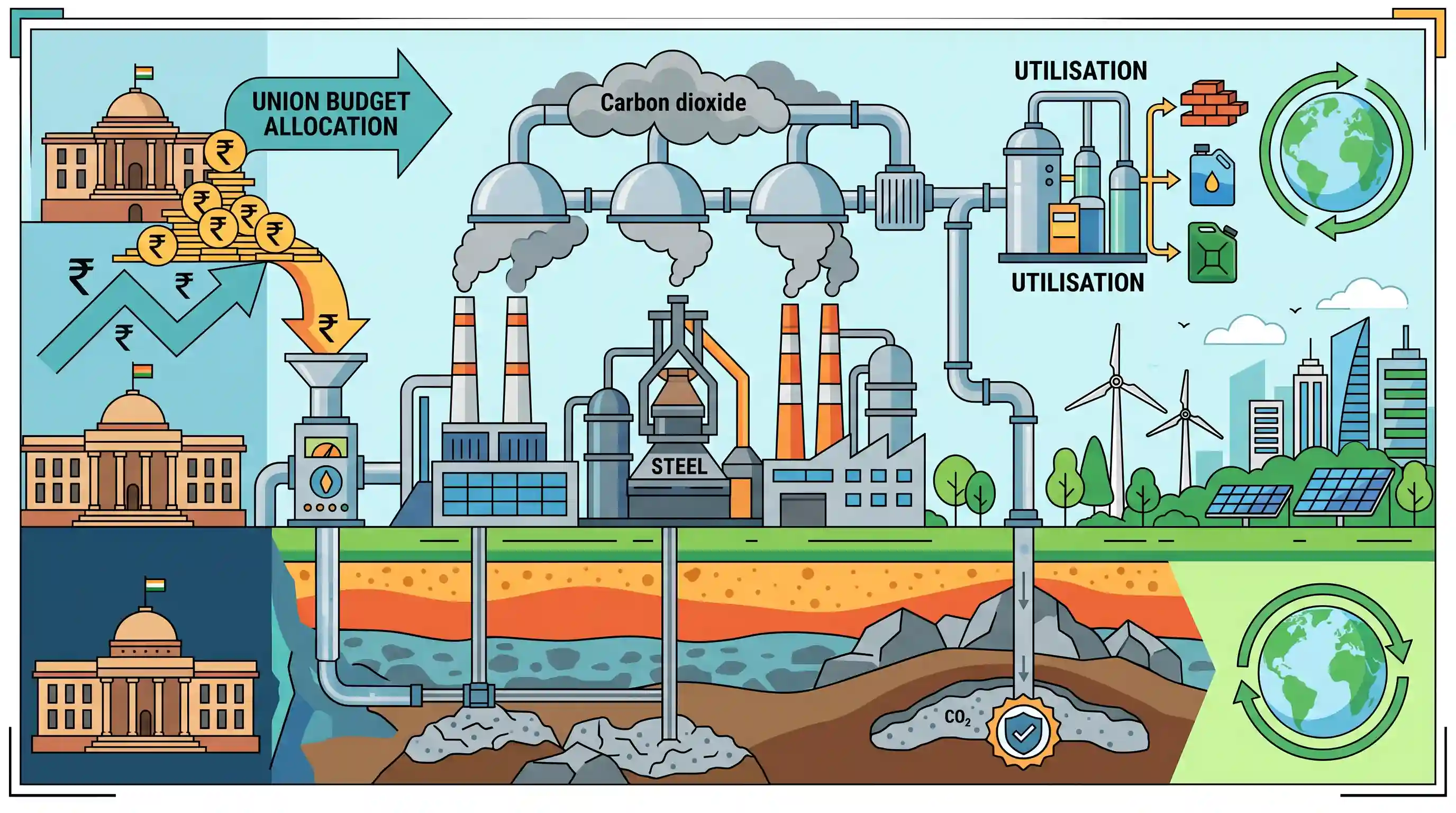
The Union Budget has announced a significant ₹20,000 crore allocation for Carbon Capture, Utilisation, and Storage (CCUS) technologies to accelerate India's transition towards its net-zero emissions target by 2070. CCUS works by trapping carbon dioxide at large emission sources, such as thermal power plants and heavy industries, and either repurposing the carbon for industrial use or storing it permanently in geological formations. This major financial push acknowledges that while renewable energy is growing, decarbonizing "hard-to-abate" sectors like steel and cement requires robust CCUS infrastructure to balance India's economic growth with its global climate commitments.
Key Points
- The Union Budget allocated ₹20,000 crore to promote the development and deployment of Carbon Capture, Utilisation, and Storage (CCUS) technologies in India.
- CCUS involves capturing carbon dioxide emissions directly from industrial sources, transporting it, and either utilizing it to create products (like chemicals and building materials) or securely storing it deep underground (sequestration).
- The technology is deemed essential for decarbonizing 'hard-to-abate' heavy industries such as steel, cement, and petrochemicals, which lack viable green alternatives at scale.
- The budgetary push aims to offset the high capital and operational costs of CCUS, making it commercially viable while allowing India to meet its 2070 net-zero emission goals despite continued reliance on fossil fuels.
Important Terms
Carbon Capture, Utilisation, and Storage (CCUS)

A suite of technologies that captures carbon dioxide (CO2) from industrial sources and either reuses it or stores it permanently underground to prevent its release into the atmosphere.
UPSC context
GS Paper III: Environmental Conservation & Tech. Tests knowledge of emerging decarbonization tools for achieving climate targets.
Net Zero by 2070
India's commitment to balance total greenhouse gas emissions with carbon removals from the atmosphere by the year 2070, announced at the COP26 summit in Glasgow.
UPSC context
GS Paper III: Climate Change. Central to India's long-term environmental strategy and international climate negotiations.
Panchamrit
A five-point action plan announced by India at COP26 (2021) focusing on renewable capacity, carbon intensity reduction, and net-zero targets to combat climate change.
UPSC context
GS Paper III: Environment. Fundamental framework for India's updated climate pledges and sustainable development roadmap.
Hard-to-Abate Sectors
Industries such as steel, cement, refineries, and chemicals where emissions are difficult to eliminate using renewable energy alone, often requiring CCUS or green hydrogen.
UPSC context
GS Paper III: Industrial Growth & Environment. Focuses on the technological challenges of decarbonizing key manufacturing sectors.
Paris Agreement
A legally binding 2015 international treaty where nations commit to limiting global warming to well below 2°C (preferably 1.5°C) through self-defined climate targets.
UPSC context
GS Paper III: International Treaties. The primary global governing framework for climate action and reporting.
Nationally Determined Contributions (NDCs)
Self-defined climate action plans submitted by countries under the Paris Agreement, outlining their targets for emission reductions and adaptation every five years.
UPSC context
GS Paper III: Environment. Tests understanding of the bottom-up mechanism for global climate accountability and India's specific pledges.
Prelims Trap
Carbon Capture and Storage (CCS) technology primarily captures carbon dioxide directly from the ambient atmosphere.
Standard CCUS targets concentrated point sources (smokestacks). Extracting CO2 from ambient air is specifically called Direct Air Capture (DAC), which is distinct and highly energy-intensive.
Static Concepts Connected
What are the primary geological formations used for long-term carbon sequestration?
- Depleted oil/gas fields: Captured CO2 is injected into mature or depleted fields, often used simultaneously for Enhanced Oil Recovery (EOR).
- Saline aquifers: Deep, porous rock formations containing unusable, highly saline water offer massive, long-term storage capacity for compressed CO2.
- Unmineable coal seams: CO2 binds physically to the coal surface, displacing trapped methane which can be harvested (Enhanced Coal Bed Methane recovery).
- Basalt rock formations: CO2 injected into basalt reacts with magnesium and calcium rich minerals to form stable carbonate rocks, permanently mineralizing the carbon.
Why are sectors like cement and steel classified as "hard-to-abate" in climate mitigation?
- Inherent process emissions: A massive share of emissions comes from unavoidable chemical reactions (e.g., calcination of limestone to make clinker), not just burning fossil fuels.
- High-heat requirements: These industries require extreme, sustained temperatures that are currently unachievable or economically unviable using electricity alone.
- Lack of green substitutes: Viable, scalable green alternatives (like widespread green hydrogen use in steel) are still in early commercial stages.
Cross-Topic Patterns
CCUS integration with the Circular Economy
Utilizing captured carbon to manufacture green urea, synthetic aviation fuels (e-fuels), and bio-plastics directly links climate mitigation to India's circular economy and import substitution goals.
CCUS as a tool for Just Transition
Massive CCUS funding justifies India's UNFCCC stance to 'phase-down' rather than 'phase-out' coal, protecting domestic energy security while credibly chasing the Net-Zero 2070 target.

Expect a 2026 Prelims multi-statement question differentiating point-source CCUS from Direct Air Capture (DAC) and natural carbon sinks.
Linked PYQs · 4
Linked PYQs · 4
- 2025MainsGS3
What is Carbon Capture, Utilization and Storage (CCUS)? What is the potential role of CCUS in tackling climate change?
- 2023PrelimsGS1
Consider the following activities: 1. Spreading finely ground basalt rock on farmlands extensively 2. Increasing the alkalinity of oceans by adding lime 3. Capturing carbon dioxide released by various industries and pumping it into abandoned subterranean mines in the form of carbonated waters How many of the above activities are often considered and discussed for carbon capture and sequestration?
- 2025PrelimsGS1
With reference to 'Direct Air Capture', an emerging technology, which of the following statements is/are correct? I. It can be used as a way of carbon sequestration. II. It can be a valuable approach for plastic production and in food processing. III. In aviation, it can be a source of carbon for combining with hydrogen to create synthetic low-carbon fuel. Select the correct answer using the code given below.
- 2025MainsGS3
Write a review on India's climate commitments under the Paris Agreement (2015) and mention how these have been further strengthened in COP26 (2021). In this direction, how has the first Nationally Determined Contribution intended by India been updated in 2022?
