Agricultural Extension Services and Lab to Land Framework
Source:The Hindu ↗
Why It Matters
Highlights a critical shift in India's agricultural policy towards stronger extension services ('Lab to Land') and improved market interventions to secure remunerative prices, both of which are central themes in GS3 Mains covering agriculture, technology missions, and farmer incomes.
Summary
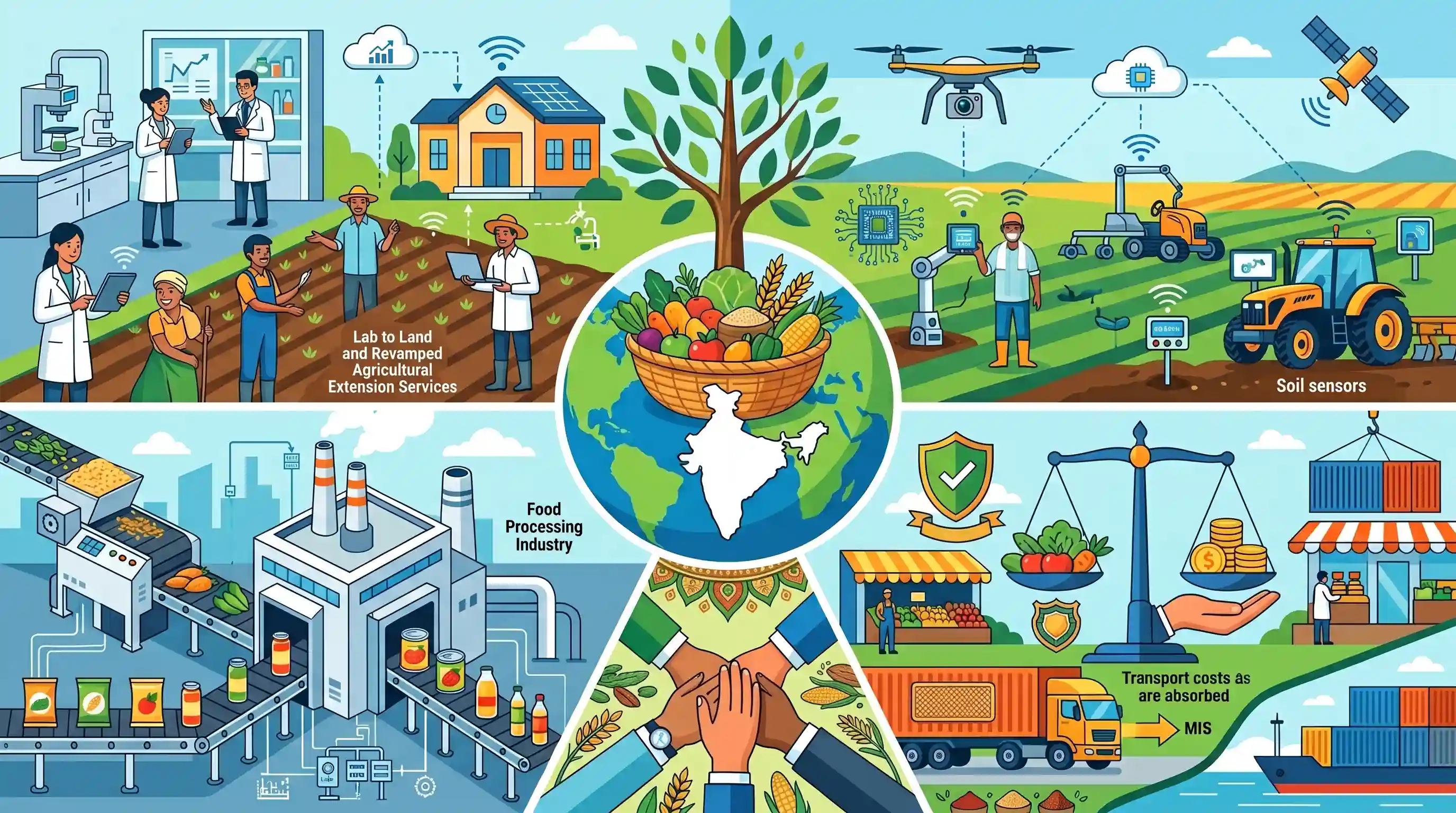
Union Agriculture Minister Shivraj Singh Chouhan has announced the Centre's objective to transform India into the 'food basket of the world' under the newly launched 'Viksit Krishi Sankalp Abhiyan'. Speaking at the ICAR-IIHR campus in Bengaluru, he outlined several initiatives to bridge the gap between agricultural research and farming practices. Central to this is the 'Lab to Land' initiative, which mandates over 16,000 scientists to interact directly with farmers to develop problem-oriented, localized solutions. Emphasizing a 'One Nation, One Agriculture, One Team' approach, the government aims to revamp extension services (like KVKs) to boost productivity. Furthermore, to address pricing challenges, the Centre will absorb transportation costs under the Market Intervention Scheme (MIS) to ensure farmers receive fair prices for their produce.
Key Points
- The Centre launched the 'Viksit Krishi Sankalp Abhiyan' to align the agricultural sector with the vision of making India a developed nation ('Viksit Bharat') by 2047.
- Under a new 'Lab to Land' initiative, over 16,000 agricultural scientists will directly engage with farmers to ensure research is need-based and problem-oriented.
- The government is promoting a 'One Nation, One Agriculture, One Team' approach to strengthen agricultural extension services.
- To ensure fair prices for agricultural produce, the Centre announced it will bear the transportation costs under the Market Intervention Scheme (MIS).
- The overarching goal of these reforms is to boost farmer incomes and transform India into the 'food basket of the world' through enhanced production and exports.
Important Terms
Viksit Krishi Sankalp Abhiyan

A nationwide outreach campaign launched to modernize Indian agriculture by connecting scientists directly with farmers to promote high-yield seeds, natural farming, and climate-resilient practices.
UPSC context
GS Paper III: Government policies for agricultural productivity and the vision for 'Viksit Bharat' by 2047.
Market Intervention Scheme (MIS)
A price support mechanism for perishable and horticultural crops not covered under Minimum Support Price (MSP), triggered during market gluts to prevent distress sales by farmers.
UPSC context
GS Paper III: Issues related to direct and indirect farm subsidies and minimum support prices.
Lab to Land initiative
An ICAR initiative focused on bridging the gap between scientific research (laboratories) and practical farming (fields) by involving scientists in direct farmer training and technology transfer.
UPSC context
GS Paper III: Agricultural extension services and e-technology in the aid of farmers.
Krishi Vigyan Kendras (KVKs)
District-level 'Farm Science Centres' established by ICAR to provide vocational training, conduct on-farm testing, and disseminate agricultural technology to the farming community.
UPSC context
GS Paper III: Institutional framework for agricultural extension and rural development.
Indian Council of Agricultural Research (ICAR)
The apex autonomous body under the Ministry of Agriculture responsible for coordinating, guiding, and managing research and education in agriculture, horticulture, fisheries, and animal sciences.
UPSC context
GS Paper III: Role of premier institutions in food security and the Green Revolution.
Prelims Trap
The Centre procures unlimited quantities of perishable crops under the Market Intervention Scheme to halt distress sales.
MIS procurement is not open-ended. It is strictly capped at 25% of total crop production and is only activated when prices drop by 10%.
Static Concepts Connected
What are the operational guidelines of the Market Intervention Scheme (MIS)?
- Coverage: Applies specifically to perishable and horticultural commodities that are not covered under the Minimum Support Price (MSP) system.
- Activation trigger: Initiated upon State requests when there is at least a 10% fall in market prices compared to the previous normal year.
- Cost sharing: Losses incurred during procurement are shared 50:50 between the Centre and the State government (75:25 for Northeastern States).
How do Krishi Vigyan Kendras (KVKs) function within India's agricultural framework?
- Funding mechanism: They are 100% centrally sponsored institutions operating under the Indian Council of Agricultural Research (ICAR).
- Core mandate: Focuses on frontline agricultural extension, on-farm technology testing, and vocational training for farmers and extension personnel.
Cross-Topic Patterns
Agri-Extension & Cooperative Federalism
The "One Nation, One Agriculture, One Team" strategy seeks to synchronize Central (ICAR), State, and local (KVK) bodies, addressing chronic fragmented delivery in grassroots agricultural extension services.
Perishables: Pricing + Logistics
Absorbing transportation costs under MIS addresses the logistical bottleneck of moving perishables from surplus states to consuming zones, heavily overlapping with the objectives of Operation Greens.

Expect a comparative Prelims question linking MIS operational criteria (perishables, 25% procurement cap, 10% price drop) with MSP.
Linked PYQs · 4
Linked PYQs · 4
- 2023MainsGS3
How does e-Technology help farmers in production and marketing of agricultural produce? Explain it.
- 2020MainsGS3
What are the challenges and opportunities of food processing sector in the country? How can income of the farmers be substantially increased by encouraging food processing?
- 2022MainsGS3
Elaborate the scope and significance of the food processing industry in India.
- 2017MainsGS3
How do subsidies affect the cropping pattern, crop diversity and economy of farmers? What is the significance of crop insurance, minimum support price and food processing for small and marginal farmers?
