BRICS agricultural ministerial meeting focus on food security
Source:The Hindu ↗
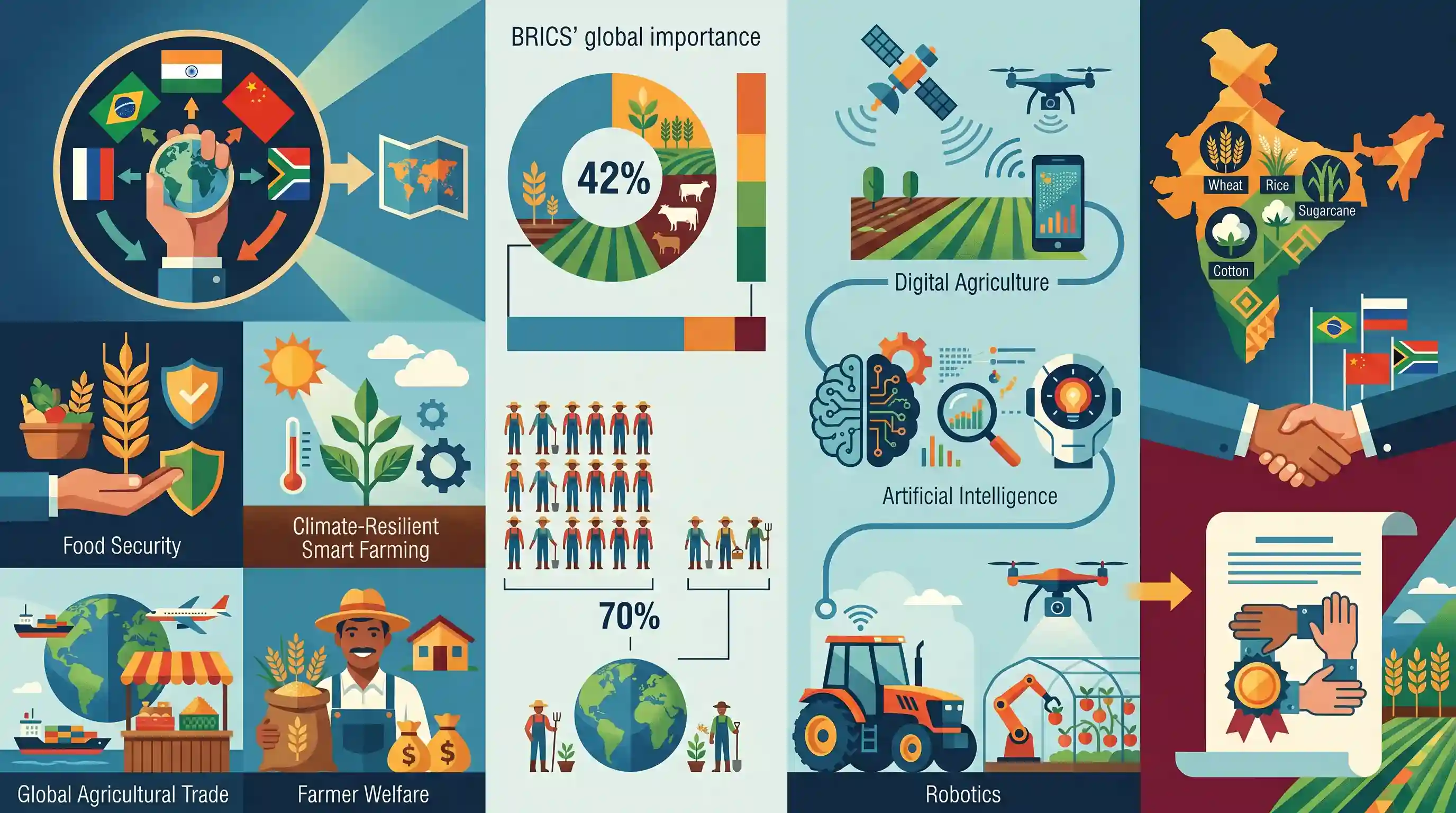
Why It Matters
BRICS nations represent 42% of global agricultural resources and output, making their cooperation in digital and climate-resilient agriculture vital for addressing global food security and protecting small-scale cultivators.
Summary
Union Agriculture Minister Shivraj Singh Chouhan announced a five-day BRICS meeting in Indore focused on food security, climate-resilient smart farming, global agricultural trade, and farmer welfare. The event highlights the strategic importance of BRICS in global agriculture, as member nations account for 42% of global agricultural land and output, and are home to 70% of the world's small cultivators. Discussions will also cover digital agriculture, artificial intelligence, robotics, and international supply chains, culminating in a joint declaration.
Key Points
- A five-day BRICS agriculture meeting commenced in Indore to deliberate on food security, smart farming, global agricultural trade, and farmer welfare.
- Key discussion areas include climate-resilient agriculture, digital agriculture, knowledge exchange, artificial intelligence, robotics, and international supply chains.
- BRICS countries account for 42% of global agricultural land and produce, housing half the world's population.
- An estimated 70% of the world's small-scale cultivators live in BRICS nations, making the grouping's policies critical for global farmer welfare.
- The conference is expected to culminate in a joint declaration by the Agriculture Ministers of the 11 member nations.
Important Terms
BRICS

An informal group of major emerging economies—Brazil, Russia, India, China, and South Africa—recently expanded to include nations like Egypt, Ethiopia, Iran, and UAE to represent the Global South.
UPSC context
GS Paper 2: Bilateral, regional, and global groupings involving India; critical for understanding multipolar world order and South-South cooperation.
Food Security
Ensuring all people have physical, social, and economic access to sufficient, safe, and nutritious food at all times, based on pillars of availability, accessibility, utilization, and stability.
UPSC context
GS Paper 3: Issues related to direct and indirect farm subsidies and PDS; essential for questions on poverty, hunger, and NFSA 2013.
Climate-Resilient Agriculture (CRA)
Farming practices that increase productivity, build resilience to climate shocks (like droughts or floods), and reduce greenhouse gas emissions through technology, better seeds, and water management.
UPSC context
GS Paper 3: Agriculture and Environment; tests knowledge on sustainable development, NICRA, and adaptation strategies against climate change.
Digital Agriculture
The use of modern Information and Communication Technologies (ICT) like AI, IoT, drones, and robotics to optimize farm operations, improve decision-making, and enhance productivity.
UPSC context
GS Paper 3: E-technology in the aid of farmers; relevant for the Digital Agriculture Mission and AgriStack initiatives.
Smallholders
Farmers who manage small plots of land (typically <2 hectares), making up 70% of the cultivators in BRICS nations and facing high vulnerability to climate and economic shocks.
UPSC context
GS Paper 3: Land reforms and issues related to agriculture; focuses on inclusive growth and farmer welfare policies.
Prelims Trap
The BRICS Agriculture Research Platform is a UN-FAO initiative to support global smallholder farmers.
The platform was proposed and developed specifically by India to facilitate agricultural science cooperation and tech transfer among BRICS nations, independent of UN bodies like the FAO.
Static Concepts Connected
What is the BRICS Agriculture Research Platform (BARP)?
- Indian Initiative: Proposed by India during the 2016 Goa Summit to promote agricultural cooperation among member states.
- Tech Transfer: Acts as a central mechanism for exchanging agricultural science, capacity building, and climate-smart technologies.
- Focus Demographic: Heavily targets improving the livelihood and productivity of smallholder farmers across member nations.
What are the core components of Climate-Resilient Agriculture (CRA)?
- Tolerant Varieties: Adoption of crop varieties resistant to abiotic stresses like drought, flood, and extreme heat.
- Resource Conservation: Zero-tillage, residue management, and precision water application (micro-irrigation) to lower environmental impact.
- Institutional Support: Initiatives like ICAR's National Innovations in Climate Resilient Agriculture (NICRA) drive CRA across vulnerable districts.
Cross-Topic Patterns
BRICS Expansion & Food Diplomacy
Adding major emerging economies shifts BRICS from a purely geopolitical bloc to a critical player in global food supply chains and Global South food security.
Precision Agriculture & E-Tech
The focus on AI and robotics in farming connects to UPSC's frequent testing of drone rules, AgriStack, and digital public infrastructure in agriculture.

Expect a multi-statement question linking BRICS expansion with the India-led BRICS Agriculture Research Platform and climate resilience.
Linked PYQs · 2
Linked PYQs · 2
- 2012MainsGS2
Compare the significance of IBSA and BRICS in the context of India's multilateral diplomacy.
- 2023MainsGS3
How does e-Technology help farmers in production and marketing of agricultural produce? Explain it.
