Madhya Pradesh Uniform Civil Code Bill Proposal and Tribal Exemption
Source:indiatoday ↗
Why It Matters
The legislative move to implement a state-specific Uniform Civil Code in Madhya Pradesh highlights the growing policy shift toward standardizing civil laws at the sub-national level in India. This carries significant implications for cooperative federalism, constitutional law (specifically Article 44 under Directive Principles of State Policy), and personal family laws of diverse religious and tribal communities.
Summary
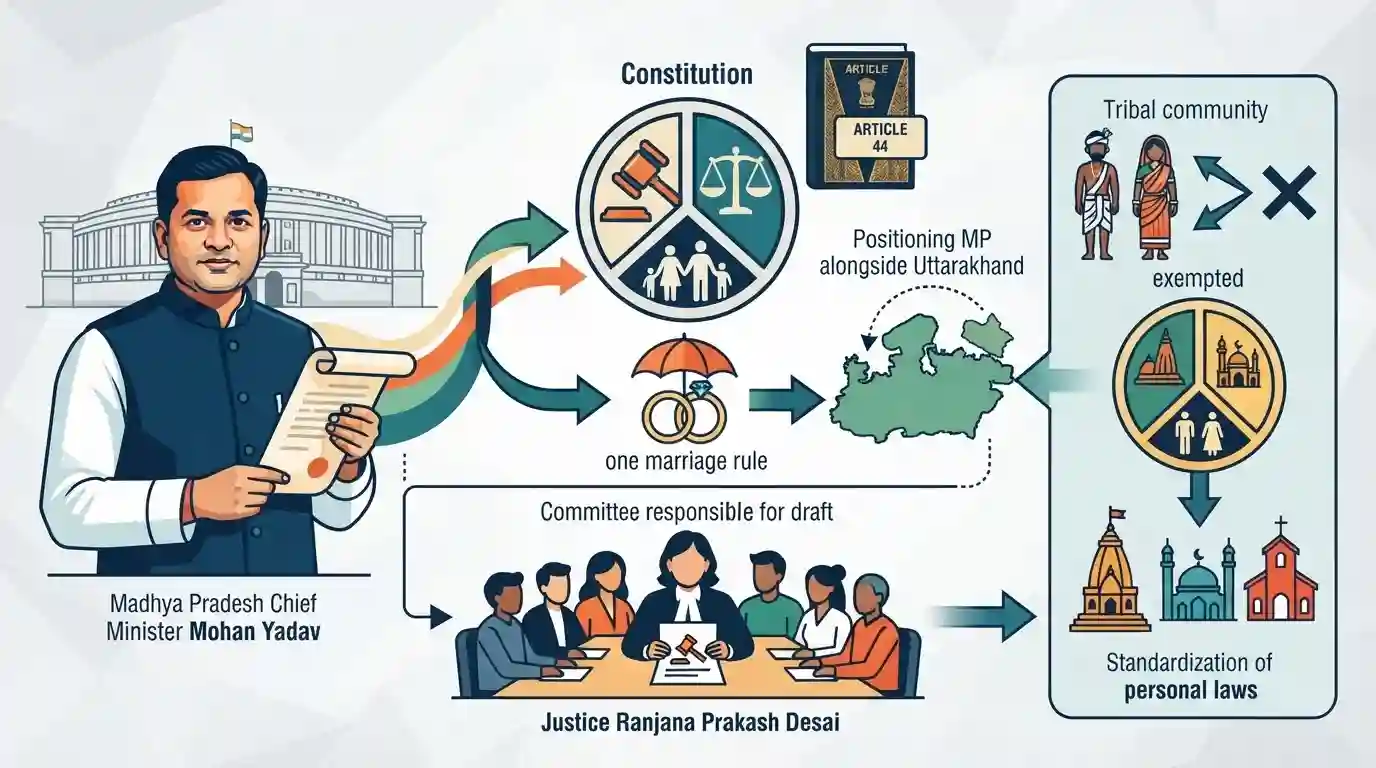
Madhya Pradesh Chief Minister Mohan Yadav announced plans to introduce a Uniform Civil Code (UCC) Bill in the state's legislative assembly during the upcoming Monsoon Session. The bill, emphasizing a 'one marriage' rule, is based on a draft prepared by a committee headed by former Supreme Court judge Justice Ranjana Prakash Desai. The draft recommends exempting tribal communities, and the move seeks to position Madhya Pradesh alongside Uttarakhand in standardizing civil and personal laws across state lines.
Key Points
- Madhya Pradesh Chief Minister Mohan Yadav pitched for the Uniform Civil Code (UCC) bill, emphasizing a 'one marriage' rule in the state.
- The CM stated that under the proposed UCC, 'only those who marry once' would have the legal right to live in Madhya Pradesh.
- The draft UCC Bill is anticipated to be introduced during the upcoming Monsoon Session of the Madhya Pradesh Assembly, starting July 20, 2026.
- A high-level committee chaired by retired Supreme Court Judge Justice Ranjana Prakash Desai conducted public consultations and formulated the draft report, recommending exemptions for tribal communities.
- This move follows Uttarakhand, which became the first state in post-independence India to pass a UCC bill in February 2024, with other BJP-ruled states like Gujarat and Assam also initiating steps towards it.
Important Terms
Uniform Civil Code (UCC) Bill

A proposed state legislation in Madhya Pradesh aiming to establish a common set of civil laws for marriage, divorce, and inheritance across religions, notably featuring a strict 'one marriage' rule.
UPSC context
GS Paper 2 (Polity); tests the constitutional validity of states enacting UCCs under the Concurrent List.
Article 44 of the Indian Constitution
A Directive Principle of State Policy in Part IV of the Constitution stating that the State shall endeavor to secure a Uniform Civil Code for all citizens throughout India.
UPSC context
Core GS Paper 2 topic; tests the significance of DPSPs, constitutional integration goals, and the role of the State.
Justice Ranjana Prakash Desai Committee
A high-level committee chaired by a retired Supreme Court Justice, responsible for studying existing personal laws and drafting the legal framework for the Uniform Civil Code in Madhya Pradesh.
UPSC context
GS Paper 2 (Governance); serves as an important current affairs example of state-level expert panels driving legal reform.
Personal Laws in India
Laws governing family and civil matters—such as marriage, divorce, succession, and adoption—that currently vary based on an individual's specific religion, customs, or community traditions.
UPSC context
GS Paper 1 (Society) & GS 2 (Social Justice); tests the impact of legal frameworks on gender equality and secularism.
Madhya Pradesh State Legislative Assembly
The unicameral state legislature of Madhya Pradesh. It holds the constitutional authority to debate and pass state-level laws, including the proposed Uniform Civil Code, utilizing the Concurrent List.
UPSC context
GS Paper 2 (Polity); tests understanding of state legislative powers, the law-making process, and federalism dynamics.
Prelims Trap
The power to enact a Uniform Civil Code belongs exclusively to the Parliament to ensure uniformity.
Personal laws (marriage, divorce, succession) are under Entry 5 of the Concurrent List. State legislatures have the constitutional competence to enact a state-level UCC.
Static Concepts Connected
How do State legislatures have the constitutional power to enact a Uniform Civil Code?
- Concurrent List: Entry 5 of List III (Concurrent List) covers marriage, divorce, succession, adoption, and wills, explicitly allowing states to legislate on personal laws.
- Article 254(2): If a state UCC conflicts with existing Central personal laws (like Hindu Marriage Act), it requires the President's assent to be applicable within that state.
What are the constitutional grounds for exempting Scheduled Tribes from the UCC?
- Cultural Protection: Article 29 protects the fundamental right of minorities and distinct groups to conserve their distinct culture, language, and script, including customary laws.
- Scheduled Areas: Under the 5th and 6th Schedules, laws affecting the customary social practices of tribal communities can be restricted or modified by Governors and Autonomous Councils.
Cross-Topic Patterns
UCC vs Tribal Autonomy
Exempting tribal communities from State UCCs bridges the debate between Article 44's push for uniformity and the PESA Act / 5th Schedule's mandate to preserve tribal customary laws.
Goa Civil Code distinction
While Uttarakhand and MP are actively legislating new codes via the Concurrent List, Goa's Uniform Civil Code is historically continuous, retained from the Portuguese Civil Code of 1867.

Prelims 2026 will likely test the exact Concurrent List entry for personal laws and state UCC validity via Article 254(2) Presidential assent.
Linked PYQs · 1
Linked PYQs · 1
- 2023MPPSC_PRELIMSGS1
The Directive Principles of State Policy are explained in Part IV of the Indian Constitution. This system has been taken from the Constitution of which country ?
