Morbi Well Waves Attributed to Rapid Groundwater Recharge
Source:the-print ↗
આ શા માટે મહત્વનું છે
Understanding local hydrogeological and geological phenomena is crucial for geography and disaster management, distinguishing between benign groundwater recharge events and actual seismic activity in seismically active regions like Gujarat.
સારાંશ
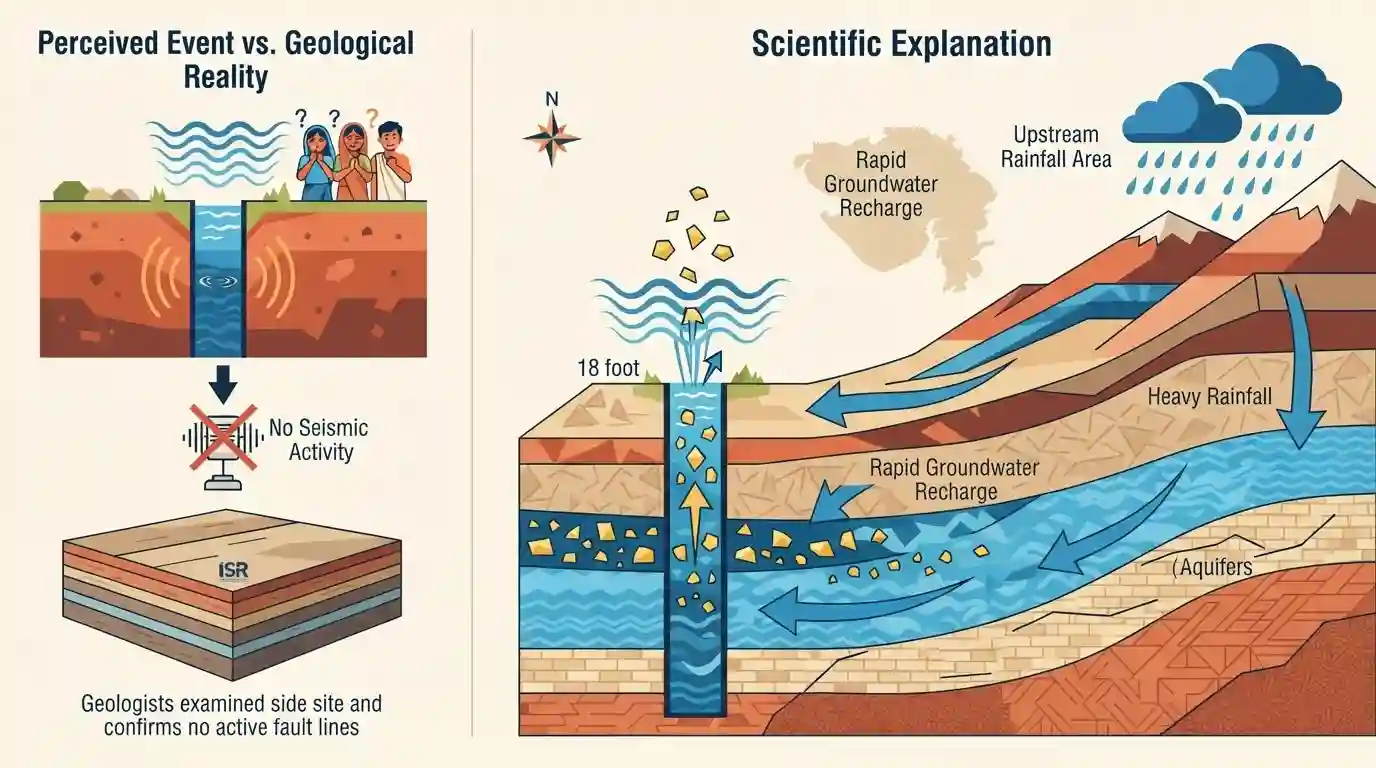
Unexplained rhythmic waves in an 18-foot-deep well in Gujarat's Morbi district caused panic among locals who suspected an earthquake. However, geologists and experts from the Institute of Seismological Research (ISR) in Gandhinagar ruled out seismic activity, confirming no active fault lines in the area. The phenomenon was explained as a hydrogeological event: heavy upstream rainfall led to rapid groundwater recharge. The sudden influx of water into underground aquifers displaced air trapped in the pore spaces of rocks, which was released forcefully through the well, creating the rhythmic waves.
મુખ્ય મુદ્દા
- Unexplained rhythmic waves were observed in an 18-foot-deep well in Gujarat's Morbi district, initially leading locals to suspect seismic activity.
- Experts from the Institute of Seismological Research (ISR) confirmed that there are no active fault lines near the village, ruling out an earthquake.
- Geologists attribute the phenomenon to rapid groundwater recharge caused by heavy upstream rainfall.
- The sudden influx of water into aquifers forced air trapped in the pore spaces of rocks to release forcefully, creating the waves.
મહત્વપૂર્ણ શબ્દો
Institute of Seismological Research (ISR)

A premier research institute under the Science and Technology Department of Gujarat, dedicated exclusively to seismological studies, earthquake monitoring, and seismic hazard assessment.
UPSC context
GS Paper 3 (Science & Technology/Disaster Management) and GS Paper 1 (Geography). Tests institutional roles in disaster mitigation.
Groundwater Recharge
The natural or artificial process by which water from precipitation, surface runoff, or recharge structures infiltrates the ground to replenish underground aquifers.
UPSC context
GS Paper 1 (Water Resources) and GS Paper 3 (Environment). Tests concepts of sustainable water resource management.
Aquifer
An underground layer of water-bearing permeable rock, gravel, sand, or silt from which groundwater can be usefully extracted.
UPSC context
GS Paper 1 (Physical Geography). Tests fundamental geological and hydrological concepts essential for resource distribution.
Seismology
The scientific study of earthquakes and the propagation of elastic waves through the Earth or other planet-like bodies.
UPSC context
GS Paper 1 (Physical Geography - Geophysical phenomena). Tests physical science behind tectonic activities and disaster hazards.
Hydrogeology
The branch of geology that deals with the distribution and movement of groundwater in the soil and rocks of the Earth’s crust.
UPSC context
GS Paper 1 (Physical Geography). Tests understanding of geological influences on hydrological cycles and water security.
પ્રિલિમ્સ ટ્રેપ
Anomalous well-water fluctuations or bubbling are exclusively indicative of tectonic stress and earthquake precursor activity.
These phenomena frequently occur due to non-seismic hydrogeological factors, such as sudden rainfall forcing trapped pore air out of unsaturated aquifers.
સંલગ્ન સ્થિર ખ્યાલો
How does rapid groundwater recharge affect aquifer pore pressure and trapped air?
- Vadose Zone Displacement: Recharging water fills unsaturated rock pores, displacing and compressing trapped air, which then escapes forcefully through open vents like wells.
- Hydraulic Head Surge: Sudden intense precipitation increases localized hydraulic pressure, pushing water and displaced gases upward with high velocity.
What is India's seismic zoning framework and Gujarat's tectonic status?
- BIS Categorization: India is divided into four seismic zones (Zones II to V), omitting Zone I due to prevailing seismic vulnerability across the subcontinent.
- Kutch Fault System: Gujarat features highly active fault systems putting Kutch in high-risk Zone V, whereas nearby regions like Morbi lie in safer Zone III or IV.
આંતર-વિષય પેટર્ન
Hydro-meteorology and panic management
Misinterpreting localized aquifer recharge as seismic activity underscores the need for real-time scientific communication to prevent public panic during extreme climate events.

Distinction between seismic precursors and hydrogeological anomalies (like aquifer air displacement) likely in 2026 physical geography.
સંલગ્ન PYQ · 1
સંલગ્ન PYQ · 1
- 2025GPSC_PRELIMSGS1
Through which of the following processes is there continuous exchange of water between the atmosphere, oceans and continents? 1. Evaporation 2. Transpiration 3. Condensation 4. Humidity Choose the correct option from the following.
