UNESCO Data Highlights Persistent Gender Gap in STEM Fields
Source:Indian Express ↗
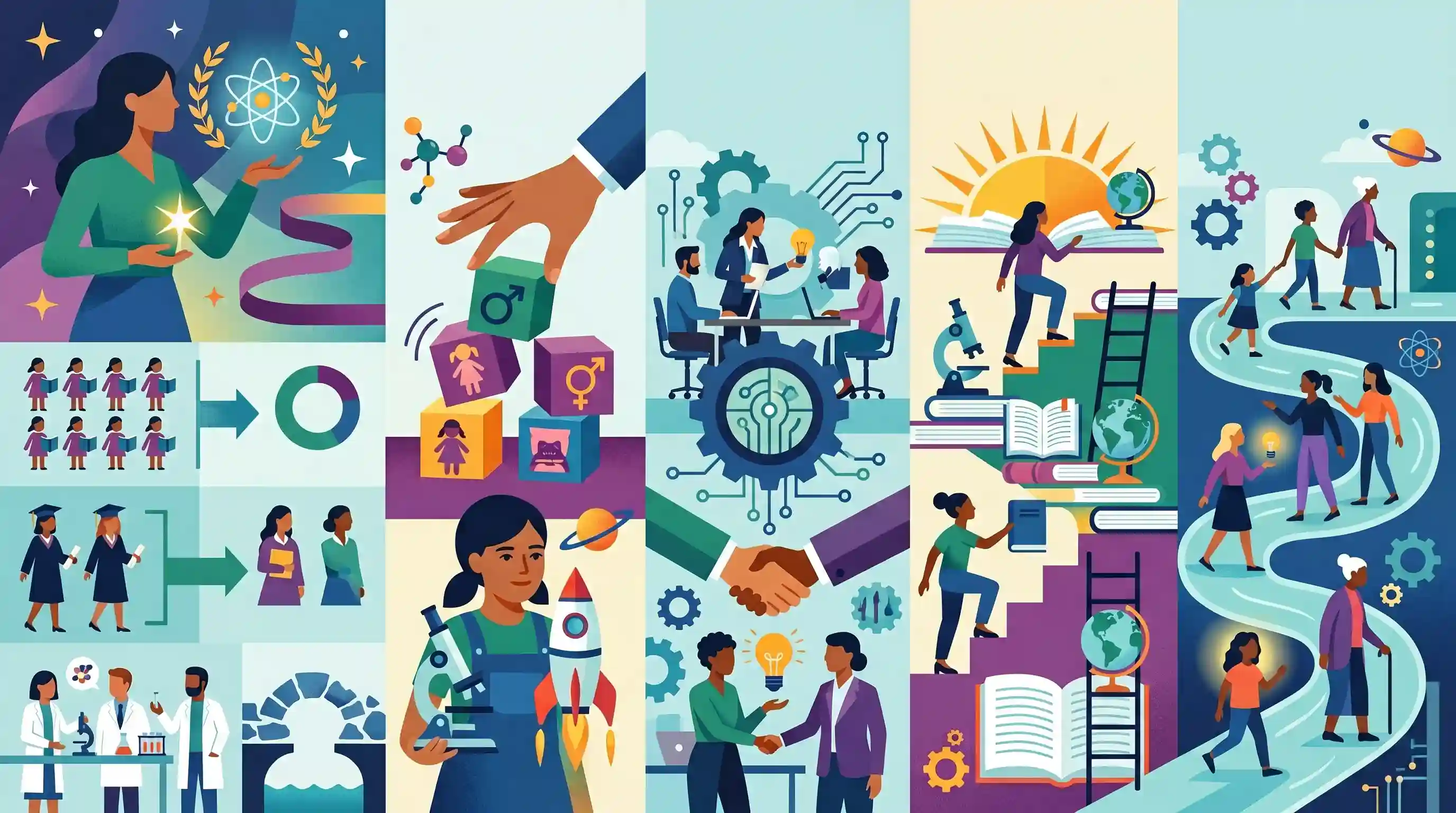
Why It Matters
Highlighting the persistent gender gap in STEM fields sheds light on systemic barriers and emphasizes the need for inclusive policy interventions. It provides vital statistics and institutional examples for GS1, GS2, and Essay answers dealing with gender equity, human resource development, and women's empowerment.
Summary
The article highlights the significance of the International Day of Women and Girls in Science, observed on February 11, with the 2026 theme focusing on redefining STEM by closing the gender gap. Despite women making up 46% of those entering advanced studies globally, UNESCO data shows they only represent 35% of science graduates and one in three scientific researchers. To combat these disparities, particularly the dominance of men in private-sector scientific roles, UNESCO's Call to Action advocates for dismantling gender stereotypes, creating inclusive workplace environments, and expanding educational pathways to ensure equitable participation of women across the STEM pipeline.
Key Points
- The International Day of Women and Girls in Science is observed annually on February 11 to promote equal access and participation in STEM fields.
- The 2026 theme is “From Vision to Impact: Redefining STEM by Closing the Gender Gap,” focusing on scalable solutions and policy interventions.
- UNESCO data reveals that while women make up 46% of advanced studies entrants, they account for only 35% of science graduates and one-third of researchers globally.
- A significant sector imbalance persists, with men dominating scientific roles in the private sector, whereas women are better represented in academia and the public sector.
- UNESCO's Call to Action emphasizes the need to dismantle gender stereotypes, expand educational pathways, and foster inclusive workplace environments to achieve true gender parity in science.
Important Terms
International Day of Women and Girls in Science

Annual observance on February 11, established by the UN General Assembly in 2015, to promote full and equal access to and participation in science for women and girls.
UPSC context
GS Paper I (Social Empowerment) and Paper II (International Bodies); tests knowledge of UN-mandated days and gender-inclusive development goals.
UNESCO Call to Action to Close the Gender Gap in Science
A 2024 initiative urging governments and institutions to dismantle gender stereotypes, create inclusive workplaces, and expand educational pathways to bridge the disparity in scientific representation.
UPSC context
GS Paper II (Social Justice/Education) and GS Paper III (Science & Tech); relevant for discussing global policy frameworks for women in STEM.
STEM
Collective term for Science, Technology, Engineering, and Mathematics. In gender discourse, it highlights fields where women represent only ~35% of graduates despite high overall enrollment in advanced studies.
UPSC context
GS Paper III (Science and Technology); crucial for analyzing human resource development and the 'leaky pipeline' in technical education.
UNESCO
A specialized UN agency that tracks global scientific data and coordinates the International Day of Women and Girls in Science to foster international cooperation and gender parity.
UPSC context
GS Paper II (International Organizations); frequently tested regarding its mandates, reports (e.g., Science Report), and global cultural/scientific initiatives.
UN General Assembly
The principal deliberative and policymaking organ of the United Nations, which adopted Resolution 70/212 to formally recognize the role of women and girls in science.
UPSC context
GS Paper II (International Institutions); fundamental for understanding the legislative process of the UN and international law-making through resolutions.
Gender Gap in STEM
The persistent disparity between men and women in STEM fields, where women represent only 1 in 3 researchers and hold fewer than 25% of private-sector scientific roles.
UPSC context
GS Paper I (Issues related to Women) and GS Paper III; vital for essay topics on economic participation and technological equity.
Prelims Trap
"India's female STEM graduation rate is significantly lower than the global average due to deep-rooted patriarchal barriers."
India actually boasts one of the highest female STEM graduation rates globally (~43%). The real deficit occurs during workforce transition, not in higher education enrollment.
Static Concepts Connected
What are India's key schemes for women in STEM?
- Vigyan Jyoti: Mentors meritorious girls in classes 9-12 to encourage them to pursue higher education in underrepresented STEM fields.
- WISE-KIRAN: Provides opportunities for women scientists and technologists to resume their careers after a break, alongside research grants.
- GATI: Gender Advancement for Transforming Institutions assesses and promotes gender equity across scientific and higher education institutes.
What is the 'Leaky Pipeline' in workforce economics?
- Definition: A metaphor describing the progressive dropout of women at each consecutive stage of educational and professional advancement.
- Causes in STEM: Driven by unpaid care burdens, workplace hostility, lack of mentorship, and structural biases, especially pronounced in private sector R&D.
Cross-Topic Patterns
The FLFPR U-Curve Paradox
The sharp drop from STEM graduation (43%) to employment (14-27%) exemplifies India's broader paradox where higher education doesn't seamlessly translate to higher female labor force participation.
AI Bias & Tech Workforce Demographics
Male dominance in private-sector R&D (highlighted by UNESCO) is frequently cited as a root cause of algorithmic bias in AI, directly linking workforce demographics to emerging tech ethics.

GS-1 or GS-2 Mains will likely test the paradox of India's high female STEM graduation rate versus their low workforce participation.
Linked PYQs · 5
Linked PYQs · 5
- 2024MainsGS1
Distinguish between gender equality, gender equity and women's empowerment. Why is it important to take gender concerns into account in programme design and implementation?
- 2025MainsGS2
Women's social capital complements in advancing empowerment and gender equity. Explain.
- 2023MainsEssay
Girls are weighed down by restrictions, boys with demands – two equally harmful disciplines.
- 2021MainsGS2
Discuss the desirability of greater representation to women in the higher judiciary to ensure diversity, equity and inclusiveness.
- 2022PrelimsGS1
With reference to the United Nations General Assembly, consider the following statements: 1. The UN General Assembly can grant observer status to the non-member States. 2. Inter-governmental organisations can seek observer status in the UN General Assembly. 3. Permanent Observers in the UN General Assembly can maintain missions at the UN headquarters. Which of the statements given above are correct?
