UNESCO Heritage Conservation and Community Participation in Hampi
Source:The Hindu ↗
Why It Matters
This highlights the evolving paradigms in heritage management—moving from rigid administrative preservation toward community-centric governance, which is a key theme for GS1 Art and Culture and essay topics regarding sustainable development and cultural preservation.
Summary
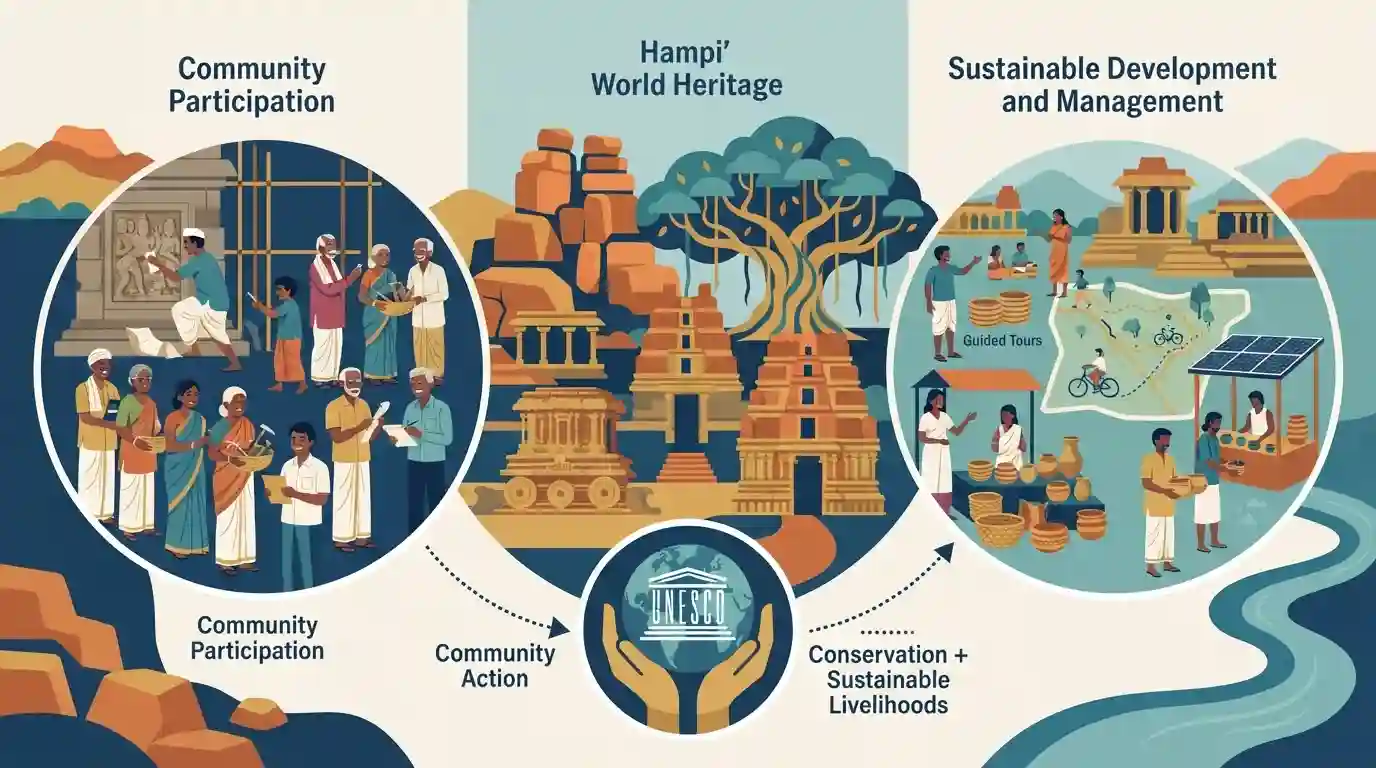
A UNESCO expert committee has recommended bolstering community participation in the conservation and management of the World Heritage site of Hampi, Karnataka, stressing that local stakeholder engagement is vital for balancing heritage preservation with sustainable development.
Key Points
- A UNESCO expert committee reviewing the conservation of the World Heritage site of Hampi has emphasized the critical need for stronger community participation.
- The committee underlined that sustainable heritage management requires involving local residents and stakeholders rather than relying purely on top-down administrative controls.
- Integrating local communities helps balance modern developmental needs with the preservation of historical integrity and archaeological value at Hampi.
Important Terms
UNESCO

A specialized agency of the United Nations promoting international cooperation in education, arts, sciences, and culture, known for designating and monitoring World Heritage Sites globally.
UPSC context
Important for GS Paper I (Art and Culture) and GS Paper III (Environment/Heritage Management), focusing on international conventions and preservation of historical monuments.
UNESCO Expert Committee
A specialized evaluation body deployed by UNESCO to inspect, review, and advise on the conservation status, management frameworks, and sustainable development compliance of designated World Heritage Sites.
UPSC context
Relevant for GS Paper I (Indian Heritage and Culture) regarding international oversight, conservation challenges, and community-centric heritage management in India.
Static Concepts Connected
What are the key architectural and historical features of the Vijayanagara Empire as seen in Hampi?
- Geographical Setting: Situated along the Tungabhadra River, Hampi served as the imperial capital of the Vijayanagara Empire from the 14th to the 16th century.
- Key Structures: Notable monuments include the Virupaksha Temple, Vittala Temple (famous for its stone chariot and musical pillars), and Lotus Mahal.
- Water Engineering: Showcased advanced urban planning with extensive aqueducts, temple tanks, and advanced ancient water management systems.
- Historical Decline: The empire's decline was precipitated by its defeat at the Battle of Talikota in 1565 by the Deccan Sultanates.
Cross-Topic Patterns
World Heritage Sites vs Local Livelihoods
UNESCO World Heritage listings in India intersect with urban planning laws, CAMPA funds, and the Ancient Monuments and Archaeological Sites and Remains (AMASR) Act, often leading to friction between local livelihoods and conservation zones.

UNESCO heritage management models emphasizing community-led conservation vs top-down bureaucratic control are high-yield for Mains GS-1.
Linked PYQs · 3
Linked PYQs · 3
- 2024PrelimsGS1
Consider the following properties included in the World Heritage List released by UNESCO: 1. Shantiniketan 2. Rani-ki-Vav 3. Sacred Ensembles of the Hoysalas 4. Mahabodhi Temple Complex at Bodhgaya How many of the above properties were included in 2023 ?
- 2026PrelimsGS1
Which one of the following statements with regard to the Moidams, built by the Tai-Ahom kingdom and inscribed as a World Heritage Site by UNESCO, is/are correct ? 1. They acted as army fortresses. 2. They were recreation centres of the Royals and Nobles. 3. They were burial grounds of the Royals and Nobles. 4. They were battle drill centres of the Royals and Nobles. Select the answer using the code given below :
- 2018MainsGS1
Safeguarding the Indian art heritage is the need of the moment. Discuss.
