UNEP Emissions Gap Report and Global Climate Targets
Source:Indian Express ↗
Why It Matters
Critical for understanding global climate governance, the implementation of the Paris Agreement, and evaluation of India's climate commitments and mitigation strategies under GS Paper III.
Summary
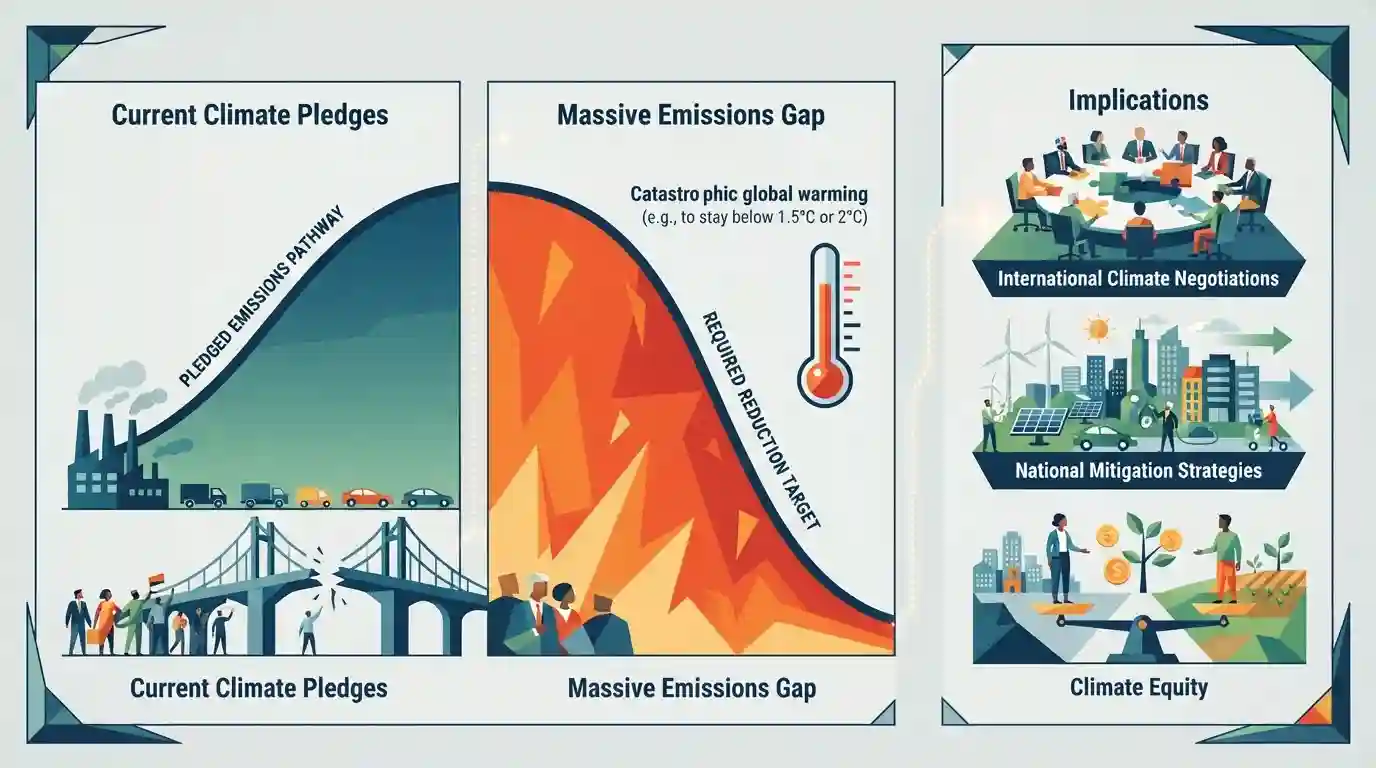
The UNEP Emissions Gap Report underlines the massive gap between current global climate pledges and the reduction targets required to prevent catastrophic global warming. The article analyzes the implications of these findings for international climate negotiations, national mitigation strategies, and climate equity.
Key Points
- The UNEP Emissions Gap Report highlights a severe shortfall between current national climate pledges (NDCs) and what is required to limit global warming to 1.5 degrees Celsius.
- Current greenhouse gas emission trends put the planet on a trajectory significantly above safe thresholds, increasing climate vulnerabilities.
- There is an urgent need for enhanced ambition in upcoming Nationally Determined Contributions (NDCs) and immediate, scaled-up climate finance and mitigation action by developed nations.
- India continues to balance its developmental priorities with ambitious climate goals, emphasizing equity and common but differentiated responsibilities (CBDR).
Important Terms
Emissions Gap Report

An annual flagship report by the United Nations Environment Programme that measures the gap between countries' current climate pledges under the Paris Agreement and the emission reductions needed to prevent catastrophic global warming.
UPSC context
GS Paper III: Conservation, environmental pollution, and degradation. Tests awareness of global climate reporting, mitigation gaps, and international climate assessment mechanisms.
Paris Agreement
A landmark legally binding international treaty on climate change adopted in 2015 at COP21, aiming to limit global temperature rise to well below 2°C, and preferably to 1.5°C, above pre-industrial levels.
UPSC context
GS Paper III: Environmental impact assessment, climate agreements, and international commitments like NDCs. Crucial for understanding global governance frameworks.
UNEP
The United Nations Environment Programme, established in 1972, is the leading global environmental authority that sets the global environmental agenda and promotes sustainable development within the UN.
UPSC context
GS Paper II & III: International organizations, environmental governance, and reports evaluating global conservation and pollution control efforts.
UNFCCC
The United Nations Framework Convention on Climate Change, a foundational international environmental treaty adopted in 1992 to stabilize greenhouse gas concentrations in the atmosphere at a level preventing dangerous anthropogenic interference.
UPSC context
GS Paper III: Environmental degradation and climate negotiations framework (COPs), testing core institutions of global climate law.
Static Concepts Connected
What is the core mandate of the United Nations Environment Programme (UNEP)?
- Origin & Role: Established in 1972 following the Stockholm Conference, UNEP is the leading global environmental authority.
- Flagship Reports: Publishes key flagship reports including the Emissions Gap Report, Adaptation Gap Report, and Frontiers Report.
- Headquarters: Headquartered in Nairobi, Kenya, it sets the global environmental agenda and promotes sustainable implementation.
Cross-Topic Patterns
Emissions Gap + UNFCCC COP Negotiations
UNEP reports directly feed into UNFCCC COP negotiations, linking global environmental assessments with legally binding Paris Agreement commitments and nationalNDC updates.
CBDR Principle + Developmental Economics
India's insistence on CBDR-RC bridges international environmental law with developmental economics, balancing rapid growth with binding climate obligations.

Expect a statement-based question pairing UNEP's warming trajectory figures (e.g., 2.6°C) with Paris Agreement targets and CBDR principles.
Linked PYQs · 3
Linked PYQs · 3
- 2025MainsGS3
Write a review on India's climate commitments under the Paris Agreement (2015) and mention how these have been further strengthened in COP26 (2021). In this direction, how has the first Nationally Determined Contribution intended by India been updated in 2022?
- 2021MainsGS3
Describe the major outcomes of the 26th session of the Conference of the Parties (COP) to the United Nations Framework Convention on Climate Change (UNFCCC). What are the commitments made by India in this conference?
- 2025MainsGS3
What is Carbon Capture, Utilization and Storage (CCUS)? What is the potential role of CCUS in tackling climate change?
