UNEP Emissions Gap Report and Global Climate Commitments
Source:Indian Express ↗
ఇది ఎందుకు ముఖ్యం
The Emissions Gap Report is a critical benchmark for evaluating global progress under the Paris Agreement. Questions regarding India's climate commitments, NDCs, and international climate negotiations frequently draw upon its findings.
సారాంశం
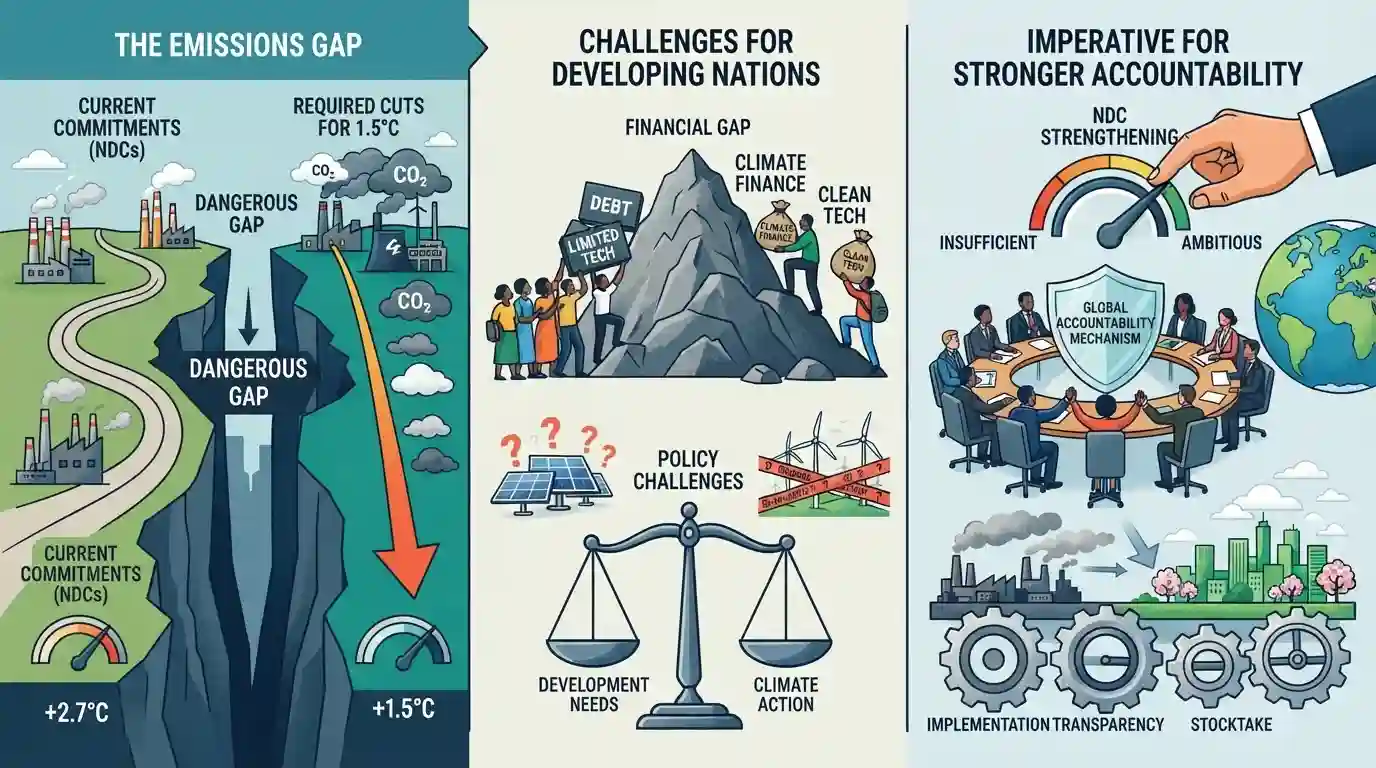
The article examines the findings of the UNEP Emissions Gap Report, highlighting the dangerous chasm between current global climate commitments and the deep emission cuts required to prevent runaway global warming. It underscores the financial and policy challenges facing developing nations and stresses the imperative for stronger NDCs and global climate accountability.
ముఖ్య అంశాలు
- The UNEP Emissions Gap Report highlights a severe discrepancy between national climate pledges and the actions required to limit global warming to 1.5 degrees Celsius.
- Current Nationally Determined Contributions (NDCs) fall vastly short, pointing toward a catastrophic temperature rise unless immediate, ambitious mitigation occurs.
- Developing countries face severe financial, technology, and implementation bottlenecks in scaling up climate action without compromising developmental needs.
- There is an urgent need for enhanced international cooperation, climate finance flows from developed nations, and domestic policy overhauls.
ముఖ్యమైన పదాలు
Emissions Gap Report

An annual publication by the United Nations Environment Programme that measures the discrepancy between projected global greenhouse gas emissions and the cuts needed to achieve Paris Agreement climate goals.
UPSC context
UPSC GS Paper III (Environment & Ecology): Important international reports, climate change trends, and global emission trajectories.
Paris Agreement
A landmark legally binding international treaty adopted at COP21 in 2015 to limit global warming to well below 2°C, preferably 1.5°C, above pre-industrial levels.
UPSC context
UPSC GS Paper III: International environmental conventions, global climate governance, NDCs, and mitigation strategies.
United Nations Environment Programme (UNEP)
The leading global environmental authority within the United Nations system that sets the global environmental agenda and promotes sustainable development.
UPSC context
UPSC GS Paper II & III: International organizations, UN bodies, and global environmental governance frameworks.
ప్రిలిమ్స్ ఉచ్చు
Nationally Determined Contributions (NDCs) are legally binding emission reduction targets mandated directly by the Paris Agreement.
Aspirants often confuse NDCs as legally binding targets under the Paris Agreement, whereas they are nationally determined and voluntary in commitment level, though submission is mandatory.
అనుసంధానమైన స్థిర భావనలు
What are the core institutional features and reporting mechanisms of the UNFCCC and Paris Agreement?
- Paris Agreement: Legally binding framework requiring parties to prepare successive Nationally Determined Contributions (NDCs) every five years.
- Equity Principle: Operationalizes CBDR-RC, making historical emitters primarily responsible for financial flows and capacity building.
- Global Stocktake: First concluded at the 2023 COP28, evaluating collective global progress toward Paris goals.
అంతర-అంశ నమూనాలు
Emissions Gap + Global Stocktake (GST)
UNEP reports feed directly into the Global Stocktake under the Paris Agreement, evaluating collective progress every five years.
Climate Pledges + CBDR-RC Principle
Developing nations link ambitious NDCs to predictable climate finance and technology transfer under UNFCCC frameworks.

UNEP Emissions Gap Report findings + NDCs + G20 emission shares is a prime candidate for a multi-statement Prelims question.
అనుసంధాన PYQలు · 2
అనుసంధాన PYQలు · 2
- 2025MainsGS3
Write a review on India's climate commitments under the Paris Agreement (2015) and mention how these have been further strengthened in COP26 (2021). In this direction, how has the first Nationally Determined Contribution intended by India been updated in 2022?
- 2021MainsGS3
Describe the major outcomes of the 26th session of the Conference of the Parties (COP) to the United Nations Framework Convention on Climate Change (UNFCCC). What are the commitments made by India in this conference?
