UNEP Emissions Gap Report Highlights Global Climate Targets
Source:Indian Express ↗
Why It Matters
This editorial critically evaluates global climate progress using the latest UNEP Emissions Gap Report, providing essential analytical inputs for questions regarding international climate negotiations, NDCs, the Paris Agreement, and climate finance/loss and damage.
Summary
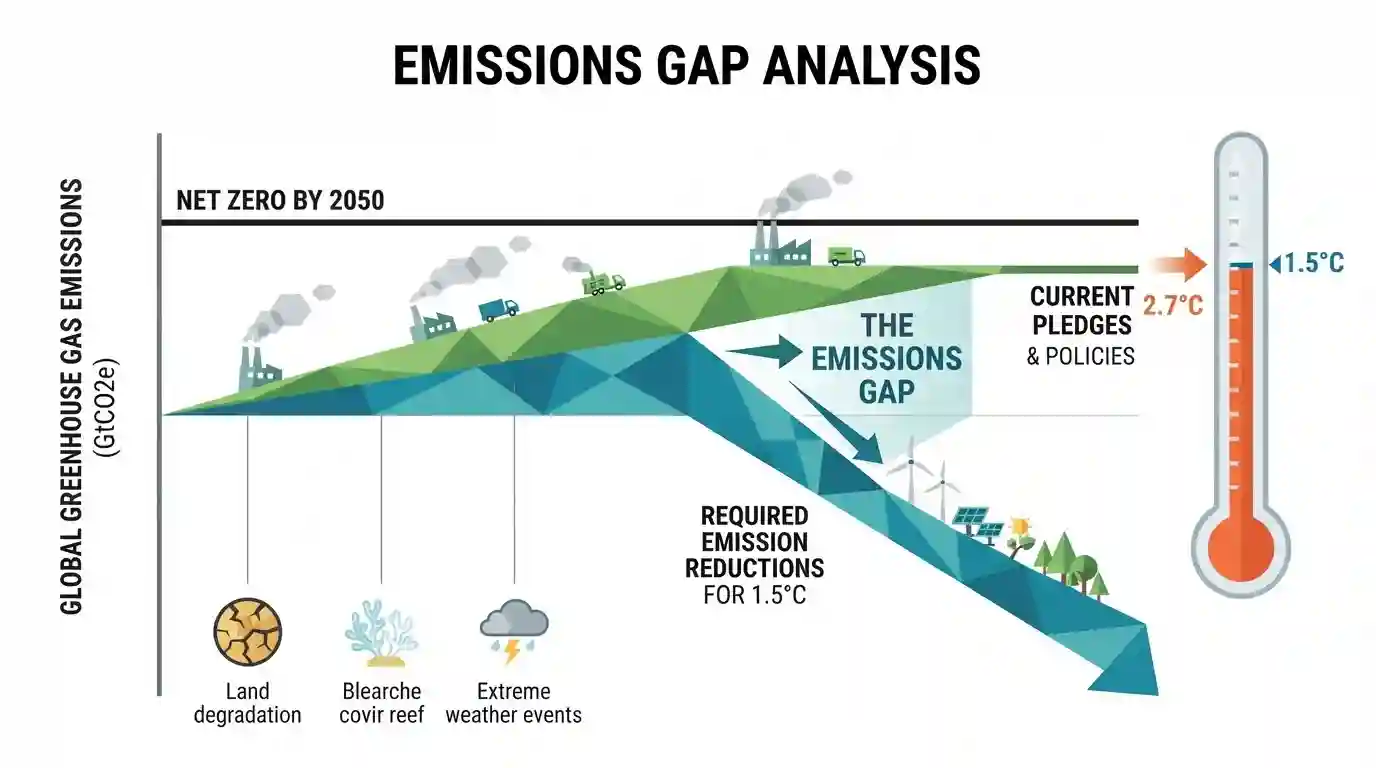
An analysis of the UNEP Emissions Gap Report 2026, highlighting the widening gap between current national climate pledges and the aggressive emission cuts required to keep global temperature rise within the Paris Agreement's 1.5°C threshold.
Key Points
- The UNEP Emissions Gap Report 2026 indicates that the 1.5°C global warming target under the Paris Agreement is slipping and unattainable in the near term, with a potential temperature overshoot peaking at 1.7-1.8°C around 2050.
- To return to the 1.5°C threshold by century-end, global greenhouse gas emissions must fall by 18 percent by 2030, 45 percent by 2035, and 69 percent by 2040 compared to 2025 levels.
- Current national climate action plans (NDCs) fall significantly short, projected to reduce emissions by only 5-8 percent by 2030 and 11-15 percent by 2035 relative to 2025 levels.
- While renewable energy (solar and wind) installations have surged 2.5 times since the Paris Agreement, they must triple over the next decade, facing roadblocks from geopolitics and energy storage demands.
- The report highlights shortcomings in climate finance and adaptation support, pointing out the failure of the Loss and Damage Fund to aid vulnerable countries like Nepal during recent floods.
Important Terms
Paris Agreement

A landmark legally binding international treaty on climate change adopted in 2015, aiming to hold global temperature rise well below 2 degrees Celsius above pre-industrial levels and pursue efforts to limit it to 1.5 degrees Celsius.
UPSC context
UPSC GS Paper III (Environment & Ecology): Tests knowledge of global climate governance, Nationally Determined Contributions (NDCs), and mitigation frameworks.
Loss and Damage Fund
A dedicated financial mechanism established under the UNFCCC framework to provide financial assistance to vulnerable developing countries suffering from severe economic and non-economic losses due to slow-onset and extreme weather events.
UPSC context
UPSC GS Paper III (Environment & Climate Change): Tests understanding of climate justice, international climate finance, and negotiation dynamics at COPs.
United Nations Environment Programme (UNEP)
The leading global environmental authority within the United Nations that sets the global environmental agenda, promotes sustainable development, and authoritative scientific reporting like the annual Emissions Gap Report.
UPSC context
UPSC GS Paper III (Environment & Biodiversity): Tests roles of international bodies, environmental governance, and critical reports tracking global carbon budgets.
Prelims Trap
Nationally Determined Contributions mandate legally binding emission cuts of 18 percent by 2030 across all signatory nations.
Aspirants often confuse NDCs as legally binding emission reduction targets under international law, whereas they are nationally determined and non-binding.
Static Concepts Connected
What are the key flagship reports published by the United Nations Environment Programme (UNEP)?
- Emissions Gap: Emissions Gap Report assesses the gap between national climate pledges and required emission reductions for Paris goals.
- Adaptation Gap: Adaptation Gap Report evaluates country-level financing, planning, and implementation progress for climate change adaptation.
- Frontiers Report: Frontiers Report identifies emerging environmental issues and threats of concern to global ecological stability.
- GEO Review: Global Environment Outlook (GEO) is UNEP's premier environmental assessment review on the state of the global environment.
Cross-Topic Patterns
Emissions Gap + Climate Stress Testing
The UNEP gap report links directly to RBI and central bank climate stress tests, as unachieved NDCs translate to immense macroeconomic and fiscal shocks for emerging economies.
Loss and Damage Fund + Climate Justice
UNEP findings on adaptation shortfalls intersect with UNFCCC climate finance architecture, testing the operationalization of the Loss and Damage Fund agreed at COP27.

Expect statement-based questions combining NDCs targets under Paris Agreement with UNEP flagship report findings on temperature overshoot.
Linked PYQs · 2
Linked PYQs · 2
- 2025MainsGS3
Write a review on India's climate commitments under the Paris Agreement (2015) and mention how these have been further strengthened in COP26 (2021). In this direction, how has the first Nationally Determined Contribution intended by India been updated in 2022?
- 2021MainsGS3
Describe the major outcomes of the 26th session of the Conference of the Parties (COP) to the United Nations Framework Convention on Climate Change (UNFCCC). What are the commitments made by India in this conference?
