Fiscal Consolidation Challenges and Capital Expenditure Pressures
Source:The Hindu ↗
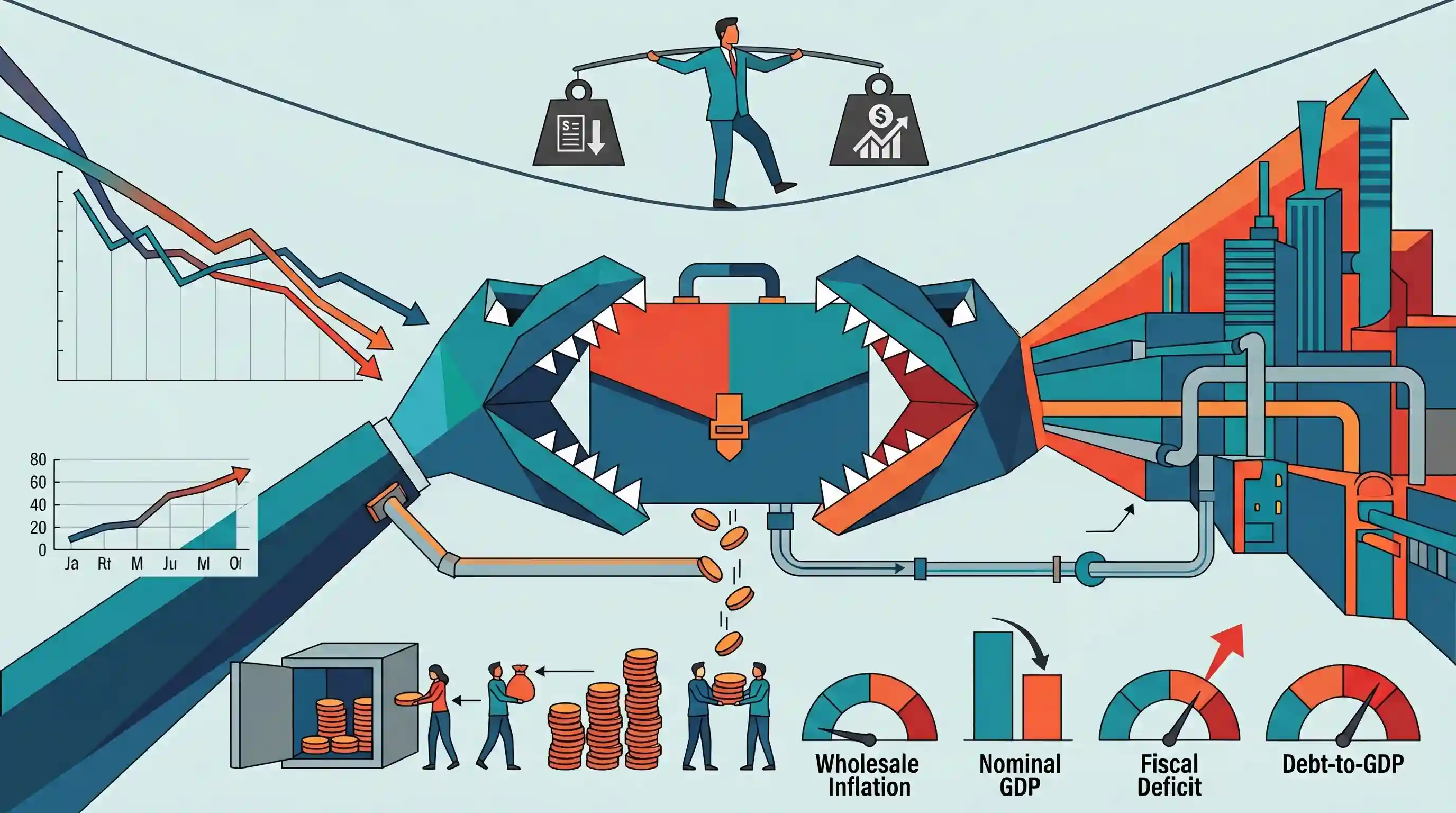
Why It Matters
Highlights the practical challenges of fiscal consolidation in the face of slowing tax revenues and deflationary WPI trends, which is highly relevant for GS3 questions on government budgeting, GST performance, and debt management.
Summary
The article analyzes the government's narrowing fiscal policy space ahead of the Union Budget. With December GST revenues growing at a tepid 5.7% and total tax revenues declining by 3.4% between April and November, the government is struggling to fund its massive 28% increase in capital expenditure. Recent tax relaxations appear to have led to higher savings or debt repayment rather than increased consumption. Furthermore, low wholesale inflation has reduced the nominal GDP, mechanically inflating the fiscal deficit and debt-to-GDP ratios. This places the government in an unenviable position where it must balance fiscal consolidation targets against the need to sustain capital expenditure-driven economic growth.
Key Points
- India's December GST collections stood at ₹1.74 lakh crore, growing at a modest 5.7% and indicating sluggish consumption.
- Direct tax revenues grew by 17.6% between April and November, falling short of the Budget estimate of 23.9%.
- While overall tax revenue declined by 3.4% during this period, capital expenditure surged by 28%, tightening the government's fiscal headroom.
- Low wholesale inflation has led to a smaller nominal GDP, which mathematically pushes up the fiscal deficit and debt-to-GDP ratios.
- The government faces a tough choice between continuing growth-enhancing capital expenditure and adhering to fiscal consolidation targets.
Important Terms
Fiscal Deficit

The gap between the government’s total expenditure and its total non-debt receipts (revenue and recovery of loans), indicating the total borrowing needed to fund expenses.
UPSC context
GS III: Government Budgeting. Tests knowledge of fiscal health, borrowing sustainability, and the FRBM Act targets.
Capital Expenditure (Capex)
Government spending on the creation of long-term physical or financial assets, like infrastructure and machinery, which enhances the economy's productive capacity and has a high multiplier effect.
UPSC context
GS III: Investment Models. Tests understanding of public investment as a driver of long-term growth and employment.
Fiscal Consolidation
A policy strategy directed at reducing government deficits and debt accumulation to achieve a sustainable fiscal position, often through revenue enhancement or expenditure rationalization.
UPSC context
GS III: Indian Economy. Tests awareness of fiscal discipline strategies and their impact on macroeconomic stability.
Debt-to-GDP Ratio
The metric comparing a country's total public debt to its annual Gross Domestic Product, used to measure the government's ability to service and pay back its debts.
UPSC context
GS III: Macroeconomic Ratios. Crucial for understanding sovereign creditworthiness and debt sustainability in the Economic Survey.
Nominal GDP
The market value of all final goods and services produced within a country, calculated at current market prices without adjusting for inflation.
UPSC context
GS III: Economic Growth. Tests the ability to evaluate how inflation/deflation mechanically alters fiscal ratios and budget calculations.
Goods and Services Tax (GST)
A comprehensive, multi-stage, destination-based indirect tax levied on the supply of goods and services, replacing most central and state-level indirect taxes.
UPSC context
GS III: Mobilization of Resources. Tests knowledge of indirect tax reforms, revenue trends, and cooperative federalism.
Prelims Trap
"Lower inflation automatically reduces the fiscal deficit-to-GDP ratio."
Deficit ratios use Nominal GDP as the denominator. Lower inflation reduces Nominal GDP growth, mathematically inflating the deficit-to-GDP ratio even if absolute borrowing is constant.
Static Concepts Connected
Why does the government prioritize Capital Expenditure over Revenue Expenditure?
- Multiplier effect: Capex creates durable assets and yields a much higher economic multiplier (approx 2.45) compared to revenue expenditure.
- Crowding in: Public infrastructure investment reduces logistics costs, structurally incentivizing and "crowding in" private sector investment.
- Future capacity: It expands the productive capacity of the economy, preventing supply-side bottlenecks and helping control long-term inflation.
What are the key structural recommendations of the NK Singh FRBM Review Committee?
- Debt trajectory: Recommended shifting focus to a combined debt-to-GDP ratio of 60% (40% Centre, 20% States) as the primary fiscal anchor.
- Escape clause: Proposed allowing a 0.5% deviation from fiscal deficit targets during specific events like national calamities or severe economic shocks.
- Fiscal Council: Advocated for the establishment of an independent, autonomous Fiscal Council to assess government fiscal math.
Cross-Topic Patterns
Macro Ratios + Denominator Effect
The mechanical inflation of debt-to-GDP due to low WPI (reducing nominal GDP) links monetary policy outcomes directly with the government's fiscal headroom and FRBM mandates.
Tax Cuts + Propensity to Consume
Tax relaxations failing to boost aggregate consumption highlights how high household debt alters the Marginal Propensity to Consume (MPC), diverting disposable income to savings rather than spending.

Expect a Prelims question testing the mathematical impact of WPI-driven nominal GDP fluctuations on FRBM fiscal deficit and debt ratios.
Linked PYQs · 4
Linked PYQs · 4
- 2021MainsGS3
Distinguish between Capital Budget and Revenue Budget. Explain the components of both these Budgets.
- 2019MainsGS3
Enumerate the indirect taxes which have been subsumed in the Goods and Services Tax (GST) in India. Also, comment on the revenue implications of the GST introduced in India since July 2017.
- 2018PrelimsGS1
Consider the following statements: 1. The Fiscal Responsibility and Budget Management (FRBM) Review Committee Report has recommended a debt to GDP ratio of 60% for the general (combined) government by 2023, comprising 40% for the Central Government and 20% for the State Governments. 2. The Central Government has domestic liabilities of 21% of GDP as compared to that of 49% of GDP of the State Governments. 3. As per the Constitution of India, it is mandatory for a State to take the Central Government's consent for raising any loan if the former owes any outstanding liabilities to the latter. Which of the statements given above is/are correct?
- 2025PrelimsGS1
A country's fiscal deficit stands at ₹50,000 crores. It is receiving ₹10,000 crores through non-debt creating capital receipts. The country's interest liabilities are ₹1,500 crores. What is the gross primary deficit?
