Tripura Unemployment Rate Below National Average
Source:Indian Express ↗
Why It Matters
This article provides relevant data points on state-wise unemployment rates versus the national average, measured by MoSPI (likely through the Periodic Labour Force Survey). It is useful for GS-3 answers on employment trends, demographic dividend, and skill development, as well as highlighting developmental and administrative progress in North-Eastern states.
Summary
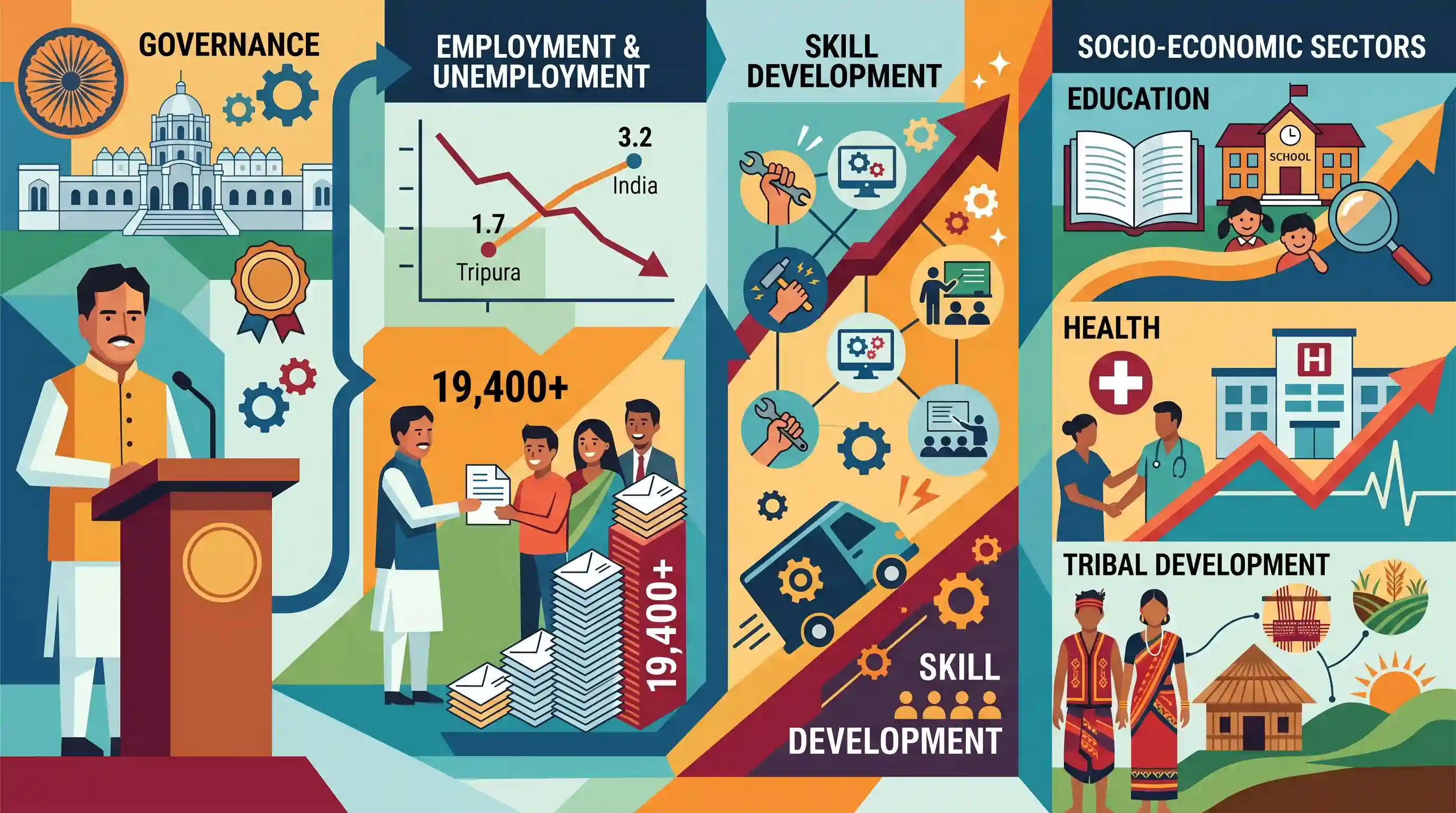
Tripura Chief Minister Manik Saha announced that the state\'s unemployment rate has fallen to 1.7%, dropping below the national average of 3.2%, according to data from the Ministry of Statistics and Programme Implementation. Distributing appointment letters in Agartala, he noted that over 19,400 government jobs have been provided since 2018. The Chief Minister also emphasized ongoing efforts to boost skill development, improve government employee efficiency, and prioritize socio-economic sectors like education, health, and tribal development.
Key Points
- Tripura Chief Minister Manik Saha stated that the state\'s unemployment rate has decreased to 1.7%, significantly lower than the national average of 3.2%.
- The data cited by the Chief Minister was based on a survey conducted by the Ministry of Statistics and Programme Implementation (MoSPI).
- Over 19,400 aspirants have secured government jobs in Tripura since the state government took power in 2018.
- The CM highlighted initiatives in skill development and reported that the overall efficiency level among government employees across India has improved to 53%.
- State efforts are focused on critical sectors including education, health, communication, and tribal development, with recent projects worth Rs 638.65 crore initiated.
Important Terms
Ministry of Statistics and Programme Implementation (MoSPI)

The central Indian ministry responsible for official national statistics and monitoring the implementation of major infrastructure projects and government programmes like MPLADS.
UPSC context
GS Paper II & III; tests institutional data frameworks, infrastructure monitoring, and socio-economic planning.
Periodic Labour Force Survey (PLFS)
A nationwide survey launched by the NSO in 2017 to provide frequent data on employment indicators like LFPR, WPR, and Unemployment Rate.
UPSC context
GS Paper III (Employment); critical for analyzing labor market trends and evaluating government job-creation policies.
Unemployment Rate
The percentage of persons unemployed among the total persons in the labour force (those working or seeking work).
UPSC context
GS Paper III (Economy); core metric for assessing economic health and demographic dividend utilization.
Labour Force
The population segment currently employed or actively seeking work; it excludes those not in the market, such as students or retirees.
UPSC context
Prelims (Economy); fundamental for calculating participation rates and understanding labor market dynamics.
Skill Development
Targeted training initiatives designed to enhance vocational competencies and productivity to bridge the gap between education and industry requirements.
UPSC context
GS Paper II & III; central to the 'Skill India' mission and human resource development.
Scheduled Tribes (ST)
Indigenous communities recognized under Article 342 of the Constitution for special protection, often prioritized in regional development and welfare schemes.
UPSC context
GS Paper I & II; tests constitutional provisions, social empowerment, and Northeast regional governance.
Prelims Trap
"The Periodic Labour Force Survey (PLFS) is conducted by the Ministry of Labour and Employment."
The PLFS is conducted by the National Statistical Office (NSO) under the Ministry of Statistics and Programme Implementation (MoSPI), not the Labour Ministry.
Static Concepts Connected
How does the PLFS measure employment status?
- Usual Status: Measures employment based on the primary activity a person spent the majority of their time on during the preceding 365 days.
- Current Weekly Status: Measures employment based on a shorter reference period of exactly seven days preceding the date of the survey.
What characterizes structural unemployment in India?
- Skill Mismatch: Arises when the existing skills of the labor force fundamentally mismatch the requirements of modern, technology-driven industries.
- Long-term Nature: Unlike cyclical unemployment driven by business cycles, it is persistent and requires structural interventions like massive investments in human capital and education.
- Jobless Growth Link: India faces this acutely, meaning economic growth alone (without skilling) will not automatically clear the unemployment backlog.
Cross-Topic Patterns
NE Development & Private Sector
Heavy reliance on government jobs in the North-East underscores the need to boost MSMEs and private manufacturing, tying into the region's broader Act East infrastructure push.
Structural Unemployment & Skilling
The CM's focus on skill development directly addresses India's structural unemployment issue, where the demographic dividend cannot be leveraged without bridging the industry-academia skill gap.

A 2026 prelims question will likely blend PLFS measurement metrics (Usual vs CWS) with structural unemployment and labor force participation.
Linked PYQs · 3
Linked PYQs · 3
- 2023MainsGS3
Most of the unemployment in India is structural in nature. Examine the methodology adopted to compute unemployment in the country and suggest improvements.
- 2022MainsGS3
Economic growth in the recent past has been led by increase in labour productivity." Explain this statement. Suggest the growth pattern that will lead to creation of more jobs without compromising labour productivity.
- 2022PrelimsGS1
In India, which one of the following compiles information on industrial disputes, closures, retrenchments and lay-offs in factories employing workers ?
