Security and Political Transitions in Jammu and Kashmir
Source:The Hindu ↗
Why It Matters
The article is highly relevant for UPSC as it encapsulates the ongoing constitutional and political transition in J&K following the 2019 Reorganization Act. It touches upon Centre-State relations, the functioning of a Union Territory with a legislature, and the critical challenge of ensuring internal security and winning 'hearts and minds' in conflict-affected regions.
Summary
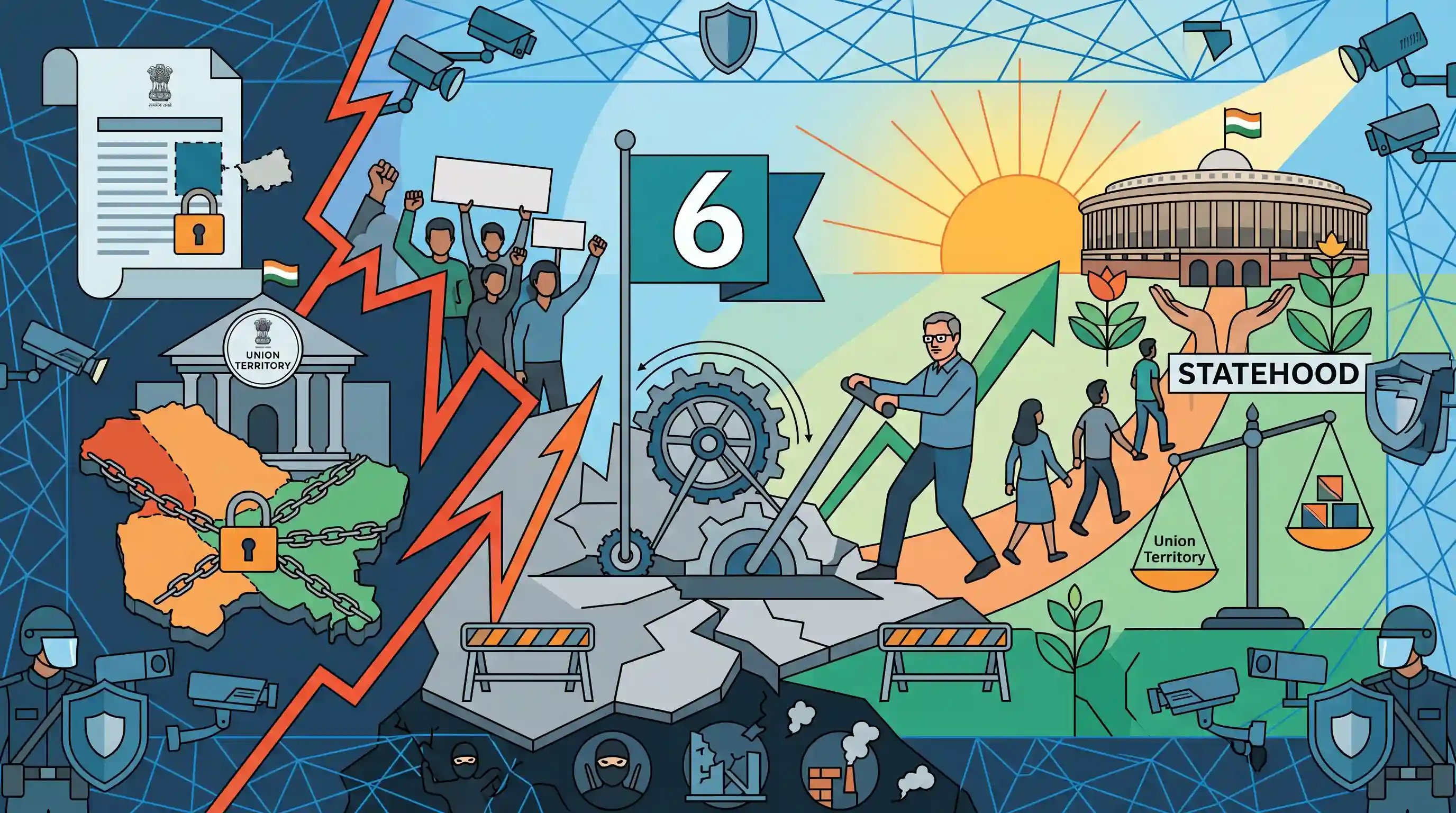
Jammu and Kashmir marked the sixth anniversary of the abrogation of Article 370 with a mix of political maneuvering and heightened security. While Chief Minister Omar Abdullah voiced optimism regarding the imminent restoration of full statehood to replace the current Union Territory framework, the PDP called for protests against the 2019 constitutional changes. Simultaneously, the region's security apparatus was placed on high alert to thwart potential terror attacks, underscoring the ongoing challenge of balancing political normalization with internal security in the region.
Key Points
- The sixth anniversary of the abrogation of Article 370 and 35A has led to political unease and heightened security in Jammu & Kashmir.
- Chief Minister Omar Abdullah emphasized the transition away from the current 'hybrid system', expressing optimism about the early restoration of full statehood.
- The PDP, led by Mehbooba Mufti, called for a blackout and protests to mark August 5 as a 'black day', highlighting continued political divergence on the 2019 changes.
- Security forces led by DGP Nalin Prabhat conducted comprehensive reviews, issuing high alerts to protect vital installations, remote areas, and non-locals from potential terror threats.
Important Terms
Article 370

A former constitutional provision (Part XXI) that granted special autonomous status to Jammu and Kashmir, limiting Parliament's legislative power in the region. It was rendered inoperative in August 2019.
UPSC context
GS II: Indian Constitution (Historical Underpinnings and Significant Provisions); GS III: Internal Security.
Article 35A
A provision introduced in 1954 empowering the J&K legislature to define 'permanent residents' and grant them exclusive rights in land ownership, employment, and scholarships. Revoked in 2019.
UPSC context
GS II: Governance and Constitution (Rights Issues, Asymmetric Federalism).
Jammu and Kashmir Reorganisation Act, 2019
Legislation that bifurcated the former state into the Union Territories of Jammu & Kashmir and Ladakh, abolishing the legislative council and applying all Indian constitutional provisions.
UPSC context
GS II: Parliament and State Legislatures (Reorganisation of States, Union Territories).
Restoration of Statehood
The constitutional process of upgrading the Union Territory of Jammu and Kashmir back to a full-fledged State, a commitment made by the Centre and affirmed by the Supreme Court.
UPSC context
GS II: Federalism (Center-State relations, Article 3 power of Parliament).
National Conference (NC)
J&K's oldest regional party, founded in 1932 by Sheikh Abdullah. It traditionally advocates for autonomy and currently leads the elected government in the Union Territory.
UPSC context
GS II: Governance and Political Dynamics (Role of regional parties).
Peoples Democratic Party (PDP)
A regional political party founded in 1999 by Mufti Mohammad Sayeed, known for its 'self-rule' ideology and involvement in significant coalition governments in J&K.
UPSC context
GS II: Regional Parties and Electoral Politics.
Prelims Trap
"Restoring statehood to Jammu & Kashmir requires a Constitutional Amendment under Article 368 with a special majority."
Under Article 3, upgrading a UT to a State requires only a simple majority in Parliament. It is explicitly exempt from being an amendment under Article 368.
Static Concepts Connected
How does the J&K UT Assembly's power differ from a full State legislature?
- State List exceptions: It cannot legislate on 'Police' and 'Public Order'. These critical State List subjects remain exclusively under Central control via the Lieutenant Governor.
- Executive override: The Lieutenant Governor holds greater discretionary power and acts directly as an administrator on behalf of the President, unlike a State Governor.
- Article 239A framework: The J&K Assembly operates under Article 239A (similar to Puducherry), meaning its existence and powers are defined by an Act of Parliament, not inherent constitutional statehood.
What is the constitutional procedure to upgrade or restore a UT to full statehood?
- Article 3 power: Parliament holds exclusive authority to create new states, alter boundaries, or change a territory's status via ordinary legislation.
- Simple majority: The reorganisation bill requires only a simple majority in both Houses of Parliament, not a special majority.
- Presidential recommendation: The bill must be introduced in Parliament solely with the prior recommendation of the President.
Cross-Topic Patterns
Asymmetric Federalism and Article 371
J&K's shift from Article 370 highlights India's broader asymmetric federalism. UPSC often tests this by comparing the abrogated provisions with ongoing protections for North-Eastern states under Article 371.
WHAM vs Kinetic Counter-Terrorism
Mains internal security questions frequently require analyzing how hard counter-terrorism (kinetic operations) must pair with civic action—'Winning Hearts and Minds' (WHAM)—to sustainably neutralize radicalization in regions like J&K.

Expect a 2026 Prelims multi-statement question comparing the exact legislative boundaries of J&K, Delhi, and Puducherry UT assemblies.
Linked PYQs · 3
Linked PYQs · 3
- 2016MainsGS2
To what extent is Article 370 of the Indian Constitution, bearing marginal note "Temporary provision with respect to the State of Jammu and Kashmir", temporary? Discuss the future prospects of this provision in the context of Indian polity.
- 2025MainsGS2
Discuss the nature of Jammu and Kashmir Legislative Assembly after the Jammu and Kashmir Reorganization Act, 2019. Briefly describe the powers and functions of the Assembly of the Union Territory of Jammu and Kashmir.
- 2023MainsGS3
Winning of 'Hearts and Minds' in terrorism-affected areas is an essential step in restoring the trust of the population. Discuss the measures adopted by the Government in this respect as part of the conflict resolution in Jammu and Kashmir.
