Security Preparedness and Political Dynamics in Jammu and Kashmir
Source:The Hindu ↗
Why It Matters
The political and security evolution of Jammu and Kashmir post-2019 is a critical topic for UPSC. The demand for the restoration of statehood highlights federalism dynamics, while the administrative steps taken to maintain law and order illustrate practical aspects of internal security management and counterinsurgency.
Summary
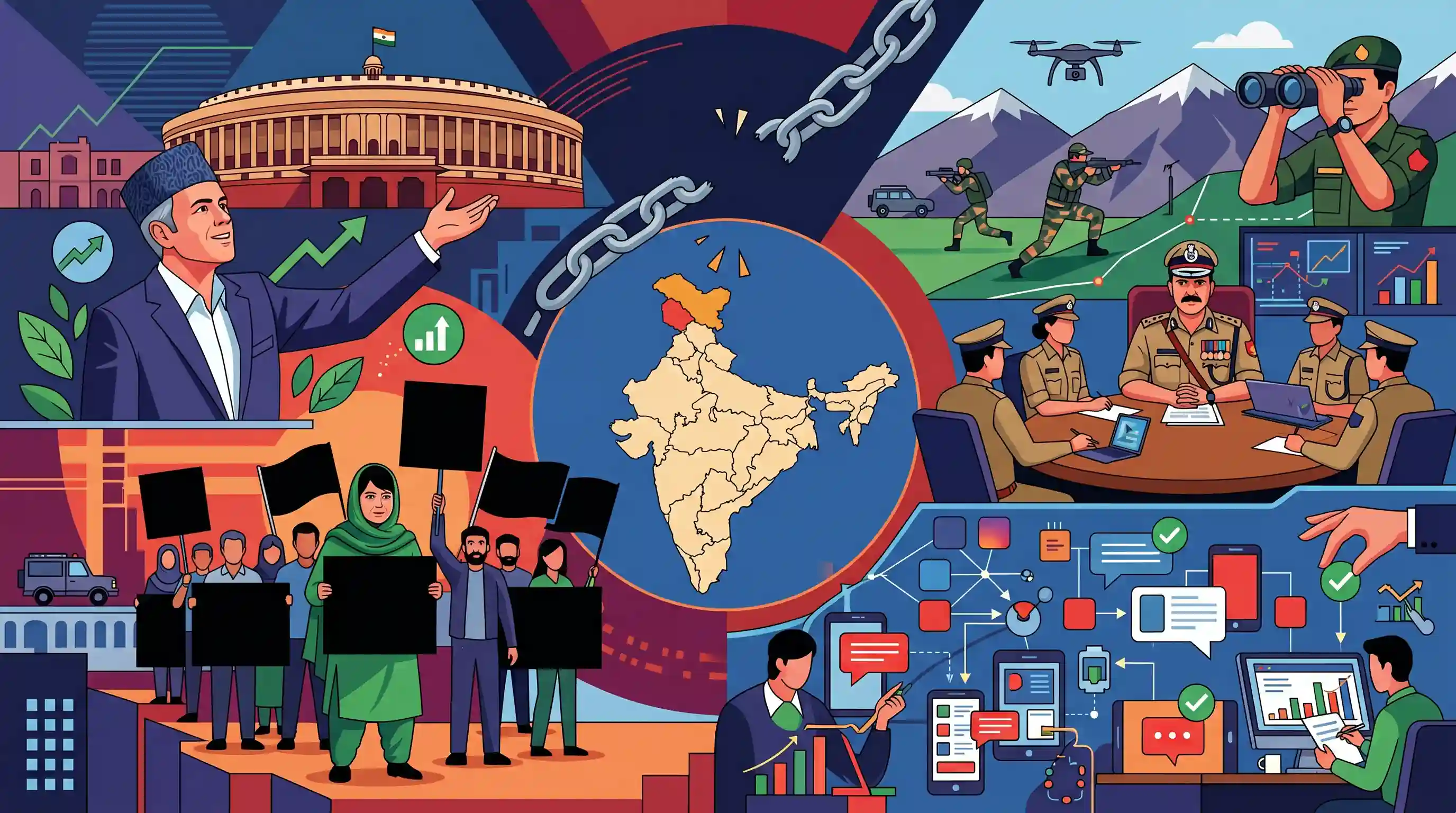
Ahead of the sixth anniversary of the abrogation of Article 370, heightened security and political unease prevail in Jammu and Kashmir. Chief Minister Omar Abdullah expressed optimism regarding the potential restoration of statehood during the monsoon session of Parliament, while the opposition PDP, led by Mehbooba Mufti, called for a blackout protest against the 2019 constitutional changes. Concurrently, the region's Director General of Police chaired a comprehensive security review to enhance surveillance, formulate counterinsurgency strategies, and monitor social media to maintain public safety and order.
Key Points
- Heightened security measures and surveillance have been implemented in Jammu & Kashmir ahead of the sixth anniversary of the abrogation of Article 370.
- J&K Chief Minister Omar Abdullah voiced optimism about the potential restoration of statehood during the ongoing monsoon session of Parliament.
- Former CM Mehbooba Mufti and the opposition PDP called for a 15-minute protest blackout to mourn the loss of the region's special status and constitutional rights.
- DGP Nalin Prabhat held a security review focusing on counterinsurgency strategies, surveillance of anti-national elements, and strict monitoring of social media to prevent the spread of misinformation.
Important Terms
Article 370

A constitutional provision (Part XXI) that granted Jammu & Kashmir special autonomous status, including its own constitution and flag, until its abrogation in August 2019.
UPSC context
GS Paper II: Indian Constitution. Tests understanding of federalism, special provisions, and the 2023 Supreme Court verdict upholding its abrogation.
Jammu and Kashmir Reorganisation Act, 2019
Legislation that bifurcated the former State of Jammu & Kashmir into two Union Territories: Jammu & Kashmir (with a legislature) and Ladakh (without a legislature).
UPSC context
GS Paper II: Governance & Polity. Essential for questions on administrative restructuring and the Parliament's power to reorganize states.
Statehood
The status of a constituent political entity in India's federal union; its restoration in J&K is a key democratic demand to reduce central control via the Lieutenant Governor.
UPSC context
GS Paper II: Federalism. Focuses on the balance of power between the Union and States and the judicial mandate for democratic restoration.
National Conference (NC)
A major regional political party in J&K founded by Sheikh Abdullah, historically advocating for "Naya Kashmir" reforms and the restoration of the region's autonomous identity.
UPSC context
GS Paper II: Political Parties. Relevant for understanding regionalism and the role of local leadership in J&K's integration.
Peoples Democratic Party (PDP)
A regional party founded by Mufti Mohammad Sayeed in 1999, known for its "self-rule" ideology and "soft-separatism" approach to resolving the Kashmir issue.
UPSC context
GS Paper II: Political Parties. Tests knowledge of regional political dynamics and their impact on internal security and peace processes.
Counter-insurgency
Military and political actions taken by a government to defeat an insurgency, involving intelligence gathering, security grid management, and winning "hearts and minds."
UPSC context
GS Paper III: Internal Security. Evaluates strategies for managing cross-border terrorism and domestic unrest in border states.
Lieutenant Governor (LG)
The administrator of a Union Territory, appointed by the President, who holds significant executive powers over public order, police, and land in J&K.
UPSC context
GS Paper II: Governance. Important for comparing the powers of an LG versus a Governor in a full state.
Article 3 (Indian Constitution)
The constitutional article that empowers Parliament to form new states, alter areas, or change boundaries and names of existing states by simple majority.
UPSC context
GS Paper II: Union and its Territories. Tests the extent of parliamentary authority over India's internal political geography.
Prelims Trap
"The J&K Legislative Assembly has the power to legislate on all subjects enumerated in the State List."
Unlike full states, the J&K Reorganization Act 2019 explicitly excludes 'Police' and 'Public Order' from the UT legislative assembly's jurisdiction, keeping them under the Union.
Static Concepts Connected
How does Article 239A govern UTs with legislative assemblies?
- Creation: Parliament can enact laws to create a body to function as a legislature for the UT (applied to Puducherry and J&K).
- Legislative Scope: The assembly can legislate on State and Concurrent list subjects, subject to specific statutory exclusions (e.g., Police and Public Order).
- LG Authority: The Lieutenant Governor acts on the aid and advice of the Council of Ministers but retains overriding discretionary powers in excluded domains.
How is social media weaponized by non-state actors in border regions?
- Radicalization: Dissemination of extremist propaganda and psychological warfare aimed at alienating local youth from democratic processes.
- Tactical Comms: Use of encrypted messaging and proxy networks by Over Ground Workers (OGWs) to coordinate logistics and terror financing.
- Disinformation: Manufacturing civil unrest and orchestrating mob protests by rapidly spreading fake news to disrupt kinetic counterinsurgency operations.
Cross-Topic Patterns
J&K vs Delhi UT constitutional models
UPSC frequently compares legislative constraints of J&K (Article 239A) and Delhi (Article 239AA). Track exact State List exclusions like Police, Public Order, and Land.
Internet curbs and Article 19 proportionality
Preemptive social media monitoring in J&K ties back to the Anuradha Bhasin judgment, which established the proportionality test for internet blackouts and digital fundamental rights.

A comparative multi-statement Prelims question on the legislative limitations of the J&K UT versus Delhi/Puducherry is highly probable.
Linked PYQs · 3
Linked PYQs · 3
- 2025MainsGS2
Discuss the nature of Jammu and Kashmir Legislative Assembly after the Jammu and Kashmir Reorganization Act, 2019. Briefly describe the powers and functions of the Assembly of the Union Territory of Jammu and Kashmir.
- 2016MainsGS2
To what extent is Article 370 of the Indian Constitution, bearing marginal note "Temporary provision with respect to the State of Jammu and Kashmir", temporary? Discuss the future prospects of this provision in the context of Indian polity.
- 2023MainsGS3
Winning of 'Hearts and Minds' in terrorism-affected areas is an essential step in restoring the trust of the population. Discuss the measures adopted by the Government in this respect as part of the conflict resolution in Jammu and Kashmir.
