Security and Political Posture Ahead of Article 370 Anniversary
Source:The Hindu ↗
Why It Matters
The article highlights the long-term political and security ramifications of the abrogation of Article 370. It touches upon federal relations (demand for statehood restoration) and internal security management (social media surveillance) in border states, which are recurring themes in GS2 and GS3.
Summary
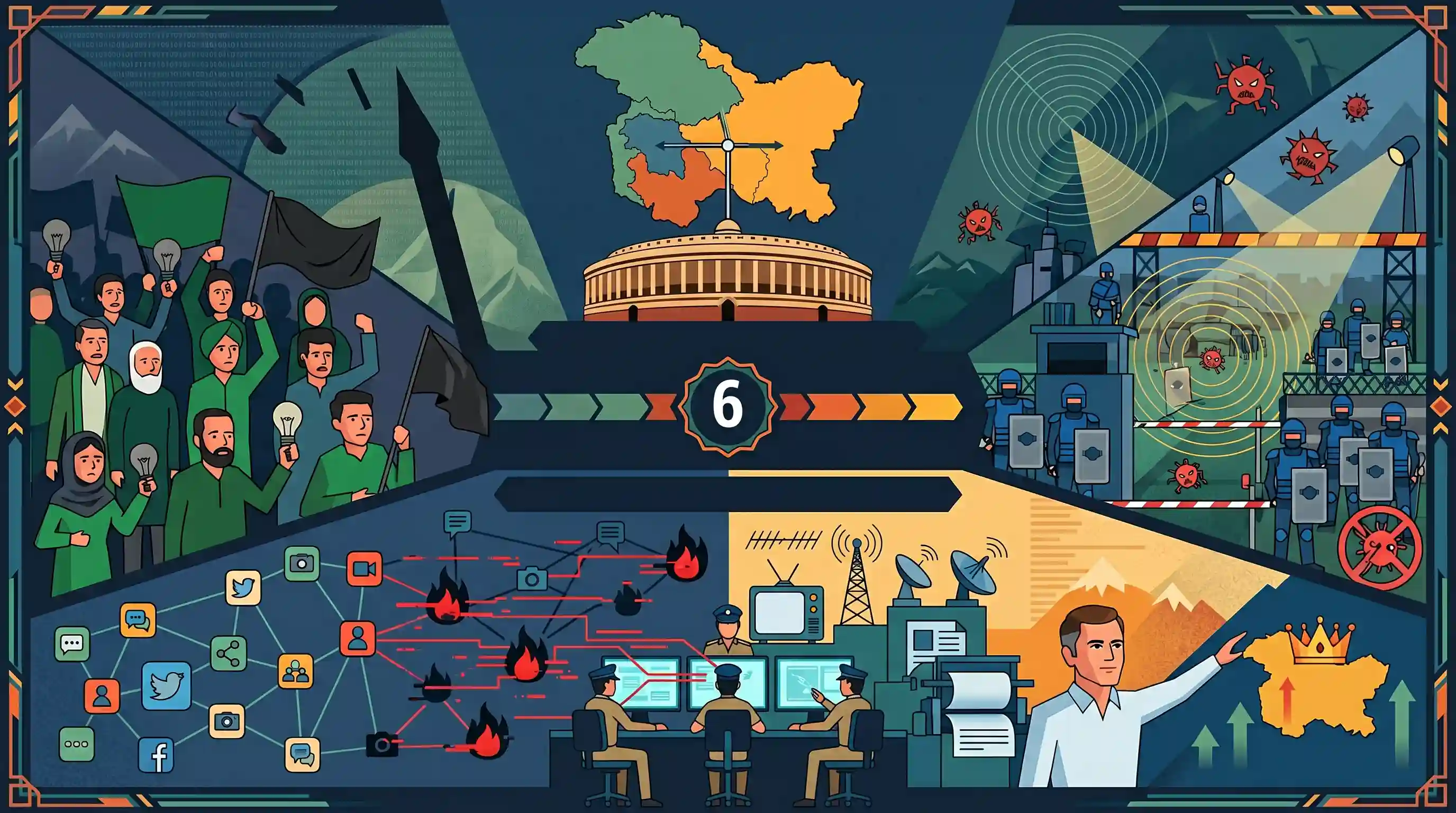
Ahead of the sixth anniversary of the abrogation of Article 370, Jammu and Kashmir is experiencing political unease alongside heightened security measures. While the Peoples Democratic Party (PDP) has called for a blackout protest, Chief Minister Omar Abdullah remains hopeful about the eventual restoration of statehood by the Union government. Meanwhile, the J&K Police have ramped up their counter-insurgency grids and are closely monitoring social media to maintain public order and prevent misinformation.
Key Points
- The sixth anniversary of the abrogation of Article 370 is marked by heightened security protocols and political tension in Jammu and Kashmir.
- Chief Minister Omar Abdullah remains optimistic about the restoration of statehood for J&K, relying on assurances from the Union government.
- The PDP, led by Mehbooba Mufti, urged citizens to observe a 15-minute blackout to protest the August 5, 2019 decision that revoked J&K\'s special status.
- The J&K Police have increased security deployments and ordered strict surveillance of social media to counter potential security challenges and misinformation.
Important Terms
Article 370

A temporary constitutional provision (Part XXI) that granted special autonomous status to Jammu and Kashmir, allowing it a separate constitution and limiting the Indian Parliament's legislative powers until its 2019 abrogation.
UPSC context
GS-II: Indian Constitution and Federalism; tests knowledge of asymmetric federalism and the evolution of Union-State relations.
Jammu and Kashmir Reorganisation Act, 2019
Parliamentary legislation that bifurcated the state of Jammu and Kashmir into two Union Territories—Jammu & Kashmir (with a legislature) and Ladakh (without a legislature)—on August 5, 2019.
UPSC context
GS-II: Governance and Polity; concerns Parliament's power to reorganize states under Article 3.
Counter-insurgency Grid (CI Grid)
A multi-layered, coordinated security framework involving the Indian Army, Central Armed Police Forces (CAPFs), and local police to prevent, detect, and respond to militant activities in volatile regions.
UPSC context
GS-III: Internal Security; relevant for security management in border areas and the role of police forces.
Statehood
The status of a territory as a full State within the Indian Union, possessing constitutionally guaranteed legislative and executive autonomy, which the Supreme Court (2023) directed be restored to J&K.
UPSC context
GS-II: Federalism; involves democratic representation and the constitutional balance between the Union and regional governments.
National Conference (NC)
The oldest regional political party in Jammu and Kashmir, founded in 1932, which traditionally advocated for "Kashmiriyat" and state autonomy within the Indian constitutional framework.
UPSC context
GS-II: Political Parties; tests understanding of regional political dynamics and their impact on national integration.
Peoples Democratic Party (PDP)
A regional political party in J&K founded in 1999 that advocates for "self-rule," reconciliation with Pakistan, and the restoration of the state's special status through constitutional means.
UPSC context
GS-II: Polity; relevant for questions on regional political ideologies and democratic movements in J&K.
Prelims Trap
"The Jammu and Kashmir Legislative Assembly has the exact same legislative restrictions on State List subjects as the Delhi Legislative Assembly."
False. Delhi cannot legislate on Police, Public Order, AND Land. J&K cannot legislate on Police and Public Order, but retains power over Land. This distinction is heavily tested.
Static Concepts Connected
How do legislative powers differ among Union Territories with assemblies?
- Delhi: Article 239AA excludes Police, Public Order, and Land from its legislative domain.
- Jammu & Kashmir: The Reorganisation Act excludes Police and Public Order, but retains legislative power over Land.
- Puducherry: Empowered under Article 239A to legislate on any State List subject without explicit constitutional exclusions.
What is the Unified Headquarters (UHQ) model in J&K?
- Command Structure: Chaired by the Lieutenant Governor (formerly the Chief Minister), ensuring centralized command over state security.
- Multi-agency Synergy: Coordinates real-time operations across the Army, CAPFs, Intelligence Bureau, and J&K Police to eliminate friction.
- Counter-insurgency Grid: Institutionalizes a grid-based area domination approach rather than relying on ad-hoc security deployments.
Cross-Topic Patterns
Social media as an OGW multiplier
UPSC frequently links digital radicalization (GS3) with insurgency. Encrypted apps used by Over Ground Workers (OGWs) highlight a shift from pure kinetic warfare to 'information warfare'.
Asymmetric Federalism & Security Command
The transition from Article 370 to a UT framework altered the Unified Headquarters structure, shifting internal security command from the elected Chief Minister to the Union-appointed LG.

Expect a tricky Prelims 2026 multi-statement question comparing the specific legislative powers of J&K, Delhi, and Puducherry.
Linked PYQs · 4
Linked PYQs · 4
- 2016MainsGS2
To what extent is Article 370 of the Indian Constitution, bearing marginal note "Temporary provision with respect to the State of Jammu and Kashmir", temporary? Discuss the future prospects of this provision in the context of Indian polity.
- 2025MainsGS2
Discuss the nature of Jammu and Kashmir Legislative Assembly after the Jammu and Kashmir Reorganization Act, 2019. Briefly describe the powers and functions of the Assembly of the Union Territory of Jammu and Kashmir.
- 2016MainsGS3
Use of Internet and social media by non-state actors for subversive activities is a major security concern. How have these been misused in the recent past? Suggest effective guidelines to curb the above threat.
- 2024MainsGS3
Social media and encrypting messaging services pose a serious security challenge. What measures have been adopted at various levels to address the security implications of social media? Also suggest any other remedies to address the problem.
