US Retreat From Multilateralism And Emerging Multipolar World Order
Source:Indian Express ↗
Why It Matters
Understanding the decline of US hegemony and the crisis in multilateralism is crucial for analyzing contemporary international relations. It helps aspirants evaluate the structural shifts from globalization to sovereign nationalism and the specific challenges facing institutions like the WTO and the UN, directly addressing core themes in GS2.
Summary
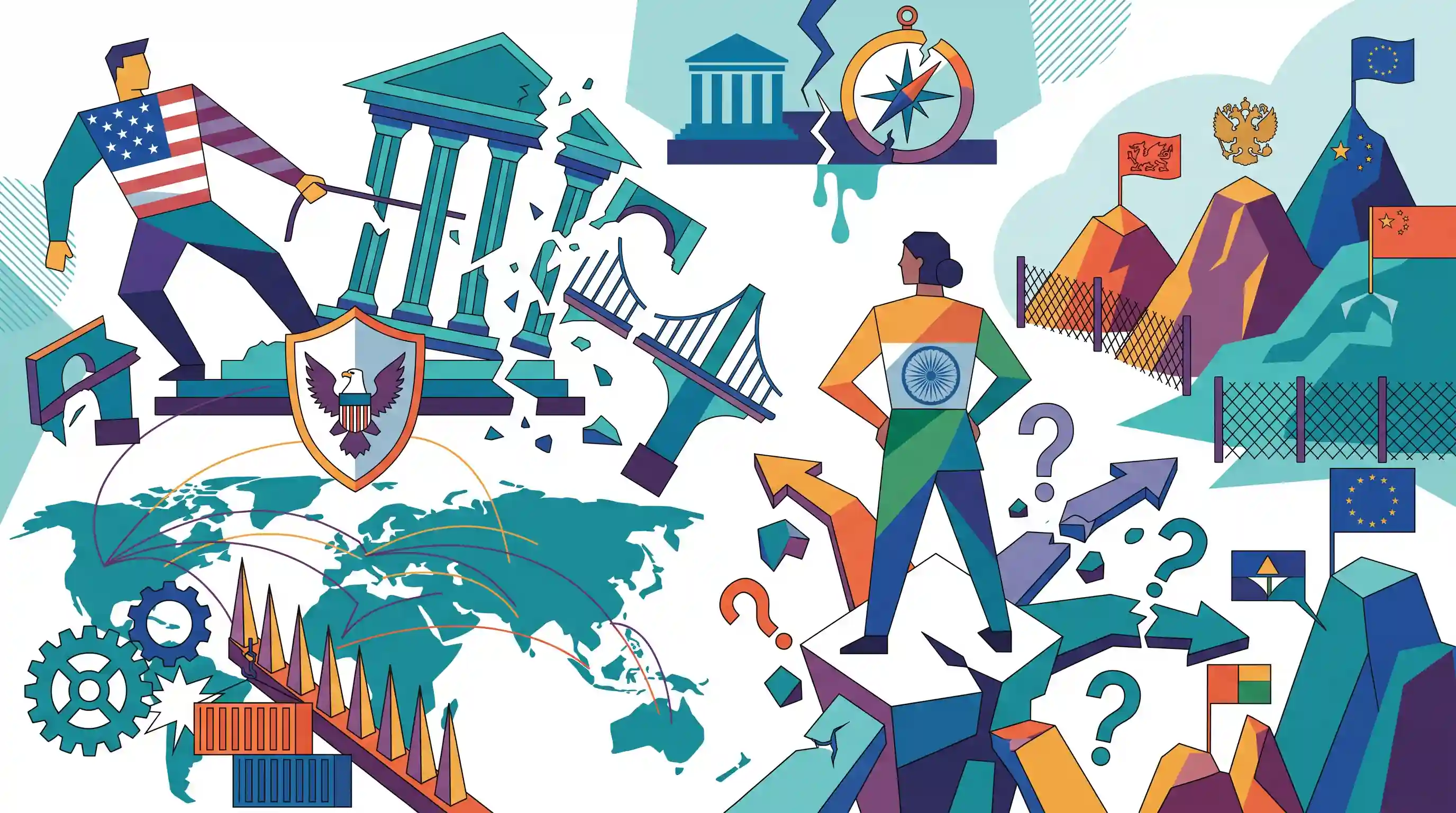
The article analyzes the profound structural shift in global geopolitics as the United States, under Donald Trump's administration, actively steps back from its historic role as the architect and guarantor of the post-WWII international order. Driven by the 'America First' doctrine, the US is retreating from multilateral institutions, embracing protectionist 'trade wars', and adopting a highly transactional approach to global alliances. This strategic withdrawal accelerates the waning of globalization and creates a significant power vacuum, cementing the transition toward a fragmented, multipolar world defined by sovereign nationalism. The resulting crisis in global governance institutions, such as the UN and WTO, presents complex challenges for nations like India in navigating an increasingly unpredictable and competitive international landscape.
Key Points
- The US, the principal architect of the post-WWII liberal international order (UN, Bretton Woods, WTO), is actively retreating from its leadership role under the Trump administration.
- The 'America First' doctrine emphasizes sovereign nationalism, protectionism, and transactional bilateralism over traditional alliances and multilateral cooperation.
- This shift accelerates the waning of globalization, escalating 'trade wars' and threatening the survival of rules-based trade architectures like the WTO.
- The US withdrawal creates a geopolitical vacuum, paving the way for a fragmented, multipolar world and intense great power rivalry, particularly with China.
- For countries like India, navigating this volatile emerging global order requires recalibrating strategies, balancing alliances, and adapting to the decline of traditional multilateral institutions.
Important Terms
America First Policy

A nationalist foreign policy prioritizing U.S. sovereignty and economic interests over international cooperation, typically involving protectionist trade measures and a withdrawal from multilateral treaties and global governance institutions.
UPSC context
GS Paper II: Effect of policies and politics of developed countries on India's interests and the rules-based global order.
Bretton Woods Institutions
The International Monetary Fund (IMF) and World Bank, established at the 1944 Bretton Woods Conference to manage the post-war global economy through financial stability and reconstruction.
UPSC context
GS Paper II/III: Important International institutions, their mandate, and the need for structural reforms in global finance.
World Trade Organization (WTO)
An intergovernmental organization regulating global trade; it currently faces a crisis due to the paralysis of its Appellate Body and the rise of unilateral trade wars.
UPSC context
GS Paper II/III: International institutions and trade agreements affecting India's economic interests and sovereignty.
Multilateralism
A diplomatic framework where multiple nations collaborate through international institutions to address global challenges, based on shared norms, inclusivity, and the principle of collective action.
UPSC context
GS Paper II: International relations, global groupings, and the transition from unipolarity to a multipolar world order.
Transactional Diplomacy
A foreign policy approach that treats international relations as short-term, zero-sum "deals" focused on immediate tangible gains rather than long-term strategic commitments or shared values.
UPSC context
GS Paper II: Changing nature of global politics and its impact on India’s strategic autonomy and bilateral partnerships.
Rules-Based International Order
A global governance framework where international relations are conducted according to established laws and norms rather than through the exercise of raw power or unilateralism.
UPSC context
GS Paper II: Important international agencies and the challenges posed by sovereign nationalism to global governance.
Prelims Trap
"The WTO, like the IMF and World Bank, is a Bretton Woods institution established after WWII."
While part of the liberal economic order, the WTO was established in 1995 (Marrakesh Agreement), replacing GATT. Only the IMF and World Bank are Bretton Woods institutions.
Static Concepts Connected
How does the WTO's origin differ from the Bretton Woods institutions?
- Bretton Woods (1944): The 1944 conference established the IMF and World Bank (IBRD) to manage post-war financial stability and reconstruction.
- GATT (1947): A provisional treaty created to reduce tariffs after the failure to create the broader International Trade Organization (ITO).
- WTO (1995): Formally established by the 1994 Marrakesh Agreement, superseding GATT and introducing a binding dispute settlement mechanism.
How does "Multi-Alignment" differ from traditional "Non-Alignment"?
- Non-Alignment (NAM): Historically focused on maintaining distance and neutrality from major Cold War power blocs (US vs. USSR).
- Multi-Alignment: Involves proactive, concurrent engagement with competing global powers (e.g., India participating in both the Quad and SCO).
- Strategic Autonomy: While both aim to preserve independent decision-making, multi-alignment is highly participatory and transactional rather than broadly ideological.
Cross-Topic Patterns
WTO crisis & the rise of Minilaterals
The US blocking of WTO Appellate Body judges has crippled multilateral dispute resolution, accelerating India's shift toward bilateral FTAs and regional frameworks like the Indo-Pacific Economic Framework (IPEF).
Trade wars accelerate de-dollarization pushes
US protectionism and weaponization of trade policies connect directly to the push by BRICS and the Global South to establish alternative payment mechanisms and localized currency settlements (de-dollarization).

A 2026 GS-II question will likely link the US retreat from WTO/UN leadership directly to India's necessity for "multi-alignment" strategies.
Linked PYQs · 4
Linked PYQs · 4
- 2025MainsGS2
"With the waning of globalization, post-Cold War world is becoming a site of sovereign nationalism.” Elucidate.
- 2025MainsGS2
"The reform process in the United Nations remains unresolved, because of the delicate imbalance of East and West and entanglement of the USA vs. Russo-Chinese alliance.” Examine and critically evaluate the East-West policy confrontations in this regard.
- 2018MainsGS2
What are the key areas of reform if the WTO has to survive in the present context of "Trade War', especially keeping in mind the interest of India?
- 2019MainsGS2
‘The long-sustained image of India as a leader of the oppressed and marginalised nations has disappeared on account of its new found role in the emerging global order.’ Elaborate.
