Retail Inflation Drops to 69 Month Low
Source:The Hindu ↗
Why It Matters
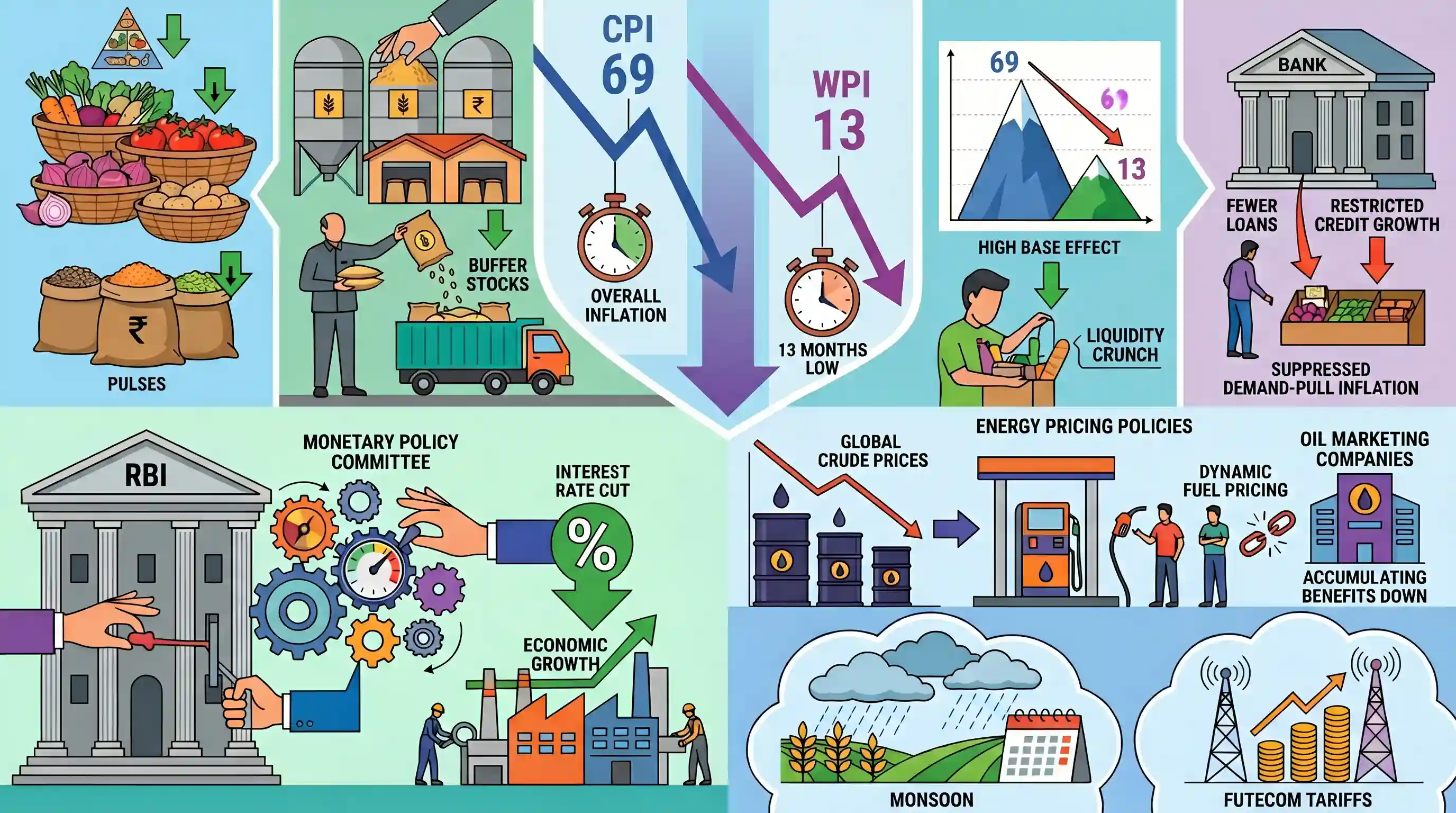
The article provides a real-time assessment of macroeconomic indicators (CPI, WPI) and the interplay between monetary policy (RBI/MPC) and fiscal/supply-side measures (buffer stocks, imports). It directly connects to the GS3 syllabus covering Indian Economy, Inflation, and Monetary Policy, offering excellent case study material for understanding how base effects, liquidity crunches, and administrative pricing (fuel) impact overall price stability.
Summary
The editorial analyzes India's latest inflation data, noting that retail inflation (CPI) has plummeted to a 69-month low and wholesale inflation (WPI) to a 13-month low. This favorable trajectory is primarily attributed to a high base effect, easing prices of essential food items like vegetables and pulses, and government interventions such as utilizing buffer stocks. Furthermore, a banking liquidity crunch has curtailed credit growth, suppressing demand-pull inflation. The cooling inflation environment supports the Reserve Bank of India's monetary policy stance, creating room for a potential interest rate cut by the Monetary Policy Committee in June to bolster economic growth. However, the author criticizes Oil Marketing Companies for failing to pass on the benefits of falling global crude prices to consumers, exposing the shortcomings of the dynamic fuel pricing policy. Ultimately, future inflation trends will hinge on the upcoming monsoon and potential adjustments in telecom tariffs.
Key Points
- Retail inflation (CPI) has cooled to a 69-month low, while wholesale inflation (WPI) dropped to a 13-month low, largely driven by a high base effect and easing food prices.
- The softening of prices validates the Reserve Bank of India\'s recent decisions to hold or cut interest rates, raising expectations for an MPC rate cut in June to stimulate GDP growth.
- Government supply-side measures, including the strategic release of buffer stocks and easing of import restrictions, played a crucial role in curbing food inflation, particularly for vegetables and pulses.
- A liquidity crunch in the banking system has constrained credit creation, indirectly acting as a disinflationary force by suppressing aggregate demand.
- Despite a 22-month low in WPI crude oil inflation, Oil Marketing Companies (OMCs) have not reduced retail fuel prices, indicating that the dynamic fuel pricing policy is not functioning as intended for consumers.
Important Terms
Consumer Price Index (CPI)

An index measuring price changes in a fixed basket of goods/services consumed by households. It serves as the primary gauge for retail inflation in India.
UPSC context
GS Paper 3 (Economy); tested for its components, base year (2012), and central role in RBI's inflation targeting.
Monetary Policy Committee (MPC)
A statutory 6-member body chaired by the RBI Governor that sets the benchmark repo rate to maintain price stability while supporting economic growth.
UPSC context
GS Paper 3 (Monetary Policy); tested for its composition, voting rules, and legal mandate under the RBI Act.
Base Effect
A distortion in current inflation or growth figures caused by exceptionally high or low values in the corresponding period of the previous year.
UPSC context
GS Paper 3 (Economy); tested in Prelims to explain sudden fluctuations in macroeconomic data despite moderate current price changes.
Dynamic Fuel Pricing
A market-linked system where retail petrol and diesel prices are revised daily by OMCs based on global crude oil rates and foreign exchange fluctuations.
UPSC context
GS Paper 3 (Energy/Infrastructure); relevant for discussing fuel inflation, energy security, and the impact of deregulation on consumers.
Oil Marketing Companies (OMCs)
State-owned or private entities involved in refining and distributing petroleum products. They are responsible for transmitting global oil price changes to domestic consumers.
UPSC context
GS Paper 3 (Economy); relevant to energy pricing, fiscal under-recoveries, and the corporate role in national energy security.
Buffer Stock
Strategic reserves of food grains (managed by FCI) used to handle supply shocks, stabilize market prices, and ensure food security.
UPSC context
GS Paper 3 (Food Security); tested for its role in the Public Distribution System (PDS) and price stabilization.
Prelims Trap
"A sharp drop in retail inflation to a 69-month low indicates that the absolute prices of commodities have decreased."
This confuses disinflation with deflation. A drop in the inflation rate means prices are still rising, but at a slower pace than before. Absolute prices do not fall unless inflation is negative.
Static Concepts Connected
How do CPI and WPI differ in their composition and usage?
- Food Weightage: CPI assigns nearly 46% weight to food, making it highly sensitive to food shocks. WPI assigns only about 24% to food articles.
- Services Inclusion: CPI measures the retail prices of both goods and services. WPI exclusively tracks the wholesale prices of goods, ignoring services entirely.
- Policy Anchor: Under the Flexible Inflation Targeting framework, the RBI explicitly targets CPI (Combined) at 4% (+/- 2%), not WPI.
What is the 'Base Effect' in the context of inflation?
- Statistical Distortion: It is a statistical phenomenon where the current period's inflation rate is heavily influenced by the price levels in the corresponding period of the previous year.
- High Base Impact: If inflation was exceptionally high in the same month last year, the current year's inflation rate mathematically appears lower, even if absolute prices continue to rise.
Cross-Topic Patterns
Supply-side vs Monetary Policy
RBI's rate hikes address demand-pull inflation, but structural food inflation is managed via supply-side interventions like FCI buffer stock releases and import tariff reductions.
Quasi-Administered Fuel Pricing
Despite the 2017 shift to 'Dynamic Fuel Pricing', implicit state control over OMCs means global crude drops rarely reach consumers, functioning as a stealth revenue mechanism.

Expect a multi-statement prelims question contrasting RBI's monetary tools with government supply-side interventions (FCI, OMCs) in 2026.
Linked PYQs · 5
Linked PYQs · 5
- 2024MainsGS3
What are the causes of persistent high food inflation in India? Comment on the effectiveness of the monetary policy of the RBI to control this type of inflation.
- 2024MainsGS3
Elucidate the importance of buffer stocks for stabilizing agricultural prices in India. What are the challenges associated with the storage of buffer stock? Discuss.
- 2020PrelimsGS1
Consider the following statements: 1. The weightage of food in Consumer Price Index (CPI) is higher than that in Wholesale Price Index (WPI). 2. The WPI does not capture changes in the prices of services, which CPI does. 3. Reserve Bank of India has now adopted WPI as its key measure of inflation and to decide on changing the key policy rates. Which of the statements given above is/are correct?
- 2011PrelimsGS1
A rapid increase in the rate of inflation is sometimes attributed to the “base effect”. What is “base effect”?
- 2022PrelimsGS1
In India, which one of the following is responsible for maintaining price stability by controlling inflation?
