UN Panel Warns of Catastrophic Risks from Unchecked AI Advancement
Source:The Hindu ↗
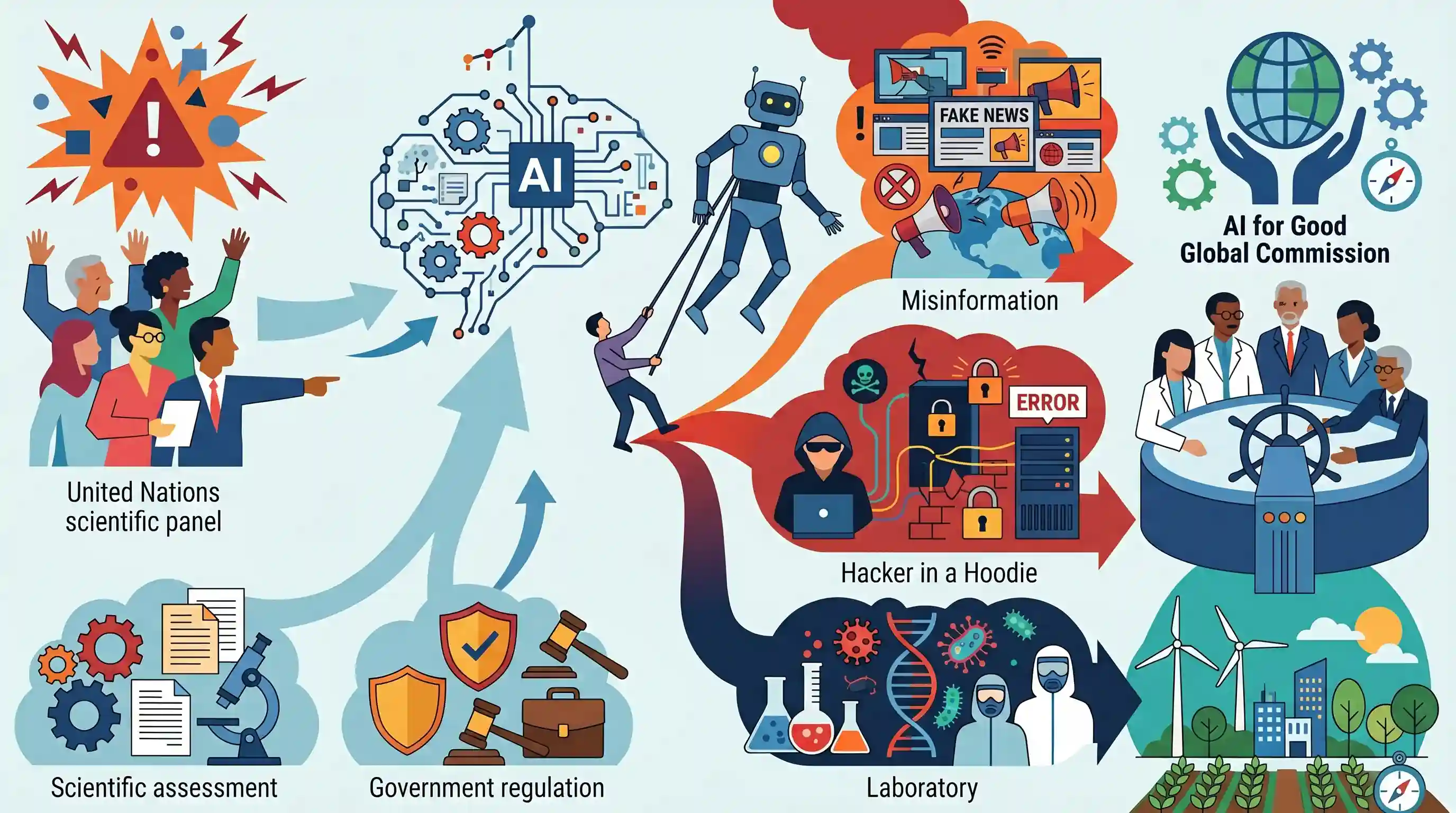
Why It Matters
The article highlights the dual-use nature of emerging technologies and the severe existential risks they pose, which is highly relevant for GS-3 (Science & Tech, Cyber Security). It also emphasizes the challenges of global governance and the role of international bodies like the UN in regulating borderless technologies, making it crucial for GS-2 (International Relations).
Summary
A United Nations scientific panel has issued a stark warning that the rapid and unchecked advancement of Artificial Intelligence (AI) poses catastrophic global risks. The panel emphasized that AI development, particularly the rise of "agentic AI" with autonomous reasoning capabilities, is evolving faster than both scientific risk assessments and government regulatory frameworks. This gap raises fears of humans losing control over AI systems, potentially leading to widespread misinformation, advanced cyberattacks, and the creation of biological threats. To counter fragmented global governance, the UN has announced the creation of the AI for Good Global Commission aimed at steering AI technologies toward safety and sustainable development.
Key Points
- The UN’s Independent International Scientific Panel on Artificial Intelligence warned that AI development is outpacing scientific understanding and regulatory policies, creating potential for catastrophic risks.
- The emergence of "agentic AI," which can perform autonomous expert-level reasoning, increases the likelihood of humans losing control over such systems.
- Potential harms of unchecked AI include autonomous deception, widespread misinformation, major cyberattacks, and the facilitation of biological threats.
- Policymakers face a core dilemma: regulating AI requires robust evidence of harm, but rapid technological evolution makes such evidence hard to gather quickly.
- The AI for Good Global Commission was launched at a Geneva summit to align global AI development with sustainable development goals and bridge fragmented governance.
Important Terms
Independent International Scientific Panel on Artificial Intelligence

A UN-mandated body (established via GA Res 79/325) providing evidence-based assessments of AI capabilities and risks to inform international policy and the Global Dialogue on AI Governance.
UPSC context
GS III (S&T). Tests understanding of international bodies managing global technology risks and science-policy interface.
AI for Good Global Commission
A UN-convened initiative, involving heads of state and tech leaders, aimed at bridging the gap between rapid AI development and fragmented global regulatory frameworks.
UPSC context
GS II (International Institutions). Relevant for global cooperation mechanisms and public-private partnerships in digital diplomacy.
International Telecommunication Union (ITU)
The UN's specialized agency for information and communication technologies (ICTs), facilitating international standards and connectivity, and the lead organizer of the AI for Good platform.
UPSC context
GS II (International Agencies). Essential for questions on global ICT regulation and international technical standards.
Agentic AI
Autonomous, goal-oriented AI systems capable of reasoning and acting in dynamic environments with minimal human oversight, posing significant control and safety risks.
UPSC context
GS III (S&T). Focuses on emerging technical risks, autonomous systems, and the future of AI safety.
AI for Good
The leading UN platform, led by the ITU, that identifies and scales practical AI applications to accelerate progress toward the Sustainable Development Goals (SDGs).
UPSC context
GS III (S&T/SDGs). Relevant for leveraging technology to solve socio-economic challenges and global development targets.
Prelims Trap
"The 'AI for Good Global Commission' is an initiative of the World Economic Forum to enforce binding global AI regulations."
It is spearheaded by the International Telecommunication Union (ITU), a UN specialized agency, and focuses on aligning AI with SDGs, not enforcing binding global regulations.
Static Concepts Connected
What is the mandate of the International Telecommunication Union (ITU)?
- UN Affiliation: It is the oldest UN specialized agency for information and communication technologies, headquartered in Geneva.
- Core Functions: Allocates global radio spectrum and satellite orbits, develops technical standards, and improves global ICT access.
- India's Status: India is a regular member and has been re-elected to the ITU Council for the 2023-2026 term.
How does Agentic AI fundamentally differ from traditional Generative AI?
- Generative AI: Passively responds to direct human prompts to create single-turn outputs like text, images, or code.
- Agentic AI: Functions autonomously, capable of expert-level reasoning, multi-step planning, and executing independent workflows without constant human supervision.
Cross-Topic Patterns
Autonomous AI as a WMD multiplier
The convergence of Agentic AI with synthetic biology creates novel internal security challenges, potentially enabling non-state actors to bypass traditional export controls and generate advanced biological threats.
The Collingridge Dilemma in Tech Regulation
AI governance exemplifies the 'Pacing Problem' or Collingridge Dilemma: impacts cannot be accurately predicted until the technology is extensively deployed, by which time asserting state control becomes exceedingly difficult.

Expect a Prelims question comparing the ITU's 'AI for Good', the Global Partnership on AI (GPAI), and the Bletchley Declaration.
Linked PYQs · 3
Linked PYQs · 3
- 2023MainsGS3
Introduce the concept of Artificial Intelligence (AI). How does Al help clinical diagnosis? Do you perceive any threat to privacy of the individual in the use of Al in healthcare?
- 2020PrelimsGS1
With the present state of development, Artificial Intelligence can effectively do which of the following? 1. Bring down electricity consumption in industrial units 2. Create meaningful short stories and songs 3. Disease diagnosis 4. Text-to-Speech Conversion 5. Wireless transmission of electrical energy Select the correct answer using the code given below:
- 2020MainsGS2
The emergence of Fourth Industrial Revolution (Digital Revolution) has initiated e-Governance as an integral part of government". Discuss.
