MGNREGS Resumption Delay and Centre State Labour Budget Friction
Source:Indian Express ↗
Why It Matters
The issue illustrates the practical challenges in cooperative federalism, particularly how financial dependence and administrative controls in centrally sponsored schemes like MGNREGS can become friction points between the Centre and the States, directly impacting rural livelihoods.
Summary
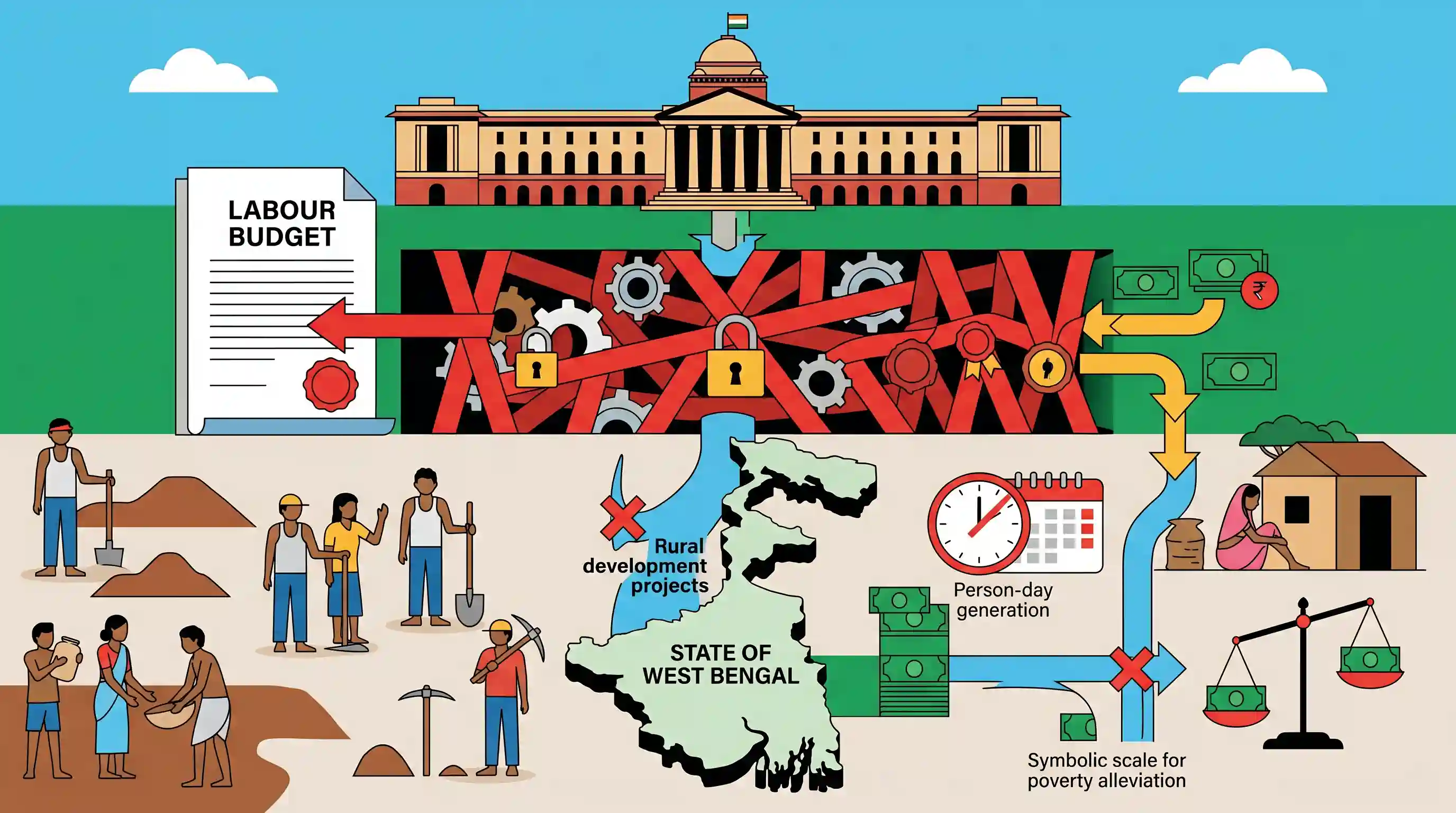
The resumption of the Mahatma Gandhi National Rural Employment Guarantee Scheme (MGNREGS) in West Bengal remains uncertain as the Union Government has yet to clear the state's labour budget. This delay creates an administrative bottleneck that stalls the generation of person-days and payment of wages, adversely affecting rural employment and poverty alleviation in the state. The situation underscores the ongoing friction in Centre-State relations and the vulnerabilities of centrally sponsored schemes to political and administrative hurdles.
Key Points
- The resumption of the Mahatma Gandhi National Rural Employment Guarantee Scheme (MGNREGS) in West Bengal is facing uncertainty.
- The primary cause of the uncertainty is the Union Government's delay in clearing the labour budget for the state.
- The clearance of the labour budget is necessary to generate person-days and facilitate wage payments to rural workers under the scheme.
- The delay highlights ongoing friction in Centre-State financial relations and the challenges of implementing centrally sponsored schemes in opposition-ruled states.
- Such delays can severely impact rural employment and poverty alleviation efforts, depriving workers of their guaranteed wages.
Important Terms
Mahatma Gandhi National Rural Employment Guarantee Scheme (MGNREGS)

A demand-driven legal guarantee providing at least 100 days of unskilled manual work annually to every rural household, aimed at enhancing livelihood security and creating durable assets.
UPSC context
GS-II (Welfare Schemes) and GS-III (Employment/Inclusive Growth); tested for its rights-based approach and implementation challenges.
Labour Budget
An annual estimate of anticipated labour demand and planned works prepared by states; it serves as the basis for the Union Government to release scheme funds.
UPSC context
GS-II/III (Government Policies/Economy); critical for understanding administrative bottlenecks and the financial planning cycle of rural schemes.
Fiscal Federalism
The division of financial powers and responsibilities between the Union and State governments, encompassing tax devolution, grants-in-aid, and the management of shared resources.
UPSC context
GS-II (Indian Constitution/Federalism); explores tensions in Centre-State financial relations and the autonomy of states in welfare spending.
Centrally Sponsored Schemes (CSS)
Social welfare programs funded jointly by the Centre and States (typically in 60:40 or 90:10 ratios) but implemented by State governments to achieve national developmental goals.
UPSC context
GS-II (Functions/Responsibilities of Union/States); tests knowledge of intergovernmental transfers and implementation hurdles in a federal setup.
Person-days
A unit of measurement for employment generated under welfare schemes, representing one day of work performed by one individual.
UPSC context
GS-III (Economic Development/Employment); used as a primary metric for assessing the performance and reach of rural job schemes.
Prelims Trap
"The Central Government bears the cost of the unemployment allowance under MGNREGA."
While the Centre funds 100% of unskilled wages, the statutory liability to pay the unemployment allowance (if work isn't given within 15 days) falls strictly on the State Government.
Static Concepts Connected
How are costs distributed between the Centre and States under MGNREGA?
- Unskilled Wages: The Central Government bears 100% of the statutory wage costs for unskilled manual labour.
- Material Costs: Material costs and wages for skilled/semi-skilled workers are shared in a 75:25 ratio between the Centre and the respective State.
- Unemployment Allowance: The State Government bears 100% of the financial burden for the unemployment allowance if work is not provided within 15 days.
What is the statutory basis for suspending MGNREGS funds to a State?
- Section 27 Power: Section 27 of the MGNREGA Act, 2005 empowers the Centre to order investigations and halt the release of funds to a specific state.
- Trigger Conditions: This power is typically invoked in cases of prima facie financial irregularities, corruption, or failure to comply with central operational and auditing directives.
- Labour Budget Link: Central funds are also strictly contingent upon the prior approval of a State's projected "Labour Budget" for the year.
Cross-Topic Patterns
Fiscal Federalism & Article 282
Withholding CSS funds under statutory clauses mirrors broader debates over Article 282 discretionary grants and the centralisation of public finance management systems (PFMS) against opposition-ruled states.
Demand-Driven vs Budget-Constrained
MGNREGA is legally demand-driven, but the prerequisite of a Centre-approved "Labour Budget" effectively imposes a financial ceiling, creating a clash between statutory rights and fiscal limits.

Expect a 2026 prelims question mixing MGNREGA funding ratios, Section 27 fund-stoppage powers, and state liabilities for unemployment.
Linked PYQs · 4
Linked PYQs · 4
- 2025MainsGS2
Examine the evolving pattern of Centre-State financial relations in the context of planned development in India. How far have the recent reforms impacted the fiscal federalism in India?
- 2024MainsGS2
What changes has the Union Government recently introduced in the domain of Centre-State relations ? Suggest measures to be adopted to build the trust between the Centre and the States and for strengthening federalism.
- 2011PrelimsGS1
Among the following who are eligible to benefit from the “Mahatma Gandhi National Rural Employment Guarantee Act”?
- 2006PrelimsGS1
Consider the following statements in respect of welfare schemes launched by the Ministry of Rural Development, Government of India. 1. Drinking water for rural areas in one of the components of the Bharat Nirman Plan. 2. NREGA 2005 provides that statutory minimum wage for agricultural workers must be paid.
