External Demand Uncertainty Poses Risks to Indian Growth
Source:The Hindu ↗
Why It Matters
It highlights the macroeconomic challenges posed by global tariff policies (like those of the US) to Indian exports and MSMEs, providing a clear context for questions on the resilience of the Indian economy, the strategic utility of FTAs, and the RBI's current monetary policy and growth outlook.
Summary
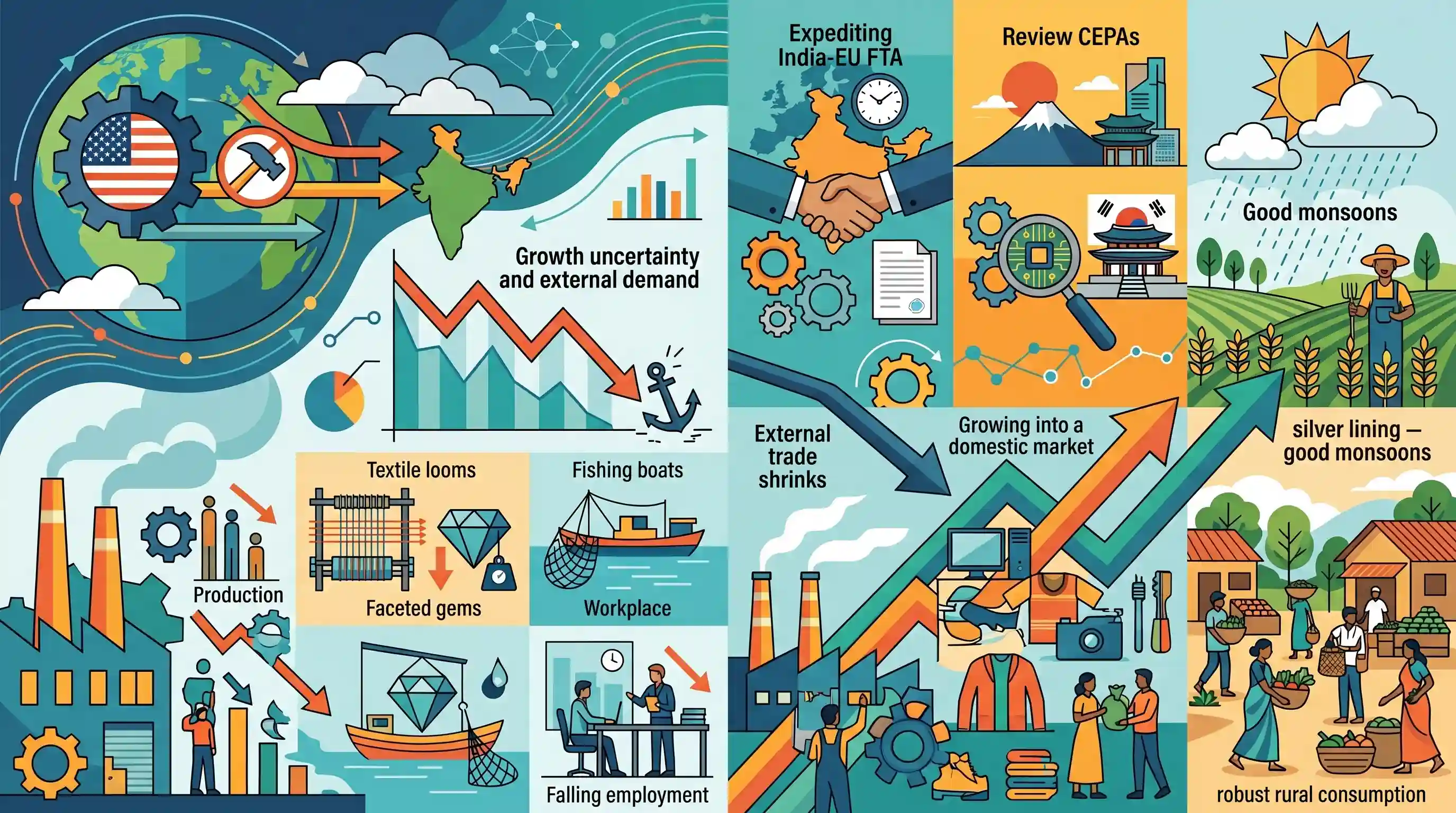
According to the recently released minutes of the RBI's Monetary Policy Committee (MPC) meeting, uncertainty in external demand due to global tariffs and geopolitical tensions remains a significant drag on India's economic growth. RBI Governor Sanjay Malhotra and external members noted that US tariffs could dent India's growth rate and severely impact job-intensive MSME export sectors such as textiles, gems, and fisheries. To counter this, experts suggest expediting the India-EU Free Trade Agreement (FTA), reviewing Comprehensive Economic Partnership Agreements (CEPAs) with Japan and South Korea, and reducing import dependence by tapping into the domestic market. However, favorable supply-side factors like good monsoons and robust rural consumption offer a silver lining.
Key Points
- RBI MPC members flagged external demand uncertainty, driven by global tariffs and geopolitical tensions, as a major hurdle to private investment and economic growth.
- Favorable monsoons and strong reservoir levels have boosted farm output, driving buoyant rural consumption, despite sluggishness in urban spending.
- Recently announced 25% US tariffs on India threaten to reduce GDP growth by 20-30 basis points and cause distress in labor-intensive MSME export sectors like textiles, leather, and gems.
- MPC members advocated for diversifying export markets by expediting the India-EU FTA and reviewing existing trade pacts (CEPAs) with Japan and South Korea.
- Promoting domestic value addition, creating global Indian brands, and leveraging Overseas Direct Investments (ODI) were highlighted as strategies to minimize import dependence.
Important Terms
Monetary Policy Committee (MPC)

A statutory body under Section 45ZB of the RBI Act (1934) that determines the policy interest rate (repo rate) required to achieve the inflation target (4% +/- 2%).
UPSC context
GS Paper III (Economy). Essential for questions on inflation targeting, liquidity management, and institutional economic frameworks.
India-EU Free Trade Agreement (FTA)
A trade pact aimed at reducing or eliminating tariffs on goods and services between India and the 27-member European Union to boost bilateral trade and investment.
UPSC context
GS Paper II (International Relations) and III (Economy). Tests knowledge of bilateral trade barriers and export diversification strategies.
Comprehensive Economic Partnership Agreement (CEPA)
A comprehensive trade agreement covering goods, services, investment, and regulatory issues (IPR, competition). It represents a deeper level of economic integration than a standard FTA.
UPSC context
GS Paper II (IR) and III (Economy). Vital for understanding India's trade architecture with partners like Japan, South Korea, and the UAE.
Micro, Small and Medium Enterprises (MSMEs)
Enterprises classified by investment and turnover limits under the MSMED Act. They are vital for employment, contributing nearly 45% of India's total exports.
UPSC context
GS Paper III (Economy/Employment). Focuses on industrial growth, rural development, and the impact of global trade shocks on labor-intensive sectors.
Reserve Bank of India (RBI)
India's central bank and regulatory body, established in 1935, responsible for monetary policy, currency issuance, and maintaining financial stability and foreign exchange reserves.
UPSC context
GS Paper III (Economy). Core topic for central banking functions, regulatory reforms, and the leadership role of the Governor.
Prelims Trap
The Monetary Policy Committee (MPC) is empowered to recommend trade policies and negotiate FTAs.
The MPC's statutory mandate under the RBI Act is solely to determine the policy interest rate for inflation targeting. It does not formulate or recommend trade policies or FTAs.
Static Concepts Connected
What is the composition and mandate of the Monetary Policy Committee (MPC)?
- Composition: Six members: 3 from RBI (including Governor as ex-officio chair) and 3 external members appointed by the Central Government.
- Mandate: To determine the policy repo rate required to achieve the inflation target (4% with a band of +/- 2%).
- Decision Making: Decisions are taken by majority vote. The RBI Governor does not have a veto but holds a casting vote in a tie.
How does a Comprehensive Economic Partnership Agreement (CEPA) differ from a traditional FTA?
- Broader Scope: While traditional FTAs focus mainly on reducing tariffs on goods, CEPAs are broader, encompassing trade in services, investments, and regulatory cooperation.
- Key Examples: India currently has operational CEPAs with countries like Japan, South Korea, and the UAE. The Asian CEPAs are currently under review.
Cross-Topic Patterns
US Tariffs & Labor-Intensive MSMEs
The 25% US tariff threat directly exposes vulnerabilities in India's export-oriented MSMEs (textiles, gems), linking global protectionism to domestic employment and industrial policy challenges in GS3.
CEPA Reviews & Trade Deficits
India's push to review CEPAs with Japan and South Korea stems from inverted duty structures and skewed trade deficits, a recurring theme when analyzing India's pivot away from RCEP.

Expect a 2026 Prelims question testing the distinction between FTAs, CEPAs, and CECAs, linked to India's rising trade deficit with Asia.
Linked PYQs · 3
Linked PYQs · 3
- 2023MainsGS3
Faster economic growth requires increased share of the manufacturing sector in GDP, particularly of MSMEs. Comment on the present policies of the Government in this regard.
- 2021MainsGS3
Do you agree that the Indian economy has recently experienced V-shaped recovery? Give reasons in support of your answer.
- 2019MainsGS2
‘The time has come for India and Japan to build a strong contemporary relationship, one involving global and strategic partnership that will have a great significance for Asia and the world as a whole.’ Comment.
