Great Nicobar Mega Infrastructure Project and Environmental Concerns
Source:The Hindu ↗
Why It Matters
The Great Nicobar project is a highly contested mega-infrastructure plan. It touches on key UPSC themes across GS2 and GS3: the tension between ecological preservation and strategic infrastructure development, the scientific validity of long-distance compensatory afforestation, and the legal/constitutional rights of Particularly Vulnerable Tribal Groups (PVTGs) under the Forest Rights Act.
Summary
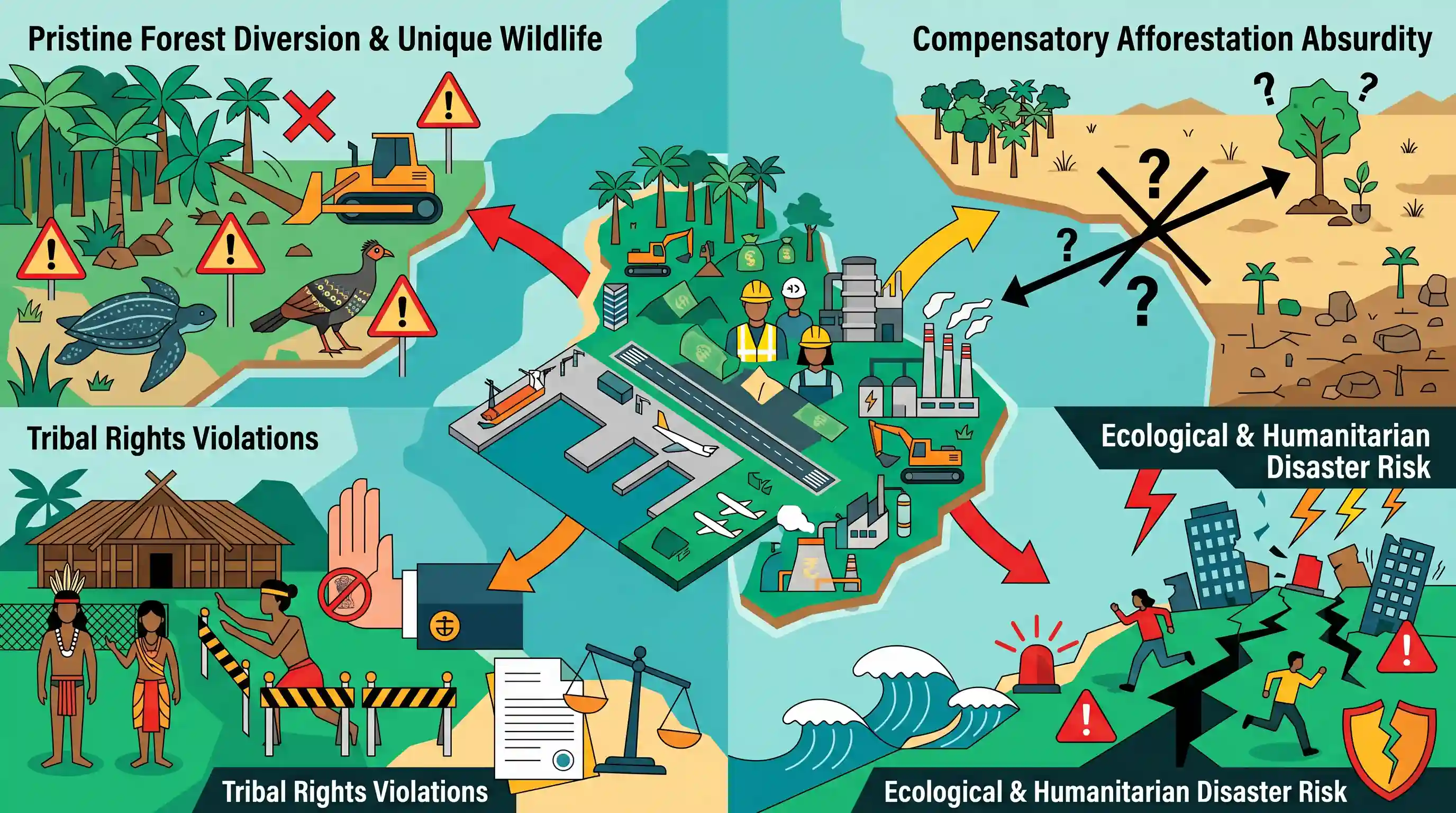
Congress leader Jairam Ramesh sharply criticized Environment Minister Bhupender Yadav for failing to provide concrete answers regarding the ₹72,000 crore Great Nicobar mega infrastructure project. Ramesh raised multiple ecological and legal red flags, noting that the project will divert massive tracts of pristine forest, jeopardizing unique wildlife like leatherback turtles and megapodes. He highlighted the absurdity of conducting compensatory afforestation in Haryana, far from the project site's tropical ecology. Furthermore, Ramesh alleged severe violations of the Forest Rights Act (2006) and the RFCTLARR Act (2013), stating that the government bypassed the Tribal Council and ignored the potential displacement of the vulnerable Shompen and Nicobarese tribes. Finally, he cited the region's vulnerability as a high-seismic zone to argue that the project risks becoming an 'ecological and humanitarian disaster.'
Key Points
- Congress leader Jairam Ramesh criticized Environment Minister Bhupender Yadav for evading specific queries regarding the ₹72,000 crore Great Nicobar mega infrastructure project.
- The project involves diverting over 13,000 hectares of forest land in an ecologically sensitive zone, threatening species like leatherback turtles, megapodes, and local coral systems.
- Ramesh questioned the ecological logic of carrying out compensatory afforestation in Haryana, which is thousands of kilometers away and has a completely different ecosystem.
- The project is alleged to have bypassed the Tribal Council of Great Nicobar, violating the Forest Rights Act of 2006 and risking the displacement of the Shompen (a PVTG) and Nicobarese tribes.
- The project's location in a high-seismic zone (impacted by the 2004 tsunami) and potential Coastal Regulation Zone (CRZ) violations were also highlighted as major disaster risks.
Important Terms
Forest Rights Act (FRA), 2006

Statutory law recognizing the rights of forest-dwelling Scheduled Tribes and other traditional forest dwellers to land and resources. It mandates Gram Sabha consent before forest land is diverted for development.
UPSC context
GS2 (Social Justice) and GS3 (Environment). Tests knowledge of indigenous rights and legal hurdles in infrastructure development.
RFCTLARR Act, 2013
Replaced the 1894 Act to ensure fair compensation, mandatory Social Impact Assessments, and rehabilitation for displaced persons. It requires 70-80% community consent for private or PPP projects.
UPSC context
GS2 (Governance) and GS3 (Land Reforms). Essential for understanding land acquisition ethics and displacement issues.
Island Coastal Regulation Zone (ICRZ)
Specific environmental regulations for India's islands (Andaman & Nicobar, Lakshadweep) that restrict construction in ecologically sensitive coastal zones to protect mangroves, corals, and nesting grounds.
UPSC context
GS3 (Environment and Disaster Management). Tests understanding of coastal protection laws and environmental clearance processes.
Shompen Policy (2015)
A 2015 government framework prioritizing the welfare and habitat protection of the Shompen, a Particularly Vulnerable Tribal Group (PVTG). It mandates caution and consultation for developmental projects.
UPSC context
GS2 (Vulnerable Sections). Crucial for questions on PVTGs and the ethical "Development vs. Tribal Rights" debate.
National Commission for Scheduled Tribes (NCST)
A constitutional body (Article 338A) mandated to monitor tribal safeguards and investigate grievances. It has flagged procedural lapses in tribal consent for the Nicobar project.
UPSC context
GS2 (Constitutional Bodies). Relevant for its role in oversight and protecting minority rights against state actions.
Compensatory Afforestation
A legal mechanism requiring project proponents to fund afforestation on alternative land to balance forest loss. In the Nicobar case, afforestation in Haryana has sparked ecological suitability debates.
UPSC context
GS3 (Environment). Tests the effectiveness of the CAMPA framework and the logic of "ecological equivalence."
Tribal Council of Great Nicobar
The primary representative governance body for the islands' indigenous people; its withdrawal of a 'No Objection Certificate' in 2022 is a central legal point in the Nicobar dispute.
UPSC context
GS2 (Governance and PESA-like structures). Demonstrates the role of local tribal institutions in national-level project approvals.
Prelims Trap
Both the Shompen and the Nicobarese tribes of Great Nicobar are classified as Particularly Vulnerable Tribal Groups (PVTGs).
While the Shompen are an isolated PVTG, the Nicobarese are a Scheduled Tribe but NOT classified as a PVTG, as they are largely assimilated and agrarian.
Static Concepts Connected
How does Compensatory Afforestation work across state borders in India?
- Legal Mandate: Under the Forest (Conservation) Act, diverting forest land requires planting trees over equivalent non-forest land or degraded forest.
- Inter-state Allocation: If a UT like Andaman & Nicobar lacks suitable land, afforestation can legally be executed in another state (e.g., Haryana) using transferred CAMPA funds.
- Ecological Criticism: Environmentalists argue that replacing tropical island rainforests with semi-arid continental plantations violates the ecological principle of equivalent biodiversity.
What are the Coastal Regulation Zone (CRZ) rules for strategic island infrastructure?
- CRZ 2019 Notification: Regulates industrial and commercial activities within up to 500m of the High Tide Line based on the Shailesh Nayak Committee recommendations.
- Strategic Exemptions: Defence and strategic national security projects can receive exemptions even in the most ecologically sensitive CRZ-I zones, utilizing special EIA clearance pathways.
Cross-Topic Patterns
PVTG Protection vs. FRA 2006 Compliance
The bypassing of the Great Nicobar Tribal Council tests the Forest Rights Act (2006) provision that Gram Sabha consent is mandatory before diverting forest land inhabited by traditional forest dwellers.
Great Nicobar & The Malacca Dilemma
India's push for the Galathea Bay transshipment port is heavily driven by its proximity to the Malacca Strait, countering China's 'String of Pearls' and securing Indian Ocean maritime routes.
Seismic Zone V & Disaster Resilience
Great Nicobar falls in Seismic Zone V. Building heavy infrastructure here directly connects GS1 Geography to GS3 Disaster Management and the need for Coalition for Disaster Resilient Infrastructure (CDRI) guidelines.

A 2026 prelims question will likely fuse Great Nicobar's geography (Galathea Bay), endemic ecology (Leatherback turtles), and PVTGs.
Linked PYQs · 5
Linked PYQs · 5
- 2009PrelimsGS1
In which one of the following places is the Shompen tribe found?
- 2017PrelimsGS1
Which of the following is geographically closest to Great Nicobar?
- 2013PrelimsGS1
Under the Scheduled Tribes and Other Traditional Forest Dwellers (Recognition of Forest Rights) Act, 2006, who shall be the authority to initiate the process for determining the nature and extent of individual or community forest rights or both?
- 2021PrelimsGS1
At the national level, which ministry is the nodal agency to ensure effective implementation of the Scheduled Tribes and Other Traditional Forest Dwellers (Recognition of Forest Rights) Act, 2006?
- 2014MainsGS3
Environmental Impact Assessment studies are increasingly undertaken before a project is cleared by the Government. Discuss the environmental impacts of coal-fired thermal plants located at coal pitheads.
