Delays in Caste Violence Trials Highlight Criminal Justice Lags
Source:Indian Express ↗
Why It Matters
The Una case serves as a critical case study on the intersection of caste discrimination, mob violence, and judicial delays. It illustrates the practical hurdles in accessing justice for marginalized groups, questioning the efficacy of statutory protections like the SC/ST Act, which is highly relevant for GS Paper 1 (Society), GS Paper 2 (Social Justice), and GS Paper 3 (Internal Security).
Summary
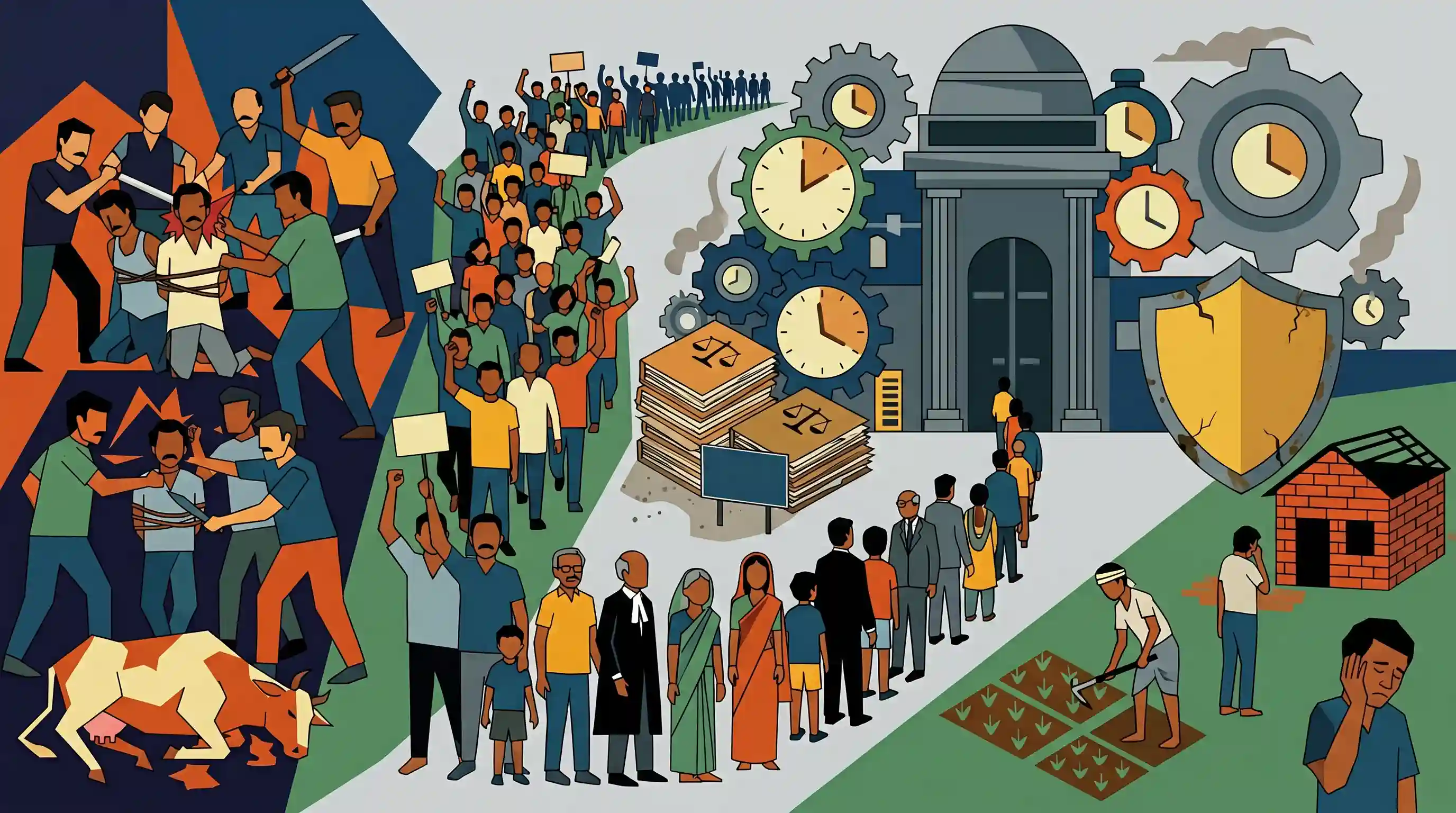
Nine years after the horrific Una flogging case in Gujarat, where members of the Dalit Sarvaiya family were assaulted by cow vigilantes, the pursuit of justice remains agonizingly slow. The protracted trial in the special atrocity court exemplifies the systemic delays in the Indian criminal justice system, particularly concerning atrocities against marginalized communities. Despite the incident sparking widespread Dalit assertion and a refusal to continue traditional caste-based occupations, the victims continue to struggle for socio-economic rehabilitation and psychological closure. The ongoing delay undermines the protective mandate of the SC/ST (Prevention of Atrocities) Act and highlights the severe human cost of pending litigations.
Key Points
- Nine years after the infamous 2016 Una flogging incident, the victimized Sarvaiya family continues to await justice, underscoring the severe delays in India's criminal justice system.
- The incident, where Dalit men were publicly flogged by cow vigilantes for skinning a dead cow, sparked massive outrage and catalyzed Dalit assertion movements across Gujarat.
- The protracted legal battle has taken a heavy toll on the victims' socio-economic well-being and psychological closure, highlighting the challenges vulnerable communities face in seeking legal recourse.
- The slow pace of the trial raises concerns regarding the effective implementation and deterrence value of the SC/ST (Prevention of Atrocities) Act.
Important Terms
Scheduled Castes and the Scheduled Tribes (Prevention of Atrocities) Act, 1989

A 1989 law designed to prevent crimes and humiliation against SC/ST communities, establishing special courts for speedy trials and providing for victim relief and rehabilitation.
UPSC context
GS Paper II (Social Justice); critical for understanding legal safeguards and administrative measures for vulnerable sections.
Special Atrocity Court
Dedicated courts mandated under Section 14 of the SC/ST (PoA) Act to ensure the speedy trial of offenses committed against marginalized communities.
UPSC context
GS Paper II (Judiciary); tests knowledge of specialized judicial mechanisms for reducing case pendency in social justice matters.
Cow Vigilantism
Extrajudicial actions by self-appointed groups to enforce cattle protection laws, frequently involving violence against Dalits and minorities engaged in traditional cattle-related trades.
UPSC context
GS Paper I (Social Empowerment) and GS Paper III (Internal Security); relevant for communal harmony and rule-of-law challenges.
Dalit Assertion
A socio-political movement where Dalit communities reclaim identity, demand equal rights, and reject traditional caste-based subordination or occupations.
UPSC context
GS Paper I (Indian Society); important for studying social movements and changing power dynamics in India.
Socio-economic Rehabilitation
Mandated measures under the SC/ST Act, including financial aid, employment, and land restoration, to restore the dignity and livelihoods of atrocity victims.
UPSC context
GS Paper II (Social Justice); focuses on the state's duty to provide restorative justice to marginalized survivors.
Prelims Trap
"Trials under the SC/ST (PoA) Act are mandated to be completed within six months of filing the charge sheet."
The 2015 Amendment Act strictly mandates that trials in Special Courts be completed within two months of filing the charge sheet, not six months.
Static Concepts Connected
What are the key changes introduced by the SC/ST (PoA) Amendment Act, 2015?
- Strict Time Limit: Statutorily requires trials to be completed within two months from the date of filing the charge sheet.
- Special Courts: Mandated the establishment of Exclusive Special Courts and specified Special Public Prosecutors to take direct cognizance of offences.
- Expanded Scope: Recognized new offences including manual scavenging, garlanding with footwear, tonsuring, and denying access to irrigation facilities.
How is the Right to Speedy Trial constitutionally protected in India?
- Article 21 Basis: The Supreme Court originally ruled in the Hussainara Khatoon case (1979) that a speedy trial is an implicit fundamental right under Article 21.
- Process as Punishment: Protracted trials without conviction amount to 'process as punishment', which violates constitutional liberties and can be grounds for bail despite stringent statutory bars.
Cross-Topic Patterns
Mob Lynching and Tehseen Poonawalla guidelines
Vigilantism acts as an extra-judicial tool of social coercion. UPSC links this directly to the Supreme Court's 2018 Tehseen Poonawalla guidelines mandating state nodal officers to prevent mob lynching.
Dalit Assertion and Economic Land Demands
The Una incident shifted movements from purely social dignity protests to structural economic demands, sparking mass renunciation of caste-based occupations (like carcass disposal) in exchange for alternative land rights.

Mains 2026 will likely feature a question analyzing why statutory safeguards like the SC/ST Act's 2-month trial mandate fail in practice.
Linked PYQs · 3
Linked PYQs · 3
- 2015MainsGS1
Debate the issue of whether and how contemporary movements for assertion of Dalit identity work towards annihilation of caste.
- 2018MainsGS1
Caste system is assuming new identities and associational forms. Hence, caste system cannot be eradicated in India." Comment.
- 2017MainsGS3
Mob violence is emerging as a serious law and order problem in India. By giving suitable examples, analyze the causes and consequences of such violence.
