International court rebukes Israel over Gaza aid restrictions
Source:Indian Express ↗
Why It Matters
The event highlights the mechanics and limitations of international jurisprudence (ICJ and ICC) during active conflicts. For UPSC aspirants, understanding the mandates, differences, and practical effectiveness of bodies like the ICJ, ICC, and UN agencies (UNRWA) is crucial for General Studies Paper II.
Summary
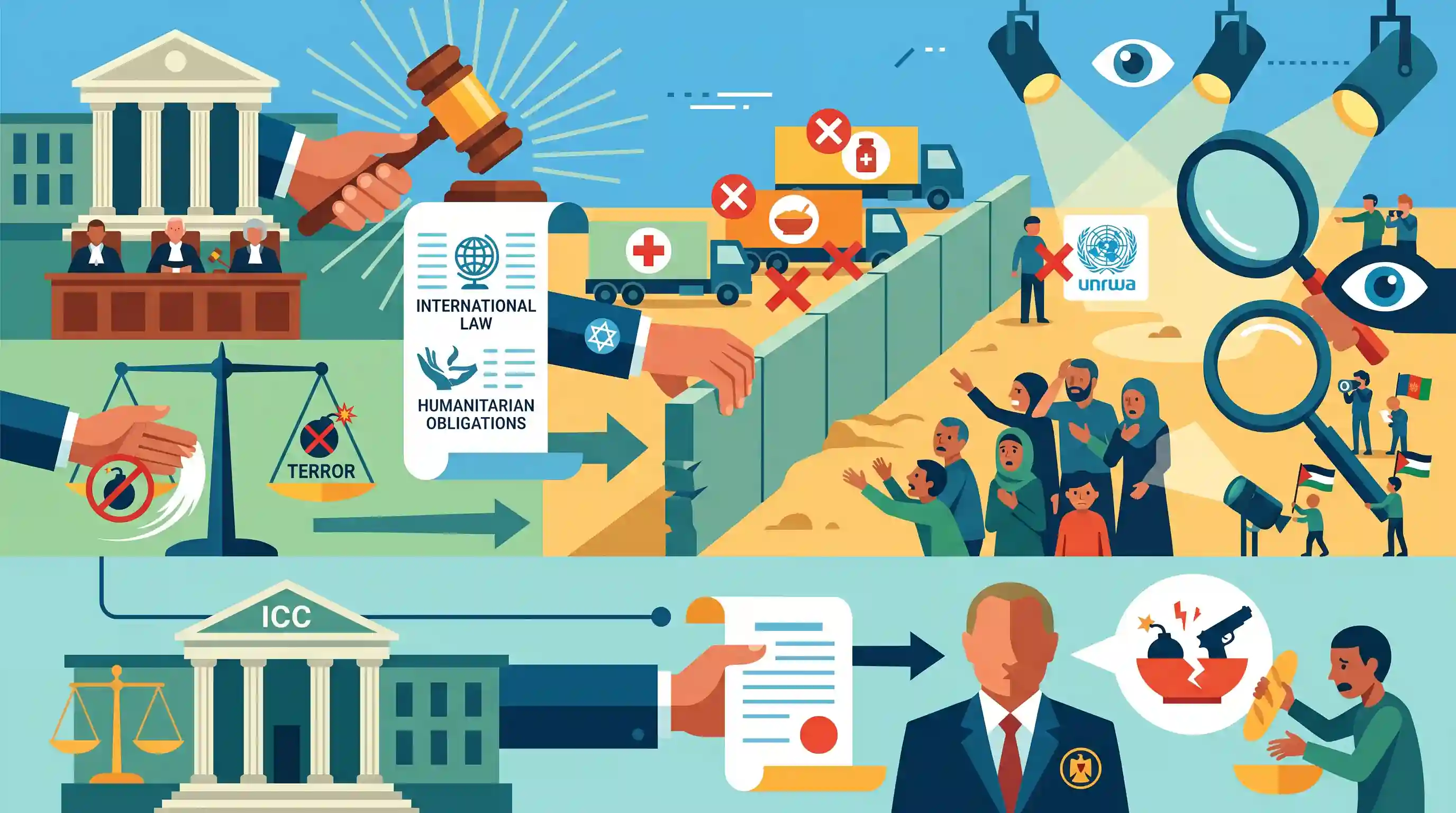
The UN's top court, the International Court of Justice (ICJ), rebuked Israel for restricting humanitarian aid groups and banning UNRWA operations in Gaza, ruling it a violation of international obligations. The ICJ ordered Israel to facilitate relief schemes and dismissed its claims of UNRWA terror links as unsubstantiated. While Israel rejected the nonbinding advisory opinion, the ruling amplifies global scrutiny of the humanitarian crisis. Furthermore, the decision intersects with ongoing International Criminal Court (ICC) efforts to secure arrest warrants for Israeli leaders, including Prime Minister Benjamin Netanyahu, over allegations of weaponising starvation.
Key Points
- The International Court of Justice (ICJ) issued an advisory opinion directing Israel to lift its ban on UNRWA operations and allow unhindered humanitarian aid delivery into Gaza.
- Israel rejected the ruling, accusing the ICJ of bias and claiming UNRWA is infiltrated by Hamas—allegations the ICJ found to be unsubstantiated.
- Although ICJ advisory opinions are nonbinding, the ruling bolsters global diplomatic pressure and scrutinizes Israel's adherence to international obligations.
- The ICJ's stance provides legal reinforcement for concurrent International Criminal Court (ICC) proceedings seeking arrest warrants against Israeli leaders for allegedly using starvation as a method of warfare.
Important Terms
International Court of Justice (ICJ)

The principal judicial organ of the United Nations (UN), established in 1945. It settles legal disputes between states and provides advisory opinions on legal questions referred by authorized UN organs and agencies.
UPSC context
GS-II: International Institutions; tests UN structure, jurisdiction, and India’s representation (e.g., Justice Dalveer Bhandari).
International Criminal Court (ICC)
An independent permanent court that prosecutes individuals for the most serious international crimes, including genocide, war crimes, and crimes against humanity. It is governed by the Rome Statute (1998).
UPSC context
GS-II: Global Governance; relevant for individual accountability and India’s non-signatory status to the Rome Statute.
International Humanitarian Law (IHL)
A body of rules (primarily the Geneva Conventions) that seeks to limit the effects of armed conflict by protecting non-combatants and restricting the means and methods of warfare.
UPSC context
GS-II: International Law; vital for topics on human rights, ethics in war, and global conflict resolution.
United Nations Relief and Works Agency (UNRWA)
A UN agency established in 1949 to provide education, healthcare, and relief services specifically to Palestinian refugees. It operates in Gaza, the West Bank, Jordan, Lebanon, and Syria.
UPSC context
GS-II: Important Agencies; significant for understanding West Asian geopolitics and humanitarian aid architecture.
Advisory Opinion
A legal statement issued by the ICJ on a matter of international law at the request of UN organs. Unlike judgments in contentious cases, these are generally non-binding but carry moral authority.
UPSC context
GS-II: Judiciary/IR; tests understanding of the ICJ’s unique jurisdiction and its role in clarifying international legal obligations.
Prelims Trap
"ICJ advisory opinions are legally binding on all UN member states involved in the conflict."
ICJ advisory opinions carry legal weight and moral authority but are strictly non-binding. Only its judgments in contentious cases between states are legally binding.
Static Concepts Connected
What are the primary differences between the ICJ and the ICC?
- Jurisdiction: ICJ settles state-to-state disputes. The ICC prosecutes individuals for international crimes like genocide and war crimes.
- Origin: ICJ is a principal organ of the UN. The ICC is an independent institution established by the Rome Statute.
- Scope of Power: ICJ cannot try non-state actors; ICC can try individuals from non-member states if crimes occur on a State Party's territory.
How is UNRWA uniquely structured compared to other UN agencies?
- Specific Mandate: Created in 1949 specifically for Palestine refugees in defined regions, unlike UNHCR which has a global refugee mandate.
- Voluntary Funding: It relies almost entirely on voluntary contributions from UN member states rather than mandatory assessed UN budgets.
Cross-Topic Patterns
Global South & International Law
South Africa's initial ICJ case and the ICC warrants highlight the Global South actively using international legal mechanisms to challenge actions by Western-backed nations.
Starvation as a War Crime
The ICC's focus on starvation intersects with the Geneva Conventions. UPSC often tests specific humanitarian terms like 'collective punishment' or 'starvation' as war crimes.

Expect a Prelims multi-statement question contrasting ICJ vs ICC jurisdiction, especially focusing on the Rome Statute and non-member states.
Linked PYQs · 3
Linked PYQs · 3
- 2015PrelimsGS1
Amnesty International is
- 2018MainsGS2
“India’s relations with Israel have, of late, acquired a depth and diversity, which cannot be rolled back.” Discuss.
- 2025MainsGS2
"The reform process in the United Nations remains unresolved, because of the delicate imbalance of East and West and entanglement of the USA vs. Russo-Chinese alliance.” Examine and critically evaluate the East-West policy confrontations in this regard.
