Election Commission Special Intensive Revision of Electoral Rolls
Source:Indian Express ↗
কেন এটি গুরুত্বপূর্ণ
This article highlighted the constitutional role of the ECI, statutory provisions under RPA 1950 for voter list revisions, and how India defends its sovereign democratic processes against allegations of discrimination raised by UN human rights bodies. It serves as an important case study for GS2 questions on the functioning of constitutional bodies, electoral integrity, and international relations.
সারসংক্ষেপ
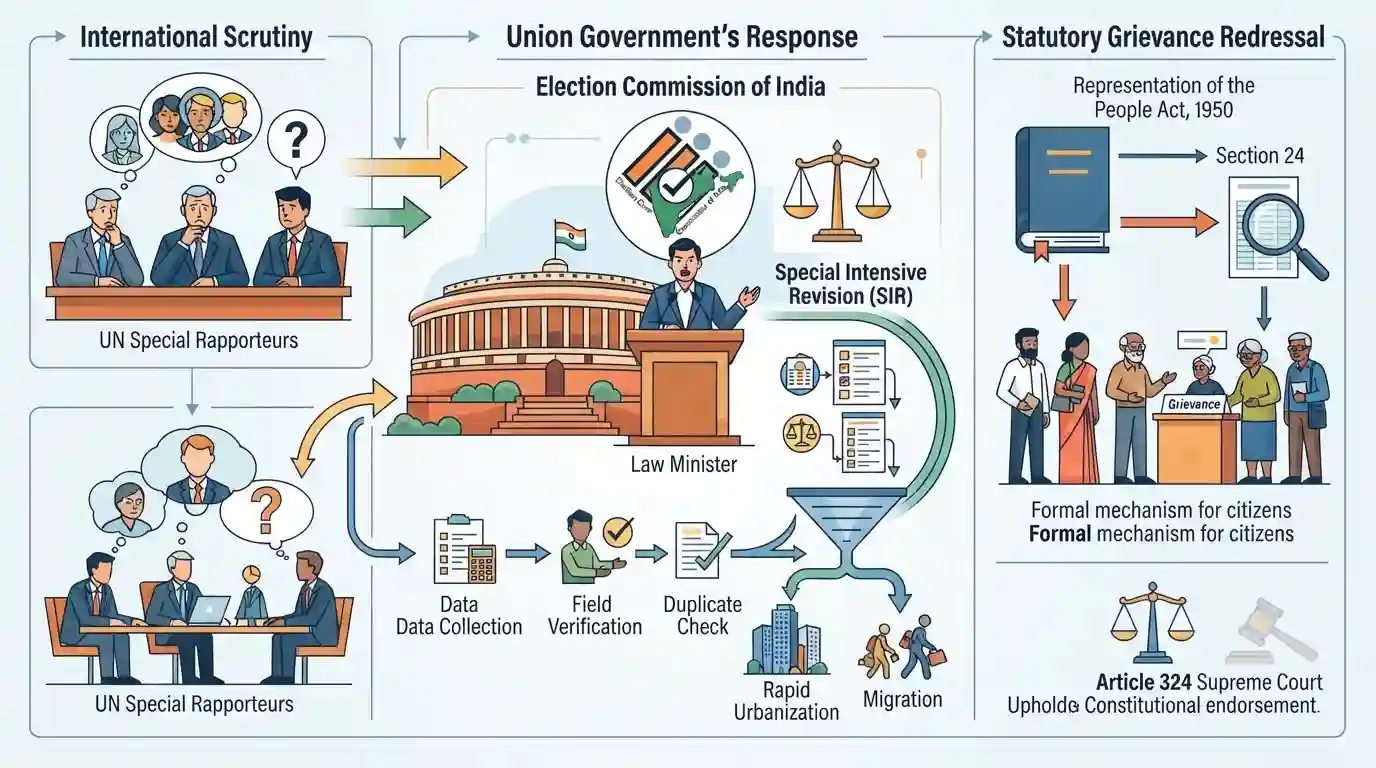
The Union Government has responded to concerns raised by three UN Special Rapporteurs regarding the alleged targeted deletion of Bengali and Muslim electors under the Election Commission of India's (ECI) Special Intensive Revision (SIR) of electoral rolls. Speaking in the Rajya Sabha, Law Minister Arjun Ram Meghwal maintained that the SIR is a constitutional exercise under Article 324, upheld by the Supreme Court, and executed with strict adherence to due process to eliminate duplicate entries arising from rapid urbanization and migration. The government emphasized the availability of robust statutory grievance redressal mechanisms under Section 24 of the Representation of the People Act, 1950, to address any discrepancy in voter deletions.
মূল বিষয়
- Three UN Special Rapporteurs (on minority issues, freedom of expression, and freedom of religion) raised concerns with the Indian government regarding the alleged targeted deletion of Bengali and Muslim voters during the ECI's Special Intensive Revision (SIR).
- The Union Government, through Law Minister Arjun Ram Meghwal in the Rajya Sabha, clarified that the SIR was carried out following the due process of law without prejudice to any group or community.
- The government underscored that the preparation and revision of electoral rolls is a constitutional mandate of the ECI under Article 324, and the Supreme Court has previously upheld the ECI's power to conduct the SIR.
- Socio-economic shifts, rapid urbanization, and migration frequently result in duplicate or incorrect entries, necessitating regular and intensive clean-ups of the rolls.
- Grievances and errors can be redressed through internal ECI quality checks, during the 'claims and objections' phase, or via statutory appeals to the District Magistrate and Chief Electoral Officer under Section 24 of the Representation of the People Act, 1950.
- The SIR exercise has so far resulted in the deletion of over 5 crore electors across 10 states and 3 Union Territories since its commencement in June 2025.
প্রিলিমস ফাঁদ
The statutory process for voter registration, revision of electoral rolls, and associated appeals is governed under the Representation of the People Act, 1951.
The registration of electors, preparation of electoral rolls, and statutory appeals (Section 24) are governed by the RPA 1950, whereas RPA 1951 deals with the conduct of elections.
সংযুক্ত স্থির ধারণা
What is the operational distinction between RPA 1950 and RPA 1951?
- RPA 1950 scope: Governs the allocation of seats, delimitation of constituencies, voter qualifications, and the preparation/revision of electoral rolls.
- RPA 1951 scope: Governs the actual conduct of elections, administrative machinery, qualifications/disqualifications of MPs/MLAs, corrupt practices, and election disputes.
- Section 24 (1950): Provides the legal pathway for appeals against voter deletions, routing them to the District Magistrate and Chief Electoral Officer.
What are UN Special Rapporteurs and their mandate?
- Status and Appointment: Independent human rights experts appointed by the UN Human Rights Council to report on thematic or country-specific situations.
- Independence: They are not UN staff, do not receive salaries, and act in their personal capacity to maintain neutrality.
- Legal Weight: Their findings, communications, and reports are advisory and hold no binding legal authority over sovereign nations.
আন্তঃবিষয় প্যাটার্ন
Sovereignty vs International Human Rights Scrutiny
Evaluates how domestic electoral integrity measures (Article 324) intersect with international treaties like the ICCPR, creating tensions between sovereign democratic processes and global human rights watchdogs.
Technology and Voter De-duplication Ethics
Links the ECI's push for technology-driven electoral clean-ups (de-duplication algorithms) with the socio-political challenges of marginalization and unintentional voter disenfranchisement.

Multi-statement MCQ will test the statutory division between RPA 1950 and 1951, specifically targeting electoral roll appeal pathways.
সংযুক্ত PYQ · 3
সংযুক্ত PYQ · 3
- 2022MainsGS2
Discuss the role of the Election Commission of India in the light of the evolution of the Model Code of Conduct.
- 2017MainsGS2
To enhance the quality of democracy in India the Election Commission of India has proposed electoral reforms in 2016. What are the suggested reforms and how far are they significant to make democracy successful?
- 2024MainsGS2
Examine the need for electoral reforms as suggested by various committees with particular reference to "one nation one election" principle.
