गाजा शांति योजना पर यूएनएससी विचार-विमर्श
स्रोत:द हिंदू ↗
क्यों मायने रखता है
यह लेख मध्य पूर्व में संघर्ष समाधान के समकालीन प्रयासों को दर्शाता है और संयुक्त राष्ट्र सुरक्षा परिषद (UN Security Council) के भीतर संरचनात्मक गतिरोधों और महाशक्ति प्रतिद्वंद्विता (US बनाम रूस) को उजागर करता है, जो अंतरराष्ट्रीय संस्थानों और वैश्विक राजनीति पर GS Paper 2 के विषयों के लिए अत्यधिक प्रासंगिक है।
सारांश
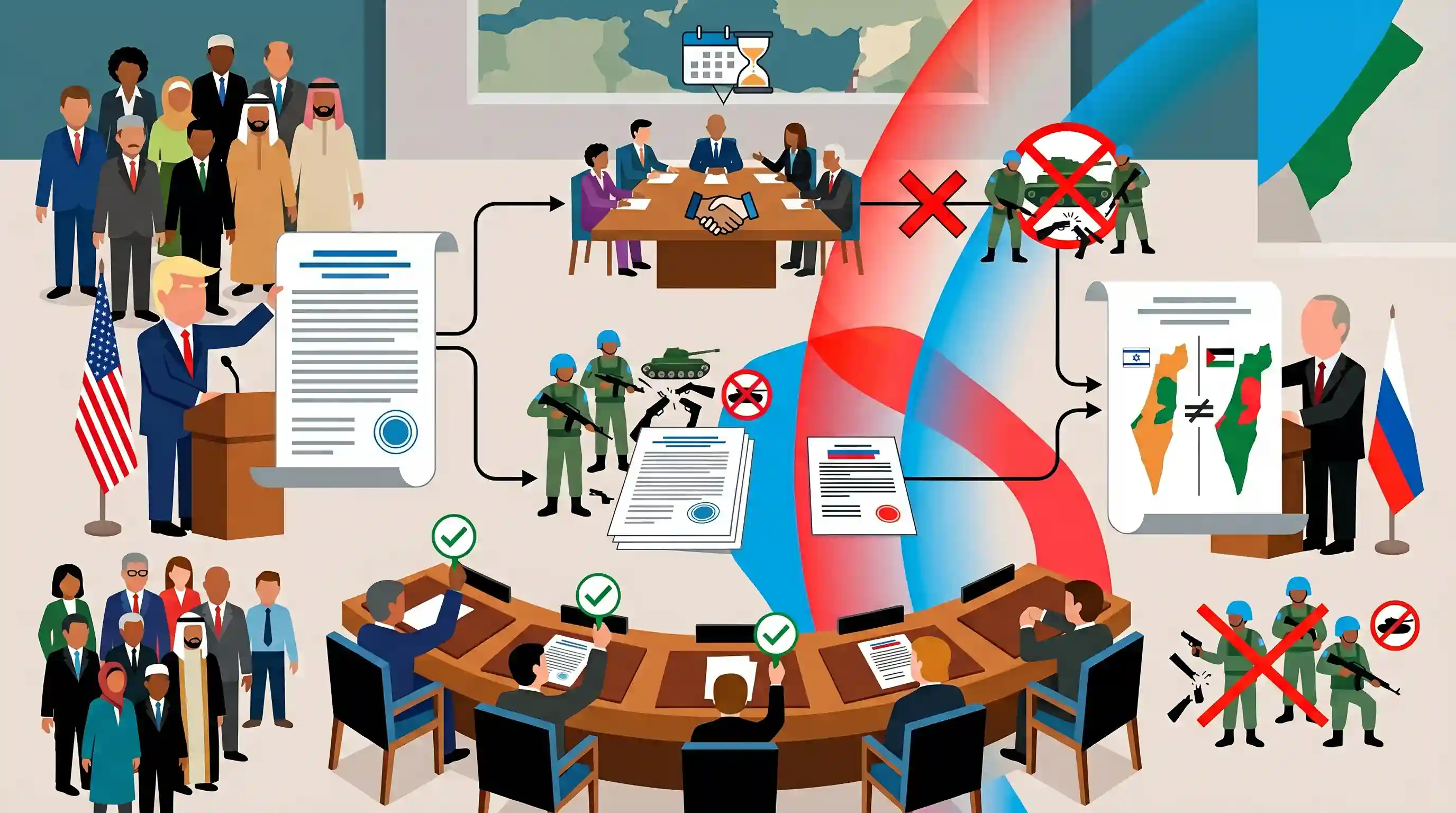
The UN Security Council is scheduled to vote on a US-drafted resolution endorsing President Donald Trump's peace plan for Gaza. The plan introduces a transitional "Board of Peace," proposed to be chaired by Trump until 2027, and authorizes an International Stabilization Force (ISF) to demilitarize the region. Supported by key Arab and Muslim nations, the US draft faces opposition from Russia, which has circulated a rival resolution reaffirming a two-state solution while rejecting the immediate deployment of the ISF and the proposed Board of Peace. This diplomatic clash highlights ongoing US-Russia divisions within the UNSC regarding Middle East peace processes.
मुख्य बिंदु
- The UN Security Council will vote on November 17 on a US-drafted resolution backing Donald Trump's peace plan for Gaza.
- The plan proposes a transitional 'Board of Peace' for Gaza, chaired by Trump until the end of 2027.
- It authorizes a temporary International Stabilization Force (ISF), involving Israeli, Egyptian, and Palestinian forces, to demilitarize Gaza and secure its borders.
- The US resolution is supported by several Arab and Muslim-majority nations, including Egypt, Saudi Arabia, UAE, Turkey, and Qatar.
- Russia has introduced a competing draft emphasizing the traditional two-state solution, opposing the immediate ISF deployment, and omitting mention of the Board of Peace.
महत्वपूर्ण शब्द
Trump's Gaza Plan

A 20-point US-led diplomatic framework proposed in late 2025 to end the Israel-Hamas conflict, involving a phased ceasefire, hostage-prisoner swaps, and internationalized governance of the Gaza Strip.
UPSC context
Relevant for GS-II: International Relations. Tests understanding of West Asian geopolitics and the role of major powers in conflict resolution.
Board of Peace (BoP)
An international transitional body established under UNSC Resolution 2803, chaired by Donald Trump, to provide strategic oversight and financial mobilization for Gaza's postwar administration until 2027.
UPSC context
GS-II: International Institutions. Examines unique governance models and the shifting role of non-state or hybrid international oversight bodies.
International Stabilization Force (ISF)
A UN-authorized multinational peacekeeping force mandated to demilitarize Gaza, secure borders, and train a new Palestinian police force, ideally composed of troops from regional and Muslim-majority nations.
UPSC context
GS-II: Global Groupings. Tests concepts of UN-mandated security interventions, "peacebuilding," and challenges in multinational military cooperation.
UNSC Resolution 2803
The November 2025 UN measure that endorsed the US peace plan for Gaza, authorizing the Board of Peace and the ISF with a 13-0 vote.
UPSC context
GS-II: International Institutions. Significant for understanding UN voting patterns, the use of abstentions by P5 members (Russia/China), and international law.
National Committee for the Administration of Gaza (NCAG)
An apolitical body of Palestinian technocrats and international experts proposed to manage Gaza's day-to-day public services under the supervision of the Board of Peace.
UPSC context
GS-II: Important International Institutions. Relates to "transitional governance" and the practical challenges of administrative reconstruction in conflict zones.
प्रारंभिक ट्रैप
The proposed International Stabilization Force (ISF) in Gaza is a traditional UN Peacekeeping mission bound by the principle of non-use of force.
Unlike traditional UN Peacekeeping, stabilization forces are authorized for robust operations, meaning they can actively use force to enforce order and neutralize spoilers.
संबंधित अवधारणाएँ
How do UN Peacekeeping Operations differ from Stabilization Forces?
- UN Peacekeeping: Traditionally operates under Chapter VI of the UN Charter, strictly adhering to principles of consent, impartiality, and non-use of force except in self-defense.
- Stabilization Forces: Often operates under Chapter VII mandates, authorized to use active force to neutralize spoilers, protect civilians, and robustly enforce regional order.
- Command Structure: ISFs are frequently multinational coalitions authorized by the UN Security Council, but not necessarily under direct "blue-helmet" UN command structures.
What is the voting procedure in the UN Security Council?
- Substantive Matters: Decisions on non-procedural (substantive) matters require 9 affirmative votes out of 15, including the concurring votes of all five permanent members (P5).
- Veto Power: A negative vote from any P5 member (US, UK, France, Russia, China) completely blocks a resolution, regardless of majority support.
- Abstention: Under established UNSC practice, if a P5 member abstains from voting, it is not considered a veto, allowing the resolution to pass if it secures 9 votes.
अंतर-विषय पैटर्न
Abraham Accords to Pragmatic Security Alignments
The backing of this US plan by Saudi Arabia and UAE signals a continuation of the Abraham Accords' pragmatic shift, prioritizing regional stabilization over the strict historical pre-condition of immediate Palestinian statehood.
US-Russia UNSC Deadlock and Peace Architectures
Just as in the Syrian context, the UNSC is fractured. Russia uses the traditional 'Two-State' paradigm to block US attempts at creating novel, ad-hoc governance structures like the Board of Peace.

Expect a multi-statement question contrasting traditional UN Peacekeeping principles with robust UN-authorized Stabilization Forces in 2026.
संबद्ध PYQ · 4
संबद्ध PYQ · 4
- 2025MainsGS2
"The reform process in the United Nations remains unresolved, because of the delicate imbalance of East and West and entanglement of the USA vs. Russo-Chinese alliance.” Examine and critically evaluate the East-West policy confrontations in this regard.
- 2024MainsGS2
‘Terrorism has become a significant threat to global peace and security.’ Evaluate the effectiveness of the United Nations Security Council's Counter Terrorism Committee (CTC) and its associated bodies in addressing and mitigating this threat at the international level.
- 2015MainsGS2
Discuss the impediments India is facing in its pursuit of a permanent seat in UN Security Council.
- 2022PrelimsGS1
The term "Levant" often heard in the news roughly corresponds to which of the following regions?
