United Nations sanctions and conflict atrocities in Sudan
Source:The Hindu ↗
Why It Matters
The ongoing civil war in Sudan highlights the severe humanitarian crises resulting from internal conflicts and ethnic violence. Understanding the geopolitical geography of the region, the mechanisms of UN sanctions, and the impact of non-state actors like the RSF is vital for International Relations and Geography sections.
Summary
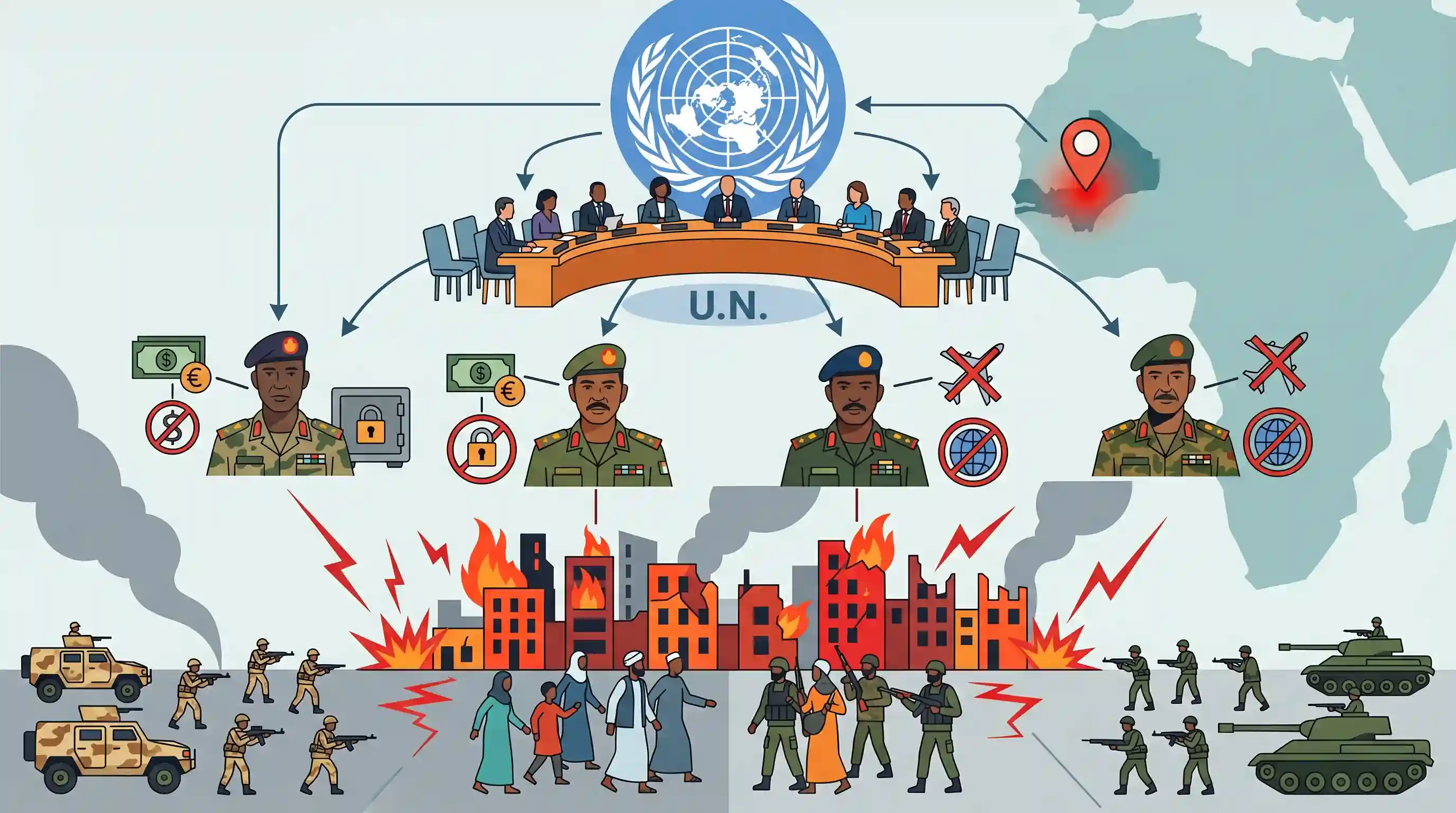
The U.N. Security Council has imposed sanctions, including asset freezes and travel bans, on four high-ranking commanders of Sudan's Rapid Support Forces (RSF) for alleged atrocities and acts of genocide committed during the capture of El-Fasher in North Darfur. A U.N. probe found the RSF responsible for horrific human rights abuses, primarily targeting the ethnic Zaghawa population, amidst the ongoing civil war that began in April 2023 between the RSF and Sudan's regular army.
Key Points
- The U.N. Security Council sanctioned four RSF commanders for atrocities and acts of genocide during the siege and capture of El-Fasher in North Darfur.
- The RSF targeted the ethnic Zaghawa population with summary executions, sexual violence, and mass detention.
- The conflict in Sudan between the Rapid Support Forces (RSF) and the regular army began in April 2023, leading to massive displacement and hunger.
- The current U.N. sanctions follow the historical context of the early 2000s Darfur war, which previously prompted a 2005 U.N. sanctions regime and arms embargo.
Important Terms
Rapid Support Forces (RSF)

A Sudanese paramilitary group led by Mohamed Hamdan Dagalo (Hemedti). Evolved from Darfur's Janjaweed militias, it is currently warring against Sudan's regular army for national control.
UPSC context
GS-II (International Relations); Prelims (Places/Entities in News). Tests knowledge of global conflict actors and humanitarian crises.
UN Security Council (UNSC)
A principal UN organ charged with maintaining international peace. It holds the unique power to issue binding resolutions, including sanctions and military authorizations under Chapter VII.
UPSC context
GS-II (International Org). Tests understanding of global governance, veto powers, and enforcement mechanisms in conflict zones.
Sudan Sanctions Regime
A framework of measures (including arms embargoes, asset freezes, and travel bans) established primarily by Resolution 1591 (2005) to penalize those fueling conflict in Darfur.
UPSC context
GS-II (International Relations). Relates to UN intervention strategies and the legal tools used to deter war crimes.
El Fasher
The strategic capital of North Darfur state. It recently became a flashpoint for mass atrocities and genocide allegations following its capture by paramilitary forces.
UPSC context
Prelims (Places in News). Frequent mapping/location-based question target regarding ongoing global humanitarian disasters.
Zaghawa
A non-Arab ethnic group inhabiting western Sudan and eastern Chad. They have been specifically targeted for ethnic cleansing during conflicts in the Darfur region.
UPSC context
Prelims (Tribes/Ethnic Groups in News). Tests awareness of ethnic dimensions in international conflicts and human rights.
Janjaweed
Pro-government Arab militias active during the 2003 Darfur war, notorious for "scorched earth" tactics. They served as the structural and personnel predecessor to the RSF.
UPSC context
GS-II (International Relations). Important for historical context of the Sudanese civil war and evolution of non-state actors.
Prelims Trap
UNSC sanctions on Sudan under Chapter VII automatically involve the deployment of UN armed peacekeepers.
Under UN Charter Article 41, UNSC sanctions (asset freezes, travel bans) specifically exclude the use of armed force. Military intervention requires authorization under Article 42.
Static Concepts Connected
What is the geopolitical significance of the Darfur region?
- Geography: Located in western Sudan, it shares borders with Libya, Chad, and the Central African Republic.
- Demographics: Home to non-Arab native groups like the Zaghawa, Fur, and Masalit, who frequently face ethnic violence from Arab militias.
- Conflict zone: Epicenter of a major humanitarian crisis since the early 2000s, currently besieged in the RSF vs SAF civil war.
Under what authority does the UN Security Council impose sanctions?
- UN Charter: The UNSC uses Chapter VII (Article 41) of the UN Charter to maintain or restore international peace and security.
- Non-military measures: Measures include economic embargoes, travel bans, arms embargoes, and asset freezes on targeted individuals or entities.
- Binding nature: Sanctions imposed by the UNSC under Chapter VII are legally binding on all UN member states.
Cross-Topic Patterns
Sudan conflict & Indian evacuation diplomacy
The RSF-SAF civil war triggered 'Operation Kaveri' in 2023. UPSC frequently tests India's diaspora evacuation operations (Ganga, Ajay, Devi Shakti) alongside the geopolitical conflicts that necessitated them.
UNSC Sanctions vs. ICC Jurisdiction
Atrocities in Darfur historically triggered ICC indictments (e.g., Omar al-Bashir). The current sanctions highlight the dual track of UNSC political embargoes versus ICC criminal prosecution for genocide.

Expect a 'Places in News' match-the-following pairing El-Fasher/Darfur with Sudan, or a question on ethnic groups like the Zaghawa.
Linked PYQs · 3
Linked PYQs · 3
- 2023PrelimsGS1
In the recent years Chad, Guinea, Mali and Sudan caught the international attention for which one of the following reasons common to all of them?
- 2023PrelimsGS1
Consider the following pairs: Area of conflict mentioned in news Country where it is located 1. Donbas : Syria 2. Kachin : Ethiopia 3. Tigray : North Yemen How many of the above pairs are correctly matched?
- 2022PrelimsGS1
Consider the following statements: 1. Bidibidi is a large refugee settlement in north-western Kenya. 2. Some people who fled from South Sudan civil war live in Bidibidi. 3. Some people who fled from civil war in Somalia live in Dadaab refugee complex in Kenya. Which of the statements given above is/are correct?
