Humanitarian Crisis and Mass Displacement Amid Resumed Gaza Conflict
Source:The Hindu ↗
Why It Matters
The Gaza humanitarian crisis highlights the complex geopolitical dynamics of the Middle East, the structural limitations of the UN and its specialized agencies in conflict zones, and the critical importance of upholding international humanitarian law. This is highly relevant for GS Paper 2 (International Relations and Global Institutions).
Summary
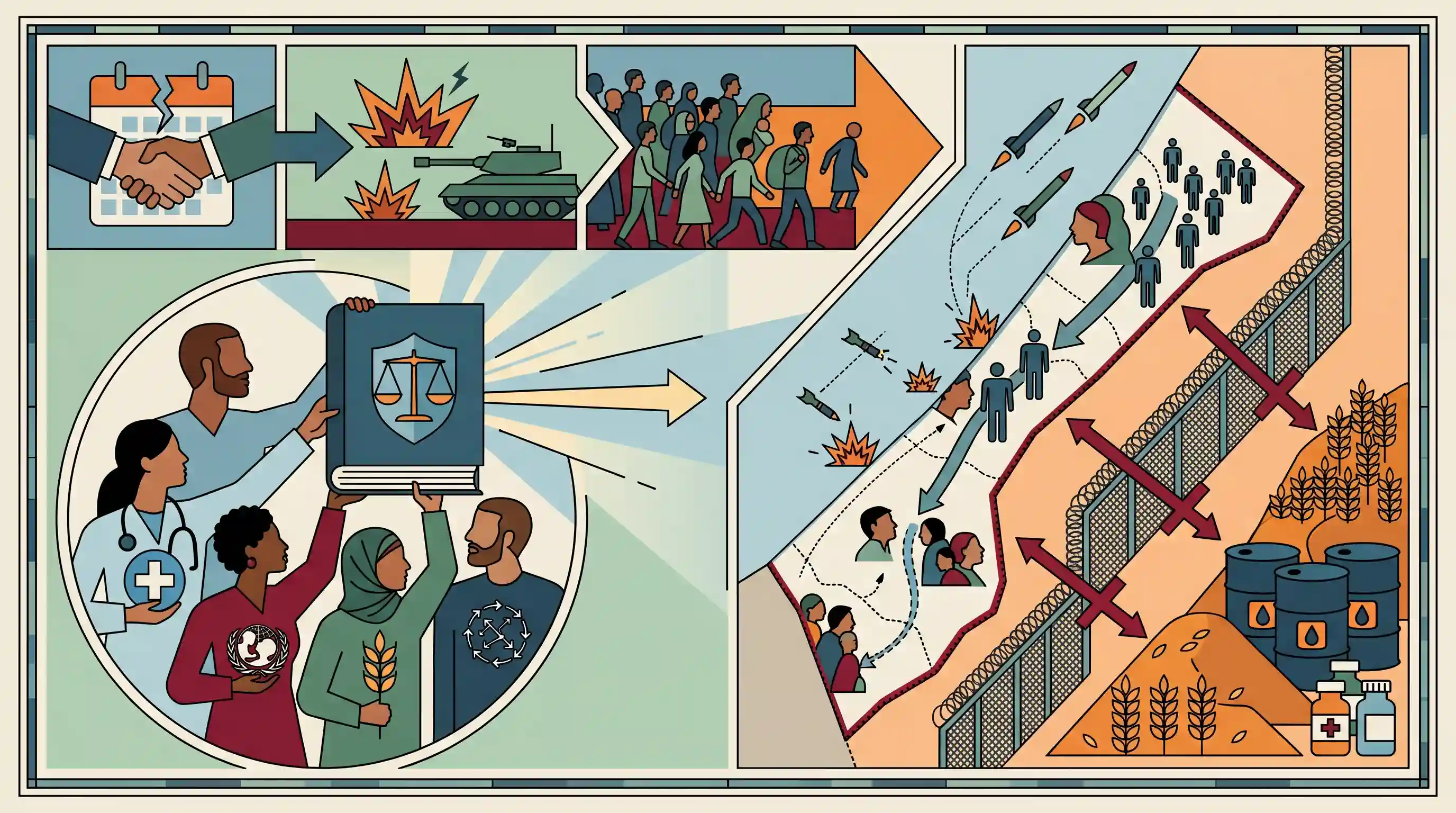
According to the UN, nearly 400,000 people have been displaced in Gaza since the breakdown of a ceasefire in January, following the resumption of Israeli military operations. The conflict has forced civilians into continuously shrinking spaces while an ongoing Israeli blockade prevents vital food, medicine, and fuel from crossing into the territory. In a joint statement, the heads of OCHA, WHO, UNICEF, and the World Food Programme urged global leaders to enforce international humanitarian law, warning of severe commodity shortages and an utter disregard for human life in the region.
Key Points
- Nearly 400,000 Gaza residents have been displaced since the ceasefire ended in January due to resumed Israeli military operations.
- A severe humanitarian and commercial blockade has resulted in essential supplies—including food, medicine, and fuel—piling up at crossing points.
- Heads of major UN agencies (OCHA, WHO, UNICEF, WFP) issued a joint appeal for world leaders to uphold international humanitarian law.
- The UN warned of utter disregard for human life and noted that food commodities inside Gaza are running extremely low despite assertions to the contrary.
Important Terms
International Humanitarian Law (IHL)

A set of rules, including the Geneva Conventions, that seeks to limit the effects of armed conflict by protecting non-combatants and restricting methods of warfare.
UPSC context
GS Paper 2 (International Relations); tests knowledge of global legal frameworks and human rights during conflict.
World Food Programme (WFP)
The world's largest humanitarian agency addressing hunger and food security; it provides emergency assistance in conflict zones and was awarded the Nobel Peace Prize in 2020.
UPSC context
GS Paper 2 (Hunger/Poverty); tests awareness of international food security and social justice initiatives.
UN OCHA
A UN Secretariat body established to strengthen international responses to complex emergencies and natural disasters by coordinating humanitarian actors and managing emergency funding.
UPSC context
GS Paper 2 (International Institutions); tests understanding of the UN’s role in global disaster and emergency coordination.
UNICEF
The United Nations agency mandated to protect children's rights and provide humanitarian and developmental assistance to children and mothers in developing countries.
UPSC context
GS Paper 2 (Social Justice); tests knowledge of international mechanisms for the protection and welfare of children.
World Health Organization (WHO)
A specialized UN agency responsible for international public health, coordinating global responses to health emergencies and setting norms for disease prevention.
UPSC context
GS Paper 2 (Health Governance); tests understanding of global health leadership and crisis management.
Hamas
A Palestinian Islamist political and militant organization that has governed the Gaza Strip since 2007; currently a primary party in the conflict with Israel.
UPSC context
GS Paper 2 (International Relations); tests knowledge of West Asian geopolitics and regional stability.
Prelims Trap
International Humanitarian Law (IHL) applies exclusively to the official armed forces of recognized States.
Under customary IHL and the Geneva Conventions, humanitarian rules apply equally to all parties in a conflict, including non-state armed groups.
Static Concepts Connected
What are the core principles of International Humanitarian Law (IHL)?
- Distinction: Parties must legally differentiate between combatants and civilians, directing attacks only at military objectives.
- Proportionality: Civilian harm must not exceed the concrete and direct military advantage anticipated from an attack.
- Precaution: Constant care must be taken to spare the civilian population and infrastructure during military operations.
How do the mandates of OCHA and WFP differ in the UN system?
- OCHA: A department of the UN Secretariat that coordinates global emergency responses and policy advocacy; it does not directly deliver aid.
- WFP: The food assistance branch of the UN and a specialized programme directly involved in delivering humanitarian relief and eradicating hunger.
Cross-Topic Patterns
IHL vs. International Human Rights Law
Human Rights Law applies continuously, whereas IHL (Geneva Conventions) specifically activates during armed conflicts to protect non-combatants and restrict methods of warfare.
Levant Geography & Border Crossings
The blockade makes exact border placements—like Rafah with Egypt and Kerem Shalom with Israel—highly testable in Prelims map-based questions.
Blockades and the Ethics of War
Using starvation as a method of warfare via blockades violates customary IHL, merging GS2 International Relations with GS4 ethics of war.

Map questions on Gaza borders (Rafah) combined with IHL core principles (Proportionality, Distinction) likely in 2026 GS Prelims.
Linked PYQs · 3
Linked PYQs · 3
- 2018MainsGS2
“India’s relations with Israel have, of late, acquired a depth and diversity, which cannot be rolled back.” Discuss.
- 2019MainsGS2
‘Too little cash, too much politics, leaves UNESCO fighting for life.’ Discuss the statement in the light of US' withdrawal and its accusation of the cultural body as being 'anti-Israel bias'.
- 2011MainsGS2
Write a short note on the World Food Programme (WFP) of the United Nations (UN).
