UN Global Plastic Pollution Treaty Negotiations and Production Caps
Source:The Hindu ↗
Why It Matters
The UN Plastics Treaty is positioned to be one of the most significant multilateral environmental agreements since the Paris Agreement. For UPSC aspirants, understanding India's negotiating stance—specifically the assertion of the 'right to development' against global pressure for production caps—is critical for GS2 (International Relations) and GS3 (Environment) analysis on how developing nations navigate global environmental governance.
Summary
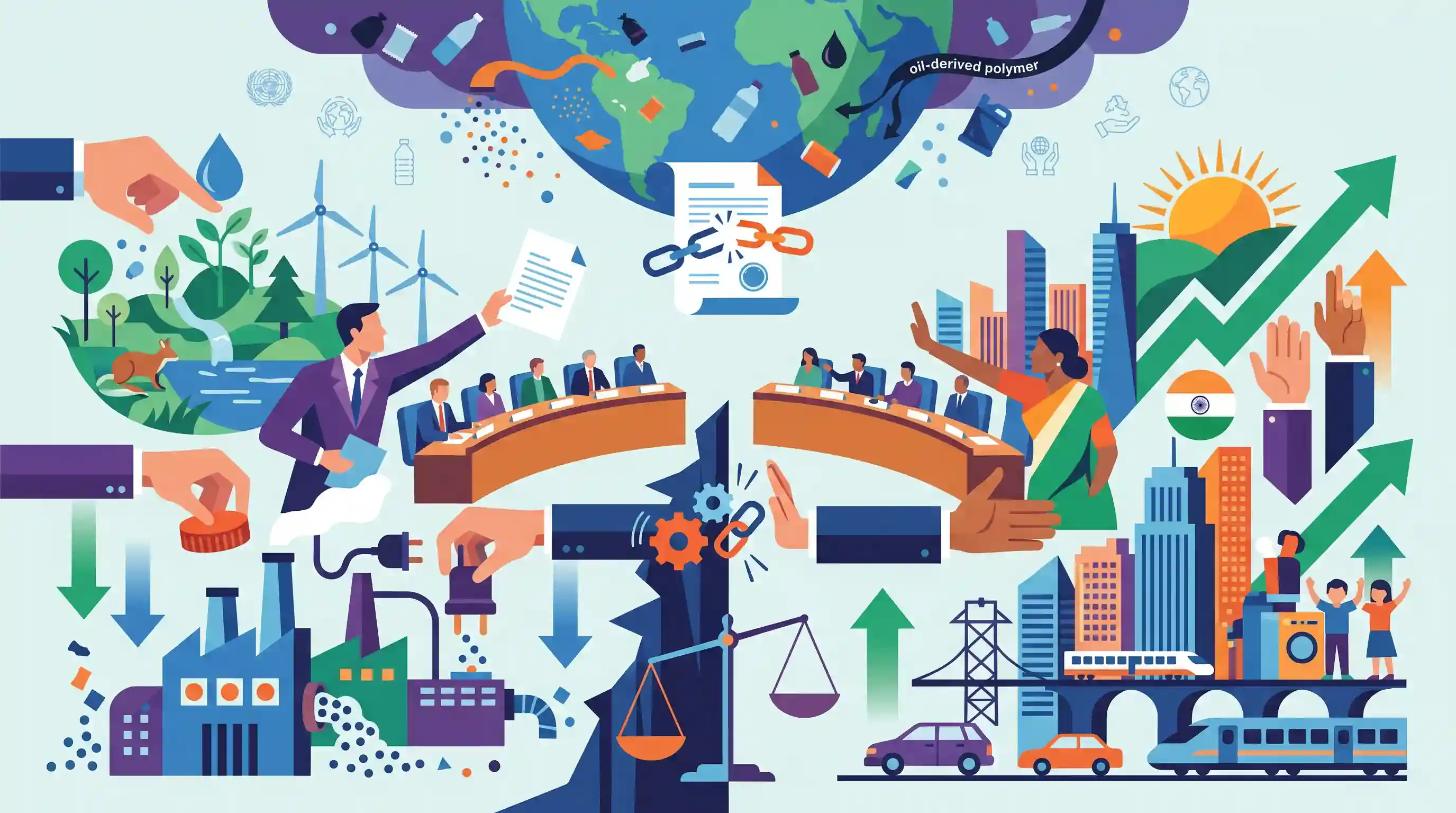
The UN Intergovernmental Negotiating Committee (INC) talks in Geneva aimed at creating a global, legally binding treaty on plastic pollution are facing severe gridlock. A fundamental divide has emerged between developed and developing nations over the treaty's scope. The 'High Ambition Coalition' wants to mandate reductions in the production of plastic polymers. Conversely, India, along with a bloc of 'Like-Minded Countries', firmly opposes production caps. They argue that plastics are essential for economic growth, and limiting production infringes on their 'right to development.' India contends that the treaty's mandate, derived from UNEA Resolution 5/14, is strictly limited to mitigating plastic pollution and waste management, not regulating raw material production. This negotiation mirrors classic global north-south climate debates balancing environmental protection against developmental imperatives.
Key Points
- Negotiations for a legally binding UN treaty on plastic pollution (INC 5.2 in Geneva) are progressing too slowly, with the draft text bogged down by over 1,500 bracketed (unresolved) points.
- A major fault line exists between the 'High Ambition Coalition' (including the EU and African nations), which advocates for capping the global production of primary plastic polymers, and 'Like-Minded Countries' (including India, Saudi Arabia, and China).
- India and other Like-Minded Countries argue that restricting plastic production violates their 'right to development' and falls outside the mandate of UNEA Resolution 5/14, which they interpret as focusing solely on managing plastic waste and pollution.
- The Business Coalition for Global Plastics Treaty, comprising large multinational corporations, supports the treaty to establish harmonized global regulations, which would be easier for businesses to navigate than a patchwork of varied national laws.
Important Terms
UN Plastic Pollution Treaty (draft)

A proposed international legally binding instrument aimed at ending plastic pollution. It seeks to establish global rules across the entire plastic lifecycle, from production and product design to waste management.
UPSC context
GS Paper 3 (Environment); relevant for questions on global pollution control and international environmental law.
UNEA Resolution 5/14
The landmark 2022 United Nations Environment Assembly resolution titled 'End Plastic Pollution.' it provided the mandate to negotiate a legally binding global treaty addressing the 'full lifecycle' of plastics.
UPSC context
GS Paper 3 (Environmental Pollution); tests knowledge of the legal foundation for current global plastic negotiations.
Intergovernmental Negotiating Committee on Plastic Pollution (INC)
The body mandated by the UN to draft the global plastic treaty. It consists of member states and observers negotiating the treaty's text over multiple sessions (INC-1 to INC-5).
UPSC context
GS Paper 2 (International Institutions) and GS 3; understanding the mechanisms of multilateral environmental diplomacy.
Like-Minded Countries (LMCs)
An informal bloc including India, Saudi Arabia, and China that opposes production caps on plastics. They emphasize waste management and national sovereignty over 'upstream' production regulations.
UPSC context
GS Paper 2 (India's Foreign Policy); critical for analyzing India's strategic positioning in global environmental negotiations.
High Ambition Coalition (HAC)
A group of 60+ countries (co-chaired by Norway and Rwanda) advocating for an ambitious treaty with mandatory global targets to reduce primary plastic production and eliminate problematic polymers.
UPSC context
GS Paper 3 (Environment); represents the 'Global North' and high-standard environmental perspective in international treaty-making.
Right to Development
An inalienable human right asserting that economic progress is essential for the realization of all rights. In environmental talks, it is used to ensure ecological mandates do not hinder development.
UPSC context
GS Paper 2 (Social Justice/IR); central to the North-South divide and the concept of Sustainable Development.
Prelims Trap
"India supports binding global caps on primary plastic polymer production under the UN Plastics Treaty."
India banned specific single-use plastics domestically but strictly opposes UN production caps, arguing it infringes on its 'right to development' and strays from waste management.
Static Concepts Connected
What is the United Nations Environment Assembly (UNEA)?
- Highest body: The world's highest-level environmental decision-making body, created in 2012 during the Rio+20 conference.
- Universal membership: It includes all 193 UN Member States and meets biennially in Nairobi, Kenya.
- Key mandates: Adopts resolutions like UNEA 5/14, which initiated negotiations for the legally binding plastic pollution treaty.
What is the principle of Common But Differentiated Responsibilities (CBDR)?
- Core principle: Acknowledges all states share responsibility for global environmental protection, but not equally based on historical contributions.
- Historical origin: Formalized at the 1992 Earth Summit (Rio Declaration) and serves as a cornerstone of the UNFCCC.
- Practical application: Demands developed nations provide financial resources, tech transfer, and capacity-building to developing countries.
Cross-Topic Patterns
Plastics Treaty mirrors UNFCCC debates
India's invocation of the "right to development" and CBDR in plastic talks perfectly parallels its historical climate stance, resisting upstream production caps to protect domestic economic growth.
MNCs favor harmonization via EPR norms
The Business Coalition supports a global treaty to establish standardized Extended Producer Responsibility (EPR) norms, showing how globalized supply chains prefer unified compliance over a fragmented patchwork of national laws.

Expect a multi-statement question in 2026 contrasting the 'High Ambition Coalition' for plastics with the 30x30 Nature/People coalition.
Linked PYQs · 4
Linked PYQs · 4
- 2025MainsGS3
Write a review on India's climate commitments under the Paris Agreement (2015) and mention how these have been further strengthened in COP26 (2021). In this direction, how has the first Nationally Determined Contribution intended by India been updated in 2022?
- 2022MainsGS3
Discuss global warming and mention its effects on the global climate. Explain the control measures to bring down the level of greenhouse gases which cause global warming, in the light of the Kyoto Protocol, 1997.
- 2020MainsGS3
Explain intra-generational and inter-generational issues of equity from the perspective of inclusive growth and sustainable development.
- 2025PrelimsGS1
Consider the following: I. Cigarette butts II. Eyeglass lenses III. Car tyres How many of them contain plastic?
