United Nations security council gridlock and multilateral reforms
Source:Indian Express ↗
Why It Matters
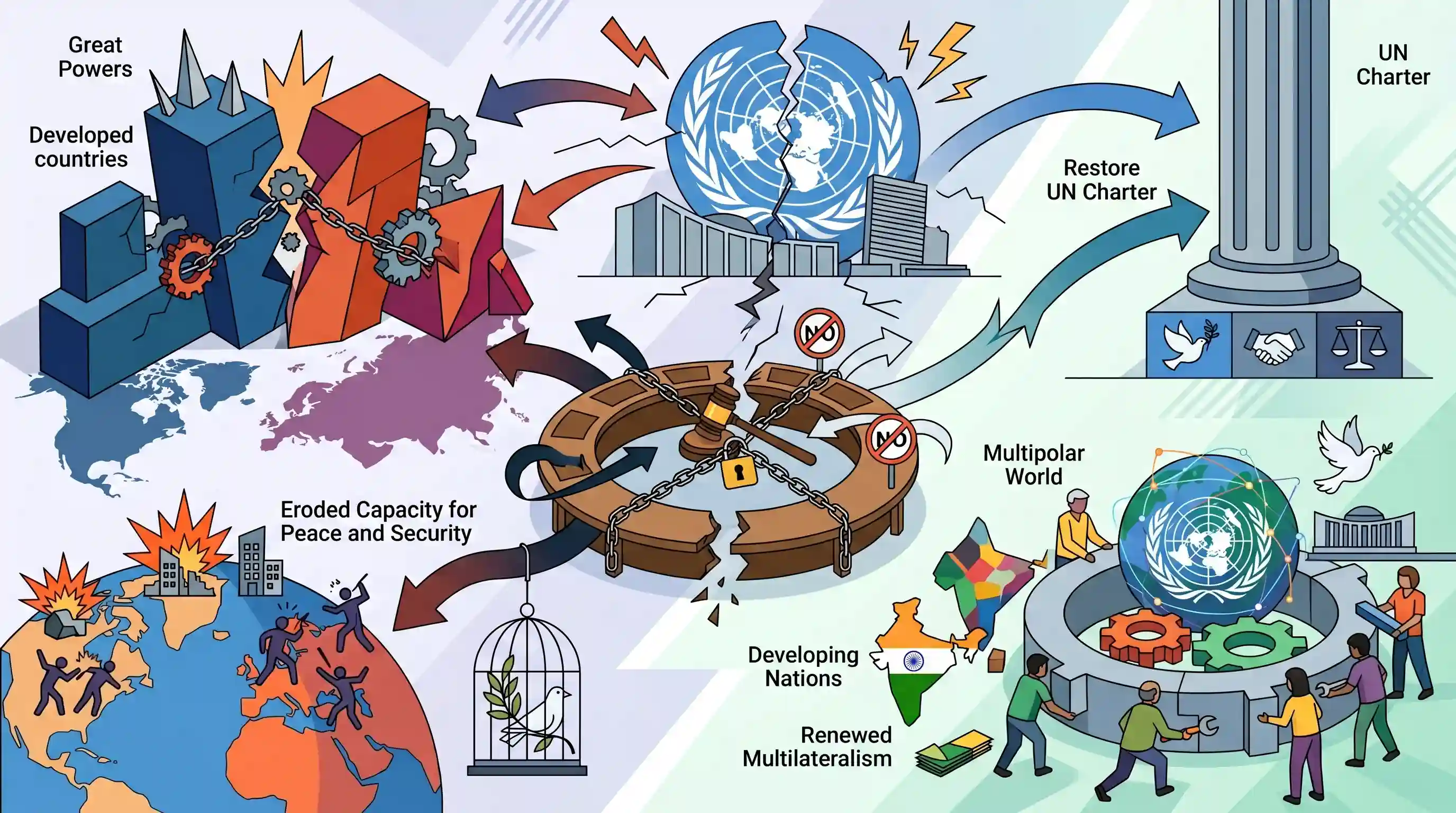
The continuous gridlock and calls for reform at the UN directly impact India's quest for a permanent seat at the UNSC, its advocacy for genuine multilateralism, and its broader strategy of championing the interests of the Global South.
Summary
The article critiques the declining relevance of the United Nations in contemporary global governance, arguing that the institution must return to its foundational roots and the principles of the UN Charter to be effective. Amidst rising geopolitical polarization and gridlock at the UN Security Council (UNSC) caused by great power rivalry, the UN's capacity to maintain global peace and security has severely eroded. The piece advocates for urgent structural reforms to restore the UN's legitimacy and problem-solving capabilities in a multipolar world.
Key Points
- The United Nations is facing a crisis of credibility and relevance due to its inability to prevent or resolve ongoing global conflicts.
- Gridlock at the UN Security Council, driven by great power rivalry and the abuse of veto power, has paralyzed the UN's collective security mechanisms.
- The article argues that the UN must return to its foundational roots and the core principles of the UN Charter, emphasizing genuine multilateralism and cooperation.
- Urgent structural reforms, including an overhaul of the UNSC to reflect contemporary geopolitical realities and empower the Global South, are essential to restore the institution's legitimacy.
Important Terms
UN Charter

The founding international treaty of the United Nations (1945) that establishes the organization's purposes, principles, and institutional framework. It codifies the sovereign equality of states and the prohibition of the use of force.
UPSC context
GS Paper 2 (International Relations); foundational document for understanding global governance, collective security, and international legal frameworks.
United Nations Security Council (UNSC)
The principal UN organ responsible for maintaining international peace and security. It consists of 15 members, including five permanent members (P5) with veto power, and is the only body capable of issuing binding resolutions.
UPSC context
GS Paper 2 (International Institutions); crucial for topics like global security, structural reforms, and India's quest for permanent membership.
United Nations General Assembly (UNGA)
The main deliberative, policymaking, and representative organ of the UN, where all 193 member states have equal representation. It serves as a universal forum for debating global issues like development and human rights.
UPSC context
GS Paper 2 (International Institutions); tests knowledge of democratic representation in global governance and the UN's deliberative functions.
Multilateralism
A diplomatic approach where multiple countries collaborate to address common challenges and achieve shared goals through international institutions. It is based on principles of inclusion, consultation, and collective action.
UPSC context
GS Paper 2 (Global Governance); central to discussions on the "crisis of multilateralism" and India's advocacy for "reformed multilateralism."
Veto Power
A special privilege granted by the UN Charter to the five permanent members of the Security Council, allowing any one of them to block substantive resolutions regardless of majority support.
UPSC context
GS Paper 2 (International Relations); key to analyzing geopolitical gridlock, great power rivalry, and the need for UNSC democratization.
United Nations (UN)
The global intergovernmental organization established post-WWII to prevent future conflicts, protect human rights, and promote sustainable development. It remains the centerpiece of the international rules-based order.
UPSC context
GS Paper 2 (International Institutions); fundamental for evaluating the effectiveness of global governance and the impact of geopolitical polarization.
Prelims Trap
Under the 'Uniting for Peace' mechanism, the UNGA can issue legally binding resolutions for deploying armed force.
UNGA resolutions, even under 'Uniting for Peace', are strictly recommendatory. Only the UNSC can authorize legally binding use-of-force resolutions under Chapter VII of the Charter.
Static Concepts Connected
What are the primary blocs negotiating UNSC reform?
- G4 Nations: India, Brazil, Germany, and Japan mutually backing each other's bids for permanent seats.
- Uniting for Consensus: Also called the 'Coffee Club' (led by Italy, Pakistan), actively opposing new permanent seats to block regional rivals.
- Ezulwini Consensus: The African Union's common position demanding at least two permanent seats with veto power.
- L.69 Group: Developing nations from Asia, Africa, and Latin America pushing for comprehensive reforms and Global South representation.
What is the 'Uniting for Peace' mechanism (Resolution 377A)?
- The Trigger: Adopted in 1950, it is invoked when the UNSC fails to maintain peace due to a deadlock caused by a P5 veto.
- UNGA Powers: Empowers the General Assembly to hold emergency special sessions to address the crisis.
- Scope of Action: Allows the UNGA to recommend collective measures, including the use of armed force, though these are non-binding.
Cross-Topic Patterns
UN decay fuels minilateralism
Paralysis at universal forums like the UNSC drives India's strategic shift toward agile, issue-based minilaterals (Quad, I2U2) to secure its geopolitical interests.
G20 adaptiveness vs UN rigidity
The G20's swift inclusion of the African Union sharply contrasts with the UN's gridlocked Intergovernmental Negotiations (IGN), highlighting a shift in global governance gravity.

Match-the-following on UNSC reform blocs (G4, UfC, L.69, Ezulwini) and the Uniting for Peace mandate is highly likely for Prelims 2026.
Linked PYQs · 3
Linked PYQs · 3
- 2025MainsGS2
"The reform process in the United Nations remains unresolved, because of the delicate imbalance of East and West and entanglement of the USA vs. Russo-Chinese alliance.” Examine and critically evaluate the East-West policy confrontations in this regard.
- 2025MainsGS2
"With the waning of globalization, post-Cold War world is becoming a site of sovereign nationalism.” Elucidate.
- 2022PrelimsGS1
With reference to the United Nations General Assembly, consider the following statements: 1. The UN General Assembly can grant observer status to the non-member States. 2. Inter-governmental organisations can seek observer status in the UN General Assembly. 3. Permanent Observers in the UN General Assembly can maintain missions at the UN headquarters. Which of the statements given above are correct?
