UNAMA Urges Taliban to Restore Internet Access in Afghanistan
Source:The Hindu ↗
Why It Matters
This article provides a stark real-world example of how internet shutdowns violate fundamental rights (freedom of expression and access to information) and disproportionately impact marginalized groups like women. It is highly relevant for GS2 discussions on fundamental rights, the humanitarian role of the UN, and the socio-political situation in India's neighborhood.
Summary
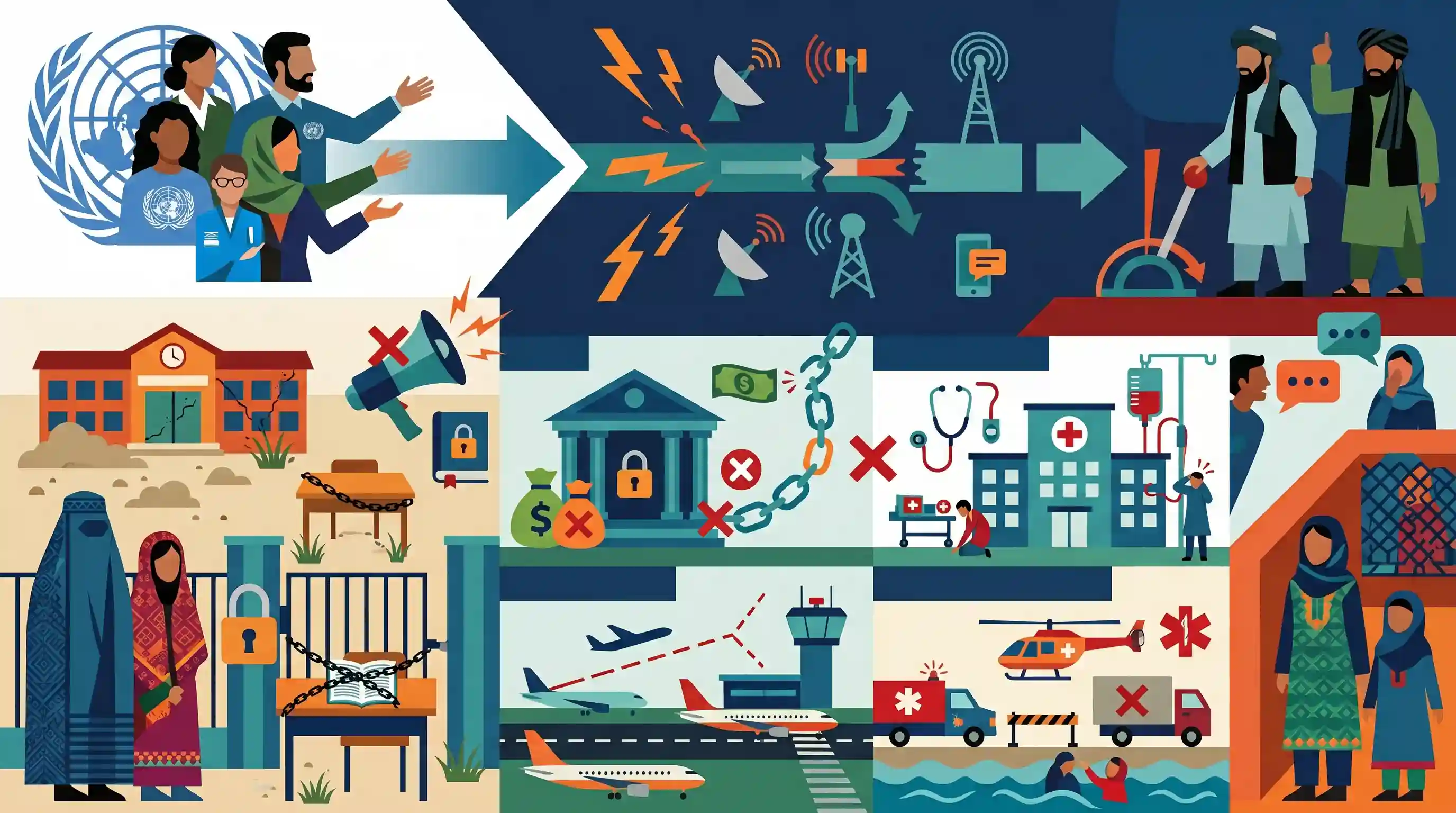
The UN Assistance Mission in Afghanistan (UNAMA) has urgently appealed to the Taliban to reverse a nationwide internet and telecommunications shutdown, which the regime instituted to allegedly prevent "immorality." UNAMA highlighted that the blackout exacerbates an already dire humanitarian crisis by disrupting banking systems, medical care, civil aviation, and disaster response. Furthermore, the blockade fundamentally violates citizens' right to information and freedom of expression, while disproportionately isolating Afghan women and girls who are already facing severe social and educational restrictions.
Key Points
- The Taliban has enforced a nationwide internet blackout in Afghanistan, citing the need to crack down on immorality.
- The UN Assistance Mission in Afghanistan (UNAMA) has appealed for the restoration of services, warning of severe humanitarian consequences.
- The shutdown severely disrupts banking, medical care, civil aviation, and emergency disaster response in a country prone to natural disasters.
- The internet ban disproportionately isolates Afghan women and girls, worsening their educational and social exclusion, and severely undermines the freedom of expression and right to information.
Important Terms
Artificial Intelligence (AI)

A branch of computer science focused on creating systems capable of performing tasks that typically require human intelligence, such as pattern recognition and decision-making.
UPSC context
GS Paper 3 (Science and Technology); relevant for discussions on emerging technologies and the Fourth Industrial Revolution.
Machine Learning (ML)
A subset of AI that enables systems to learn and improve from experience without being explicitly programmed, often used in healthcare for predictive modeling.
UPSC context
GS Paper 3 (Science and Technology); crucial for understanding modern data analysis techniques in healthcare and governance.
Precision Medicine
An innovative approach to disease treatment and prevention that accounts for individual variability in genes, environment, and lifestyle for each person.
UPSC context
GS Paper 2 (Health) and GS Paper 3 (Biotechnology); important for discussing personalized healthcare and medical advancements.
Predictive Analytics
The use of data, statistical algorithms, and machine learning techniques to identify the likelihood of future outcomes based on historical data.
UPSC context
GS Paper 3 (IT and Economy); relevant for improving public health outcomes and resource management.
Telemedicine
The remote delivery of healthcare services, including exams and consultations, over the telecommunications infrastructure.
UPSC context
GS Paper 2 (Health); relevant for improving healthcare access in rural and remote areas.
Algorithmic Bias
Systematic and repeatable errors in a computer system that create unfair outcomes, such as privileging one group over others.
UPSC context
GS Paper 4 (Ethics); essential for discussing the ethical implications, fairness, and transparency of AI.
Electronic Health Records (EHR)
Digital versions of patients' paper charts, providing real-time, patient-centered records that make information available instantly and securely to authorized users.
UPSC context
GS Paper 2 (Governance and Health); central to the Ayushman Bharat Digital Mission (ABDM).
Interoperability
The ability of different information systems and devices to access, exchange, and cooperatively use data in a coordinated manner.
UPSC context
GS Paper 2 (E-governance); key to the success of integrated digital health ecosystems.
Prelims Trap
"The Supreme Court declared the right to internet access as an absolute, standalone Fundamental Right under Article 21."
The SC recognized freedom of speech and trade *through* the internet under Article 19(1)(a) & (g), subject to reasonable restrictions. It did not declare internet access an absolute Article 21 right.
Static Concepts Connected
How is internet access protected under the Indian Constitution?
- Article 19: The SC (Anuradha Bhasin, 2020) ruled freedom of speech and trade via the internet are protected under Article 19(1)(a) and 19(1)(g).
- Proportionality Test: Internet suspensions must follow the Telegraph Act rules, be temporary, necessary, and satisfy the constitutional test of proportionality.
- Article 21 Link: The Kerala HC (Faheema Shirin, 2019) recognized internet access as integral to the Right to Education and Privacy under Article 21.
What is the mandate and nature of UNAMA?
- Political Mission: Established in 2002 via UNSC resolution, it is a civilian-led UN Special Political Mission, distinct from a military UN Peacekeeping operation.
- Core Mandate: Originally tasked to support the Bonn Agreement, it now focuses on peacebuilding, coordinating humanitarian relief, and monitoring severe human rights violations.
Cross-Topic Patterns
Digital authoritarianism & gender divide
State-sponsored digital blackouts disproportionately isolate women in restrictive regimes, severing their only safe access to remote education, telehealth, and online economic networks.
UN Special Missions vs Peacekeeping
UPSC often tests UN mandates. UNAMA's status as a civilian political mission distinguishes it from armed UN Peacekeeping operations, requiring different UNSC frameworks.

A mixed Polity-IR question linking UNHRC's digital rights stance with India's Article 19 'Anuradha Bhasin' ruling is highly probable.
Linked PYQs · 3
Linked PYQs · 3
- 2017MainsGS2
Examine the scope of Fundamental Rights in the light of the latest judgement of the Supreme Court on Right to Privacy.
- 2020MainsGS2
Recent amendments to the Right to Information Act will have profound impact on the autonomy and independence of the Information Commission". Discuss.
- 2024MainsGS1
Distinguish between gender equality, gender equity and women's empowerment. Why is it important to take gender concerns into account in programme design and implementation?
