UN Holds Emergency Talks on COP30 Summit Costs
Source:The Hindu ↗
Why It Matters
Highlights the practical and financial challenges developing nations face in ensuring fair representation at critical global climate negotiations (like UNFCCC COPs), which directly impacts the equity and inclusivity of international climate action and policy-making.
Summary
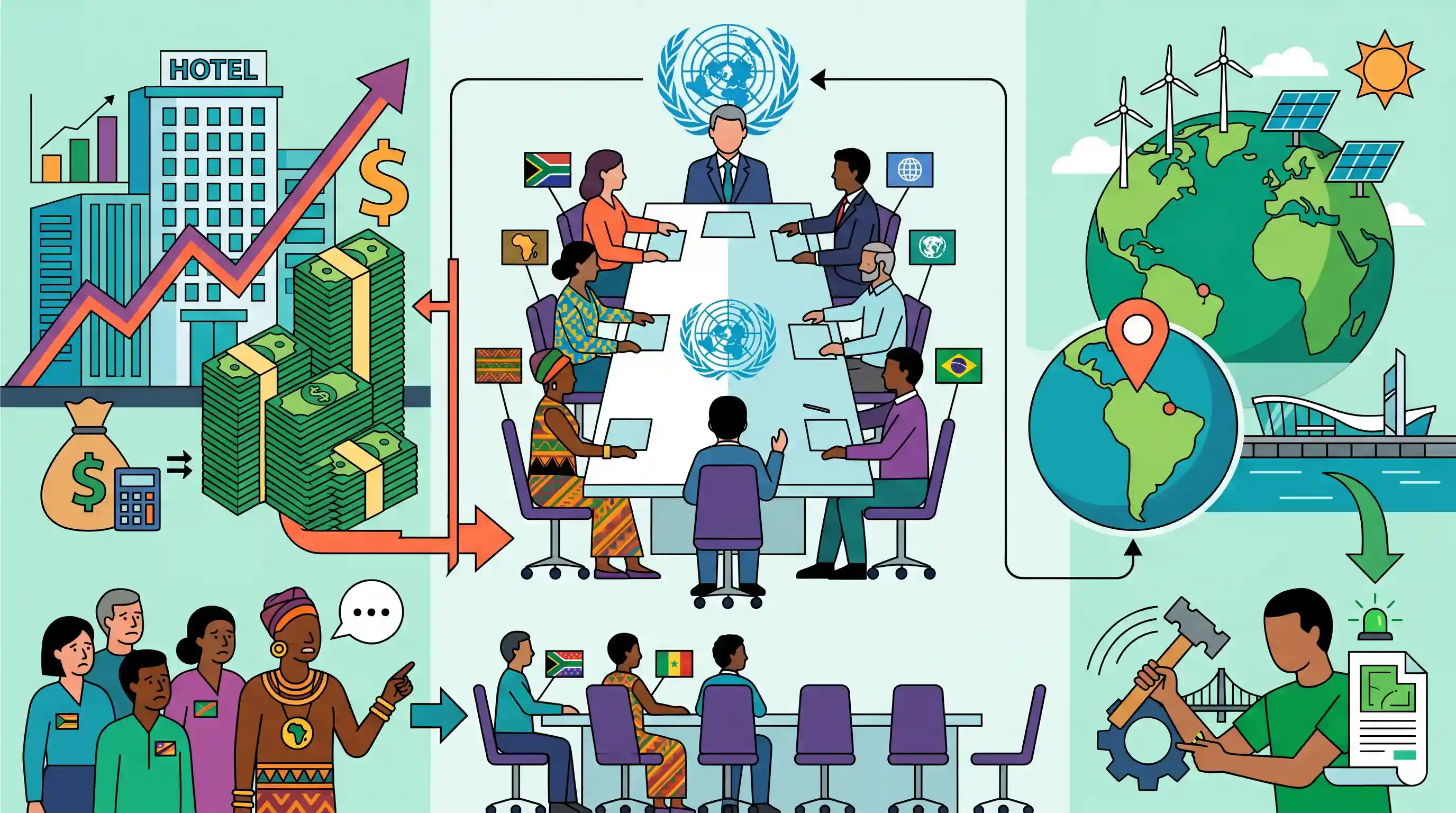
The United Nations held emergency talks to address soaring accommodation costs for the COP30 climate summit in Belem, Brazil, which threaten to price poorer developing nations out of the negotiations. With hotel rates vastly exceeding the UN's daily subsistence allowance, delegates from the Global South—including the African Group of Negotiators—warned that they might be forced to reduce their participation. The situation highlights the logistical and financial barriers that developing countries face in multilateral climate negotiations. Brazil has promised to address the issue and report back to the UN climate body.
Key Points
- The UN climate bureau convened an emergency meeting over exorbitant accommodation costs for the upcoming COP30 climate summit in Belem, Brazil.
- Sky-high hotel rates, reportedly around $700 per person per night, severely exceed the UN's $149 daily subsistence allowance for delegates from poorer nations.
- Developing countries, particularly from Africa, warned that prohibitive costs could force them to reduce their delegation sizes, undermining their representation in crucial climate change negotiations.
- Brazil has assured the UN climate body that it will address these concerns to ensure adequate accommodation for all delegates.
Important Terms
UNFCCC

A 1992 international treaty aiming to stabilize greenhouse gas concentrations. It provides the legal framework for global climate negotiations and established the "Common But Differentiated Responsibilities" (CBDR) principle.
UPSC context
GS Paper III (Environment); GS Paper II (International Relations). Crucial for understanding global climate governance and India's "climate justice" stance.
COP30
The 30th annual meeting of the UNFCCC, scheduled for 2025 in Belém, Brazil. It is expected to focus on forest conservation (Amazon) and implementing the Paris Agreement.
UPSC context
GS Paper III (Climate Change). Tests knowledge of summit outcomes, "implementation" vs. "pledges," and Brazil's leadership in the Global South.
Global South
A geopolitical term for developing and emerging economies in Africa, Asia, and Latin America. These nations prioritize equity, historical responsibility, and financial support in international negotiations.
UPSC context
GS Paper II (International Relations). Tests understanding of shifting world orders, India’s leadership role, and North-South equity debates.
African Group of Negotiators
A coalition of 54 African countries that coordinates a unified voice in UNFCCC negotiations. It emphasizes adaptation, climate finance, and the continent's "special circumstances" and high vulnerability.
UPSC context
GS Paper II/III (International Groupings/Environment). Important for understanding major negotiating blocs that influence global climate policy alongside the G77 and BASIC.
Daily Subsistence Allowance (DSA)
A UN-set stipend provided to delegates to cover lodging, meals, and incidentals during official travel. It is adjusted periodically based on local costs and commercial hotel rates.
UPSC context
GS Paper II (International Organizations). Highlights logistical barriers and financial inclusivity issues that can marginalize developing nations in multilateral diplomacy.
Prelims Trap
"The UNFCCC mandates equal delegation sizes to ensure procedural climate justice for all member states."
Delegation sizes depend entirely on a country's financial capacity. The UN only provides limited subsistence allowances, leaving poorer nations severely underrepresented in parallel negotiating tracks.
Static Concepts Connected
What are the key developing country negotiating blocs at the UNFCCC?
- G77 + China: The largest intergovernmental organization of developing countries in the UN, acting as the primary unified voice for the Global South.
- AOSIS: Alliance of Small Island States, highly vulnerable to sea-level rise, pushing aggressively for the 1.5°C limit and Loss & Damage funds.
- LMDC: Like-Minded Developing Countries (including India and China), which strongly emphasize Common But Differentiated Responsibilities (CBDR) and equity.
- AGN: African Group of Negotiators, which focuses heavily on securing adaptation finance and highlighting historical responsibility of developed nations.
What is Procedural Climate Justice?
- Definition: Ensuring fair, transparent, and inclusive participation of all stakeholders—especially vulnerable nations—in global climate decision-making.
- Distributive vs. Procedural: It differs from distributive justice, which focuses on the equitable allocation of climate finance and carbon budgets.
- Real-world barrier: Financial barriers (like exorbitant accommodation costs) undermine procedural justice by physically preventing Global South negotiators from sitting at the table.
Cross-Topic Patterns
Multilateral resource disparity
The financial exclusion of the Global South at COP mirrors their resource-based marginalization in WTO dispute settlements and UNSC representation, driving India's push for comprehensive multilateral reform.
Belem's strategic Amazonian geography
Hosting COP30 in Belem (Amazon basin) geographically reinforces Brazil's push to center tropical forest conservation and biodiversity finance alongside traditional emission reduction targets.

Expect a prelims pairing question matching climate negotiating blocs (AOSIS, LMDC, AGN) to their core strategic demands at UNFCCC.
