UN Warning on Cuba Socioeconomic Crisis and US Sanctions
Source:The Hindu ↗
Why It Matters
Provides a critical contemporary example of the humanitarian impact of unilateral economic sanctions and embargoes. It is highly relevant for GS2 discussions on international relations, the role of UN human rights bodies in monitoring state-imposed embargoes, and the geopolitics of energy security in Latin America.
Summary
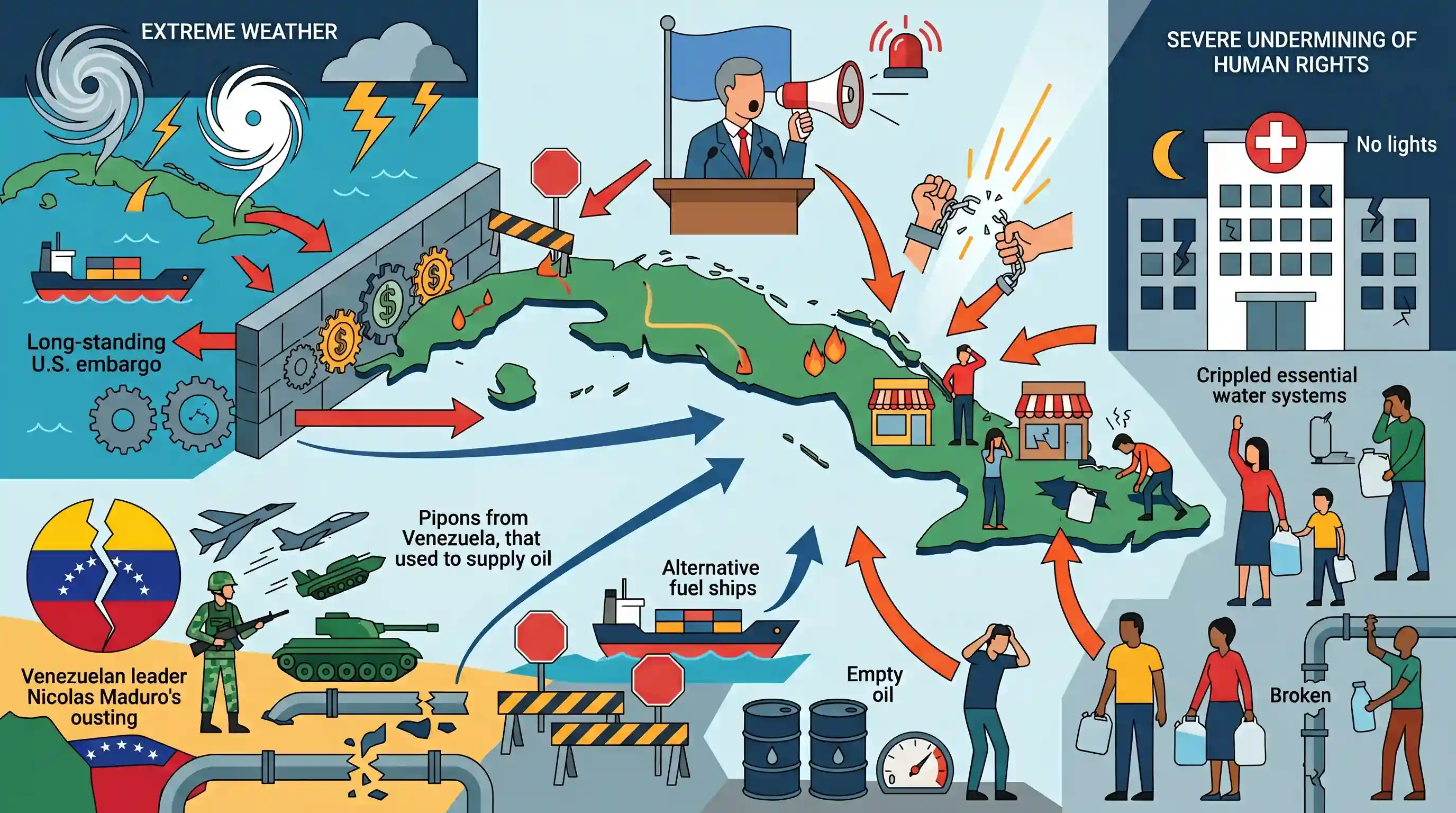
The United Nations has voiced deep alarm over the escalating socio-economic crisis in Cuba, which is severely undermining the human rights of its population. The crisis is driven by extreme weather and the compounding effects of the longstanding U.S. embargo. The situation has been critically worsened by severe oil shortages following the U.S. military ousting of Venezuelan leader Nicolas Maduro—Cuba\'s main oil supplier—and the Trump administration\'s vow to block alternative fuel deliveries to the island. UN Human Rights Chief Volker Turk has urged the lifting of these unilateral sanctions, warning that they have an indiscriminate impact on civilians and are crippling essential infrastructure, including hospitals and water systems.
Key Points
- The UN has expressed extreme concern over the deteriorating socio-economic conditions in Cuba, warning that it is severely impacting fundamental human rights.
- Cuba\'s crisis is exacerbated by the decades-old U.S. economic and financial embargo, extreme weather, and recent U.S. measures restricting critical oil shipments.
- The severe shortage of oil, intensified by the ousting of Venezuela\'s Nicolas Maduro (Cuba\'s primary oil supplier) and U.S. efforts to block alternative deliveries, is jeopardizing essential services like hospitals and water pumping.
- UN human rights chief Volker Turk reiterated calls for the U.S. to lift its unilateral sectoral measures, emphasizing their indiscriminate and devastating impact on the civilian population.
Important Terms
United Nations (UN)

An intergovernmental organization established in 1945 to maintain international peace, facilitate global cooperation, and protect human rights through various organs and specialized agencies.
UPSC context
GS Paper 2; essential for understanding multilateralism, global governance structures, and the mandate of international agencies.
Office of the High Commissioner for Human Rights (OHCHR)
A department of the UN Secretariat (est. 1993) mandated to promote and protect human rights globally and provide support to the UN Human Rights Council.
UPSC context
GS Paper 2; relevant for human rights protection frameworks, international law, and monitoring mechanisms.
Unilateral Sanctions
Coercive economic or trade restrictions imposed by a single nation without the authorization of the UN Security Council to influence a target state's behavior.
UPSC context
GS Paper 2; tests knowledge of international relations, diplomatic statecraft, and their impact on developing countries' interests.
U.S. Embargo on Cuba (El Bloqueo)
A comprehensive commercial and financial blockade imposed by the U.S. since 1962, the longest-running in modern history, significantly affecting Cuba's essential infrastructure.
UPSC context
GS Paper 2; case study for the effect of developed countries' policies on developing nations and humanitarian law.
Volker Türk
The 8th UN High Commissioner for Human Rights (assumed office in 2022), an Austrian diplomat responsible for leading the UN's global human rights efforts.
UPSC context
Prelims/Mains; identifying key officials in major international organizations and their roles in global advocacy and policy.
UN Human Rights Council (UNHRC)
The UN's principal intergovernmental body (consisting of 47 states) responsible for strengthening the promotion and protection of human rights around the globe.
UPSC context
GS Paper 2; tests knowledge of international institutions, their mandates, and India's participation in global human rights forums.
Prelims Trap
"UN General Assembly resolutions mandating the lifting of the US embargo on Cuba are legally binding."
UN General Assembly resolutions are recommendatory, unlike UN Security Council resolutions under Chapter VII. The US embargo on Cuba is strictly unilateral.
Static Concepts Connected
What is extraterritorial jurisdiction in US sanctions?
- Definition: The application of domestic laws beyond sovereign borders, penalizing third-party entities for engaging with targeted nations.
- Helms-Burton Act: The 1996 US law that controversialy penalizes foreign companies from third countries trading with Cuba.
- India's stance: India formally opposes unilateral extraterritorial sanctions, recognizing only multilateral sanctions mandated by the UN Security Council.
What is the Petrocaribe regional energy agreement?
- Origin: An oil alliance initiated by Venezuela in 2005 for Caribbean and Central American states.
- Mechanism: Supplies Venezuelan oil based on highly preferential financing, discounted rates, and deferred payment terms.
- Geopolitical impact: Built regional solidarity countering US influence; now paralyzed by Venezuela's political crisis and US sanctions.
Cross-Topic Patterns
Weaponization of energy supply chains
Blocking alternative fuel to Cuba mirrors past US sanctions on Iranian and Russian oil, forcing developing nations to navigate complex extraterritorial compliance to maintain energy security.
India's UNGA voting & NAM principles
India's consistent annual vote in the UN General Assembly condemning the US embargo highlights its enduring Non-Aligned Movement (NAM) roots and principled opposition to unilateral blockades.

Paired-matching Qs on regional alliances (Petrocaribe) or extraterritorial US sanctions (CAATSA/Helms-Burton) are highly likely in 2026.
Linked PYQs · 2
Linked PYQs · 2
- 2012MainsGS2
How have the US sanctions against Iran affected India's bilateral relations with Iran?
- 2018PrelimsGS1
"Rule of Law Index" is released by which of the following?
