UN Downgrades India 2025 Growth Outlook
Source:The Hindu ↗
Why It Matters
The article presents crucial data for evaluating India's macroeconomic stability against global headwinds like protectionism (e.g., US tariffs) and supply chain disruptions. It highlights the structural strengths (services exports, domestic consumption) and persistent weaknesses (gender disparity in labor participation) of India's current growth trajectory, which is highly relevant for GS3 questions on economic growth, trade policies, and employment.
Summary
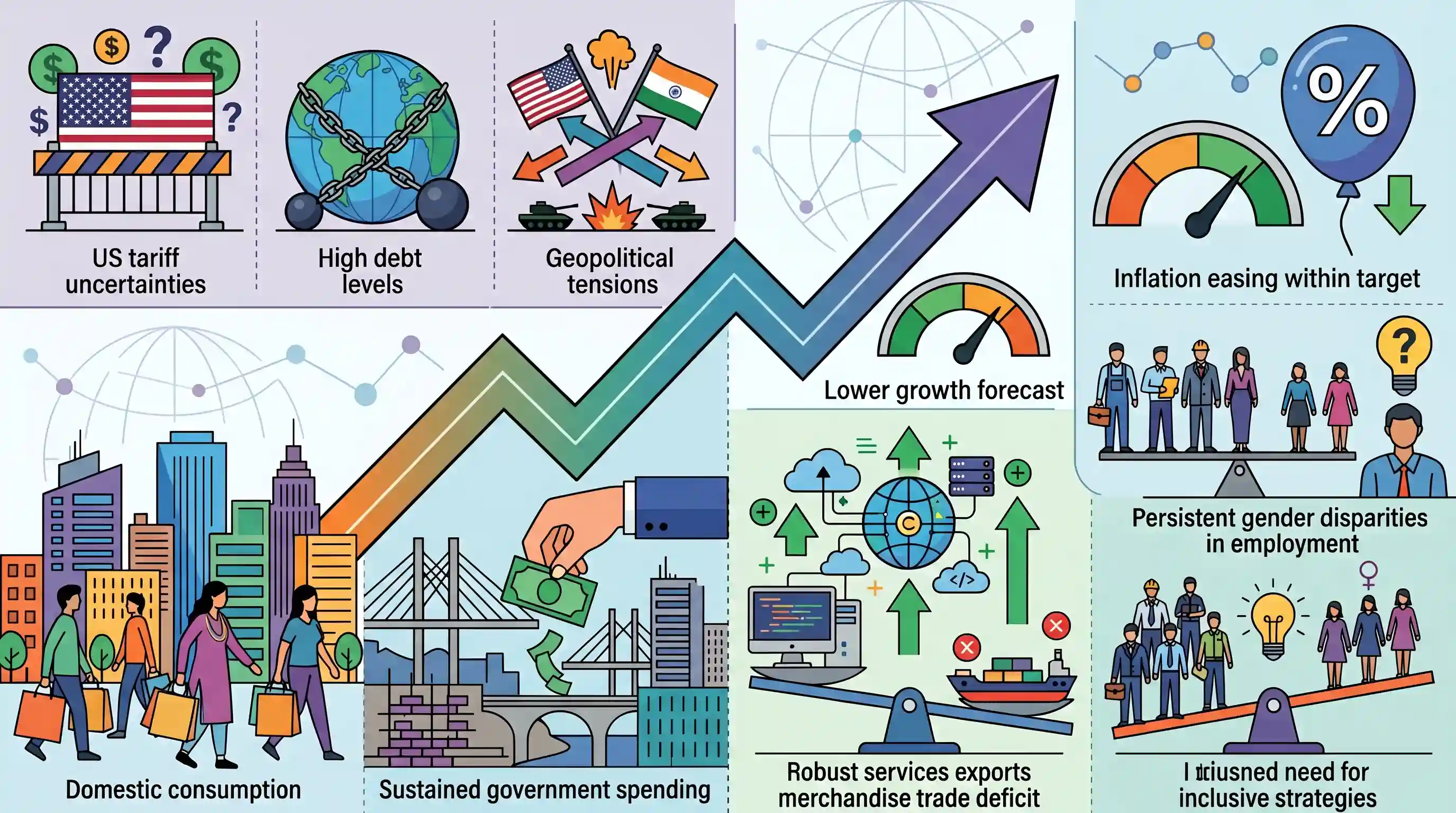
The United Nations has reduced its 2025 economic growth forecast for India to 6.3% amid a deteriorating global outlook characterized by US tariff uncertainties, high debt levels, and geopolitical tensions. Nevertheless, India continues to be among the fastest-growing major economies due to resilient domestic consumption, sustained government spending, and a robust services export sector which offsets the merchandise trade deficit. While inflation is projected to ease and remain within the central bank's target, persistent gender disparities in employment underscore the need for more inclusive workforce participation strategies.
Key Points
- The UN downgraded India's 2025 growth forecast to 6.3% from 6.6%, citing a worsening global economic outlook in its mid-year World Economic Situation and Prospects 2025 report.
- Global growth is expected to decelerate to 2.4% in 2025, primarily driven by US tariff announcements, geopolitical tensions, high debt levels, and sluggish productivity.
- India remains resilient, anchored by strong domestic consumption, government spending, and robust services exports that help counter a widening merchandise trade deficit.
- While certain export sectors like pharmaceuticals and electronics may have temporary exemptions from US tariffs, broader protectionist policies remain a risk to merchandise exports.
- Inflation in India is projected to ease to 4.3% in 2025, but systemic challenges such as persistent gender disparities in workforce participation remain.
Important Terms
World Economic Situation and Prospects 2025 report

An annual flagship publication by UN DESA, UNCTAD, and regional commissions. It provides global and regional economic forecasts and policy recommendations to achieve Sustainable Development Goals (SDGs).
UPSC context
GS3 (Economy). Important for understanding global growth trends, international benchmarks for India's GDP, and the impact of external shocks.
UN Department of Economic and Social Affairs (UN DESA)
A core department of the UN Secretariat that leads the development pillar. It produces reports like WESP and the World Social Report to support the 2030 Agenda.
UPSC context
GS2 (Global Governance). Relevant for international institutions and their role in coordinating global economic and social policies.
International Monetary Fund (IMF)
An international organization of 190 countries working to foster global monetary cooperation and financial stability. It publishes the 'World Economic Outlook,' a key source for India's growth projections.
UPSC context
GS3 (Economy) and GS2. Crucial for topics on international financial institutions, balance of payments, and global economic surveillance.
World Bank
An international financial institution providing loans and grants to governments of low- and middle-income countries. It publishes the 'Global Economic Prospects' report and supports development infrastructure.
UPSC context
GS3 (Economy) and GS2. Central to studies on development, poverty reduction, and multilateral funding for Indian infrastructure projects.
Fitch Ratings
A leading global credit rating agency that provides sovereign credit ratings. Its forecasts influence investor sentiment and indicate the health of India's macroeconomic fundamentals and fiscal stability.
UPSC context
GS3 (Economy). Important for understanding sovereign creditworthiness, foreign investment flows (FDI/FPI), and external debt sustainability.
Ministry of Commerce and Industry
The nodal ministry responsible for formulating and implementing foreign trade policy and industrial policy. It manages India's merchandise exports and monitors the trade deficit mentioned in the article.
UPSC context
GS3 (Economy). Relevant for industrial growth, Ease of Doing Business, and the 'Make in India' initiative.
Prelims Trap
"The World Economic Situation and Prospects (WESP) report is a flagship publication of the International Monetary Fund (IMF)."
The WESP report is published jointly by UN DESA, UNCTAD, and UN regional commissions. The IMF publishes the World Economic Outlook (WEO).
Static Concepts Connected
How do services exports impact India's Current Account Deficit (CAD)?
- Merchandise Deficit: India structurally imports more goods (like crude oil and gold) than it exports, leading to a persistent merchandise trade deficit.
- Services Surplus: Robust exports in IT, BPO, and professional services create a strong structural surplus in the invisibles account of the Balance of Payments.
- Net Impact: This robust services surplus substantially offsets the merchandise deficit, preventing the overall Current Account Deficit (CAD) from ballooning to unsustainable levels.
What structural factors constrain India's Female Labour Force Participation?
- Unpaid Care Work: A disproportionate burden of domestic chores and child/elder care falls on women, severely restricting their availability for formal, full-time employment.
- The U-Shaped Curve: As household income and female education rise, participation initially drops due to a lack of suitable white-collar jobs, before rising again for highly skilled roles.
- Occupational Segregation: Women who do participate are largely crowded into informal, low-paying agricultural work or specific feminized sectors like caregiving and basic education.
Cross-Topic Patterns
US Tariffs & WTO Multilateralism
Unilateral tariff hikes by the US bypass WTO dispute mechanisms and the Most-Favoured-Nation principle, shifting global dynamics from rules-based trade to transactional bilateralism.
Growth vs Inclusive Development
India's resilient 6.3% growth masks structural bottlenecks like low female workforce participation, linking macroeconomic GDP data (GS3) directly to social empowerment themes (GS1/GS2).

Expect a 2026 Prelims pairing question on flagship reports (WESP vs WEO) or a multi-statement query on how services offset the trade deficit.
Linked PYQs · 3
Linked PYQs · 3
- 2025MainsGS3
What are the challenges before the Indian economy when the world is moving away from free trade and multilateralism to protectionism and bilateralism? How can these challenges be met?
- 2020MainsGS3
Define potential GDP and explain its determinants. What are the factors that have been inhibiting India from realizing its potential GDP?
- 2023MainsGS3
Most of the unemployment in India is structural in nature. Examine the methodology adopted to compute unemployment in the country and suggest improvements.
