UN Rights Chief Warns of Escalation and Civilian Toll in Ukraine
Source:The Hindu ↗
Why It Matters
Highlights the ongoing geopolitical challenges of the Russia-Ukraine war and the critical role of international organizations like the UN and its bodies (such as OHCHR) in enforcing International Humanitarian Law and protecting human rights during armed conflicts.
Summary
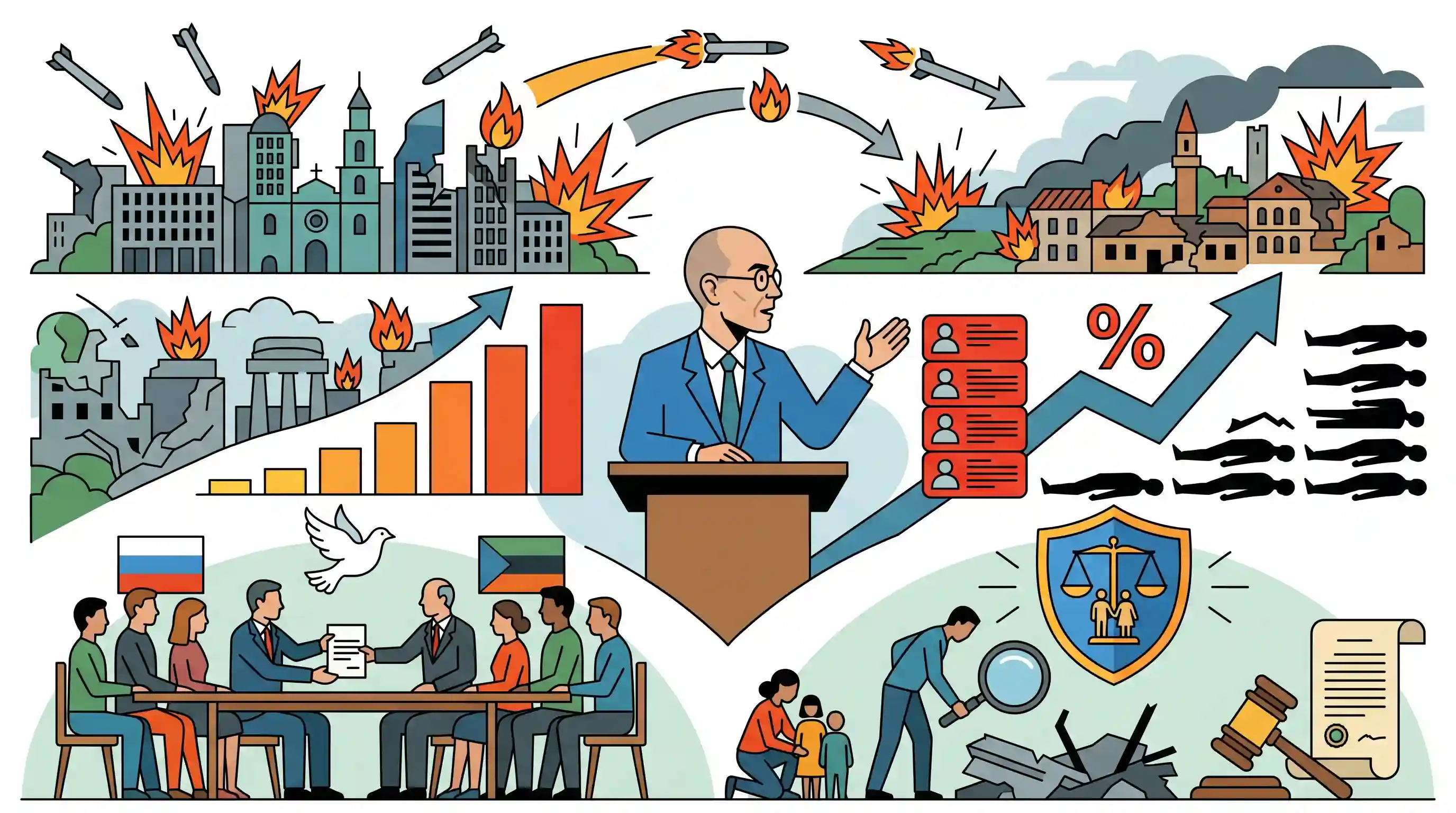
The United Nations High Commissioner for Human Rights, Volker Turk, has strongly condemned the recent escalation in the Russia-Ukraine conflict, marked by intensive strikes on Kyiv and retaliatory attacks in Russian-occupied Starobilsk. Citing a 21% rise in civilian casualties in early 2026, the UN Rights Chief urged both nations to resume negotiations. He emphasized that protecting civilians is a binding obligation under International Humanitarian Law, calling for independent investigations to hold perpetrators accountable.
Key Points
- UN High Commissioner for Human Rights Volker Turk warned of a dangerous escalation in the Russia-Ukraine war following massive combined missile and drone attacks.
- The UN Human Rights Office (OHCHR) recorded an alarming 21% increase in civilian casualties in Ukraine during the first four months of 2026, with 815 killed and 4,174 injured.
- The UN rights chief reminded both conflicting nations of their binding legal obligations under International Humanitarian Law to take all feasible precautions to avoid civilian harm.
- The OHCHR also flagged a Ukrainian attack on an educational complex in occupied Starobilsk, emphasizing the need for prompt, independent investigations into civilian deaths on both sides.
Important Terms
International Humanitarian Law (IHL)

Also known as the 'law of armed conflict,' IHL consists of international rules (Geneva and Hague Conventions) that limit war's effects by protecting non-combatants and regulating means of warfare.
UPSC context
GS Paper II (International Relations); governs legal frameworks for global conflicts, protection of civilians, and war crimes.
UN High Commissioner for Human Rights
The principal human rights official of the United Nations who oversees the OHCHR and advises the Secretary-General on human rights policy. Currently Volker Türk.
UPSC context
GS Paper II (International Institutions); tests knowledge of UN leadership mandates and international human rights advocacy.
Office of the High Commissioner for Human Rights (OHCHR)
A department of the UN Secretariat established in 1993 to promote and protect human rights globally. It serves as the secretariat for the Human Rights Council.
UPSC context
GS Paper II (International Relations/Governance); central to the UN's human rights machinery and global monitoring.
Geneva Conventions
A set of four 1949 international treaties and their protocols that establish legal standards for humanitarian treatment of civilians and wounded personnel during war.
UPSC context
GS Paper II (International Law/Relations); fundamental to understanding legal obligations and civilian protection during international conflicts.
International Human Rights Law (IHRL)
International rules guaranteeing fundamental freedoms to all individuals. Unlike IHL, IHRL applies at all times, including during peace and armed conflict.
UPSC context
GS Paper II (Social Justice/International Relations); tests the distinction between universal rights and specialized conflict-based legal frameworks.
Prelims Trap
International Humanitarian Law (IHL) is a universal framework that protects human rights during both peacetime and armed conflicts.
This conflates IHL with International Human Rights Law (IHRL). IHL (Law of Armed Conflict) applies strictly during armed conflicts, while IHRL applies at all times.
Static Concepts Connected
How does the UN OHCHR differ from the UN Human Rights Council (UNHRC)?
- Nature of UNHRC: The UNHRC is an intergovernmental body made up of 47 Member States elected by the UN General Assembly.
- Nature of OHCHR: The OHCHR is a department of the UN Secretariat that functions as the secretariat for the UNHRC, providing technical and administrative support.
What are the core pillars of International Humanitarian Law (IHL) regarding civilians?
- Principle of Distinction: Warring parties must strictly distinguish between combatants and non-combatants, ensuring attacks are only directed at military objectives.
- Fourth Geneva Convention: Adopted in 1949, it explicitly mandates the protection of civilians in armed conflict and occupied territories, outlawing collective punishment.
- Universal Jurisdiction: Signatory states are legally obligated to prosecute individuals who commit "grave breaches" of the Geneva Conventions, regardless of their nationality.
Cross-Topic Patterns
IHL breaches and ICC Jurisdiction
Violations of the Geneva Conventions flagged by OHCHR (e.g., disproportionate civilian strikes, deportations) form the legal basis for International Criminal Court (ICC) arrest warrants under the Rome Statute.
UNSC Gridlock and 'Uniting for Peace'
With the UNSC frequently gridlocked by vetoes over conflicts like Ukraine, nations increasingly rely on the UN General Assembly's 'Uniting for Peace' resolution to debate IHL violations.

A multi-statement Prelims question in 2026 will likely swap the institutional mandates of OHCHR (Secretariat) and UNHRC (47-member state body).
Linked PYQs · 3
Linked PYQs · 3
- 2025MainsGS2
"The reform process in the United Nations remains unresolved, because of the delicate imbalance of East and West and entanglement of the USA vs. Russo-Chinese alliance.” Examine and critically evaluate the East-West policy confrontations in this regard.
- 2014MainsGS2
National Human Rights Commission (NHRC) in India can be most effective when its tasks are adequately supported by other mechanisms that ensure the accountability of a government. In light of the above observation assess the role of NHRC as an effective complement to the judiciary and other institutions in promoting and protecting human rights standards.
- 2024MainsGS2
‘Terrorism has become a significant threat to global peace and security.’ Evaluate the effectiveness of the United Nations Security Council's Counter Terrorism Committee (CTC) and its associated bodies in addressing and mitigating this threat at the international level.
