West Bank Military Operations and Humanitarian Violations
Source:The Hindu ↗
Why It Matters
The ongoing crisis in the West Bank highlights critical human rights violations and humanitarian concerns in global conflict zones. It is highly relevant for GS2 (International Relations and the role of UN bodies) as well as GS4 (Ethics in armed conflict and the protection of vulnerable populations). Understanding the geographical nuances (West Bank, Gaza, Jerusalem) is also a frequent requirement for GS1 Prelims mapping questions.
Summary
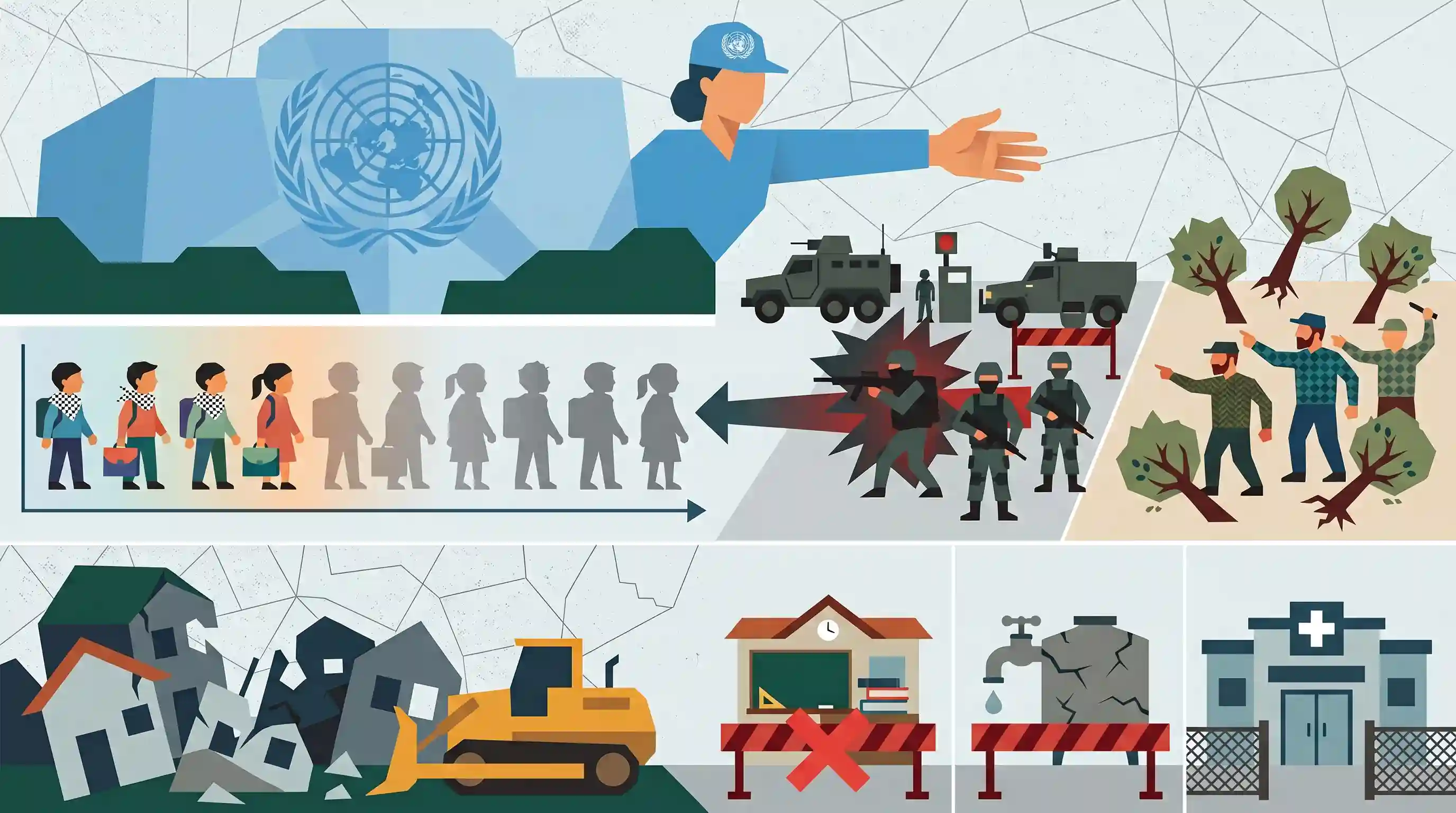
The United Nations Children's Fund (UNICEF) strongly condemned the escalating violence in the occupied West Bank and East Jerusalem, highlighting a severe toll on children. Since early 2025, at least 70 Palestinian children have been killed—an average of one per week—with 93% of deaths attributed to Israeli forces. Alongside military operations, Israeli settler attacks have reached historic highs. This violence is occurring against the backdrop of deteriorating humanitarian conditions, with widespread demolition of homes and the obstruction of access to education, water, and healthcare for Palestinian children.
Key Points
- UNICEF reports that at least 70 Palestinian children have been killed in the West Bank and East Jerusalem since early 2025.
- Since Israel launched large-scale military operations in the region in January 2025, an average of one Palestinian child has been killed every week.
- Israeli forces are responsible for 93% of these child casualties, while another 850 children have been injured.
- The humanitarian crisis is compounded by historically high levels of Israeli settler violence (peaking in March 2026) and the destruction of vital civilian infrastructure, including homes, schools, and healthcare facilities.
Important Terms
UNICEF (United Nations Children's Fund)

A UN agency established in 1946 to provide humanitarian and developmental assistance to children and mothers; it advocates for child rights in 190+ countries.
UPSC context
GS II (International Relations); tests knowledge of specialized UN agencies, their mandates, and roles in managing global humanitarian crises.
West Bank
A landlocked territory west of the Jordan River, captured by Israel from Jordan in 1967; it remains a central site of the Israel-Palestine conflict.
UPSC context
GS I (Geography) & GS II (IR); essential for map-based questions and understanding the territorial dimensions of West Asian geopolitics.
East Jerusalem
The sector of Jerusalem captured by Israel in 1967, containing major holy sites; Palestinians claim it as the capital of their future sovereign state.
UPSC context
GS II (International Relations); significant for studying sovereignty disputes, international law (UN Resolution 242), and religious-cultural diplomacy.
Israeli Settlements
Civilian communities built by Israel on land occupied since 1967; most of the international community considers them illegal under the Fourth Geneva Convention.
UPSC context
GS II (International Relations); focuses on international humanitarian law, human rights violations, and obstacles to the 'Two-State' peace process.
United Nations (UN)
The primary global intergovernmental organization founded in 1945 to maintain international peace and security and foster cooperation among nations.
UPSC context
GS II (Important International Institutions); a core topic regarding global governance, the veto power, and multilateral resolution of regional conflicts.
Prelims Trap
"The West Bank is a Palestinian territory that shares a coastline with the Mediterranean Sea."
Aspirants often conflate the geography of the West Bank with the Gaza Strip. The West Bank is landlocked, bordering only Israel, Jordan, and the Dead Sea.
Static Concepts Connected
What are the defining geographical boundaries of the West Bank?
- Landlocked territory: It is entirely landlocked, bounded by Israel to the north, west, and south, and by Jordan to the east.
- Dead Sea coast: It encompasses a significant portion of the western shore of the Dead Sea.
- 1967 Six-Day War: It was captured by Israel from Jordanian administrative control during the 1967 Six-Day War.
How is UNICEF structured and funded within the UN system?
- UN Programme status: It is a subsidiary programme/fund created by the UN General Assembly, rather than an independent specialized agency like the WHO.
- Voluntary funding: It relies entirely on voluntary contributions from governments, civil society, and private donors, rather than mandatory assessed dues.
- Historical evolution: Established for post-WWII relief in 1946, it became a permanent fixture in 1953 and won the Nobel Peace Prize in 1965.
Cross-Topic Patterns
Geneva Conventions & Settlements
The news of rising settler violence tests static knowledge of the Fourth Geneva Convention (Article 49), which prohibits occupying powers from transferring their civilian populations into occupied territories.
UNRWA vs. UNICEF Mandates
While UNICEF focuses on global child welfare, the Palestinian crisis frequently brings up UNRWA, the specific UN agency mandated exclusively to support Palestinian refugees.

A multi-statement Prelims question in 2026 will likely mix West Asia mapping (Gaza vs. West Bank borders) with specific UN agency mandates.
Linked PYQs · 3
Linked PYQs · 3
- 2019MainsGS2
‘Too little cash, too much politics, leaves UNESCO fighting for life.’ Discuss the statement in the light of US' withdrawal and its accusation of the cultural body as being 'anti-Israel bias'.
- 2003PrelimsGS1
Israel has common borders with
- 2025MainsGS4
Ashok is Divisional Commissioner of one of the border districts of the North East State. A few years back, Military has taken over the neighbouring country after overthrowing the elected civil government. Civil war situation is prevailing in the country especially in last two years. However, internal situation further deteriorated due to rebel groups taking over control of certain populated areas near own border. Due to intense fight between military and rebel groups, civilian casualties has increased manifold in recent past. In the meantime, in one night Ashok got information from the local police guarding the border check post that there are about 200-250 people mainly women and children trying to cross over to our side of the border. There are also about 10 soldiers with their weapons in military uniform part of this group who wants to cross over. Women and Children are also crying and begging for help. A few of them are injured and bleeding profusely need immediate medical care. Ashok tried to contact Home Secretary of the State but failed to do so due to poor connectivity mainly due to inclement weather. (a) What are the options available with Ashok to cope with the situation ? (b) What are the ethical and legal dilemmas being faced by Ashok ? (c) Which of the options, do you think would be more appropriate for Ashok to adopt and why? (d) In the present situation, what are the extra precautionary measures to be taken by the Border Guarding Police in dealing with soldiers in uniform?
